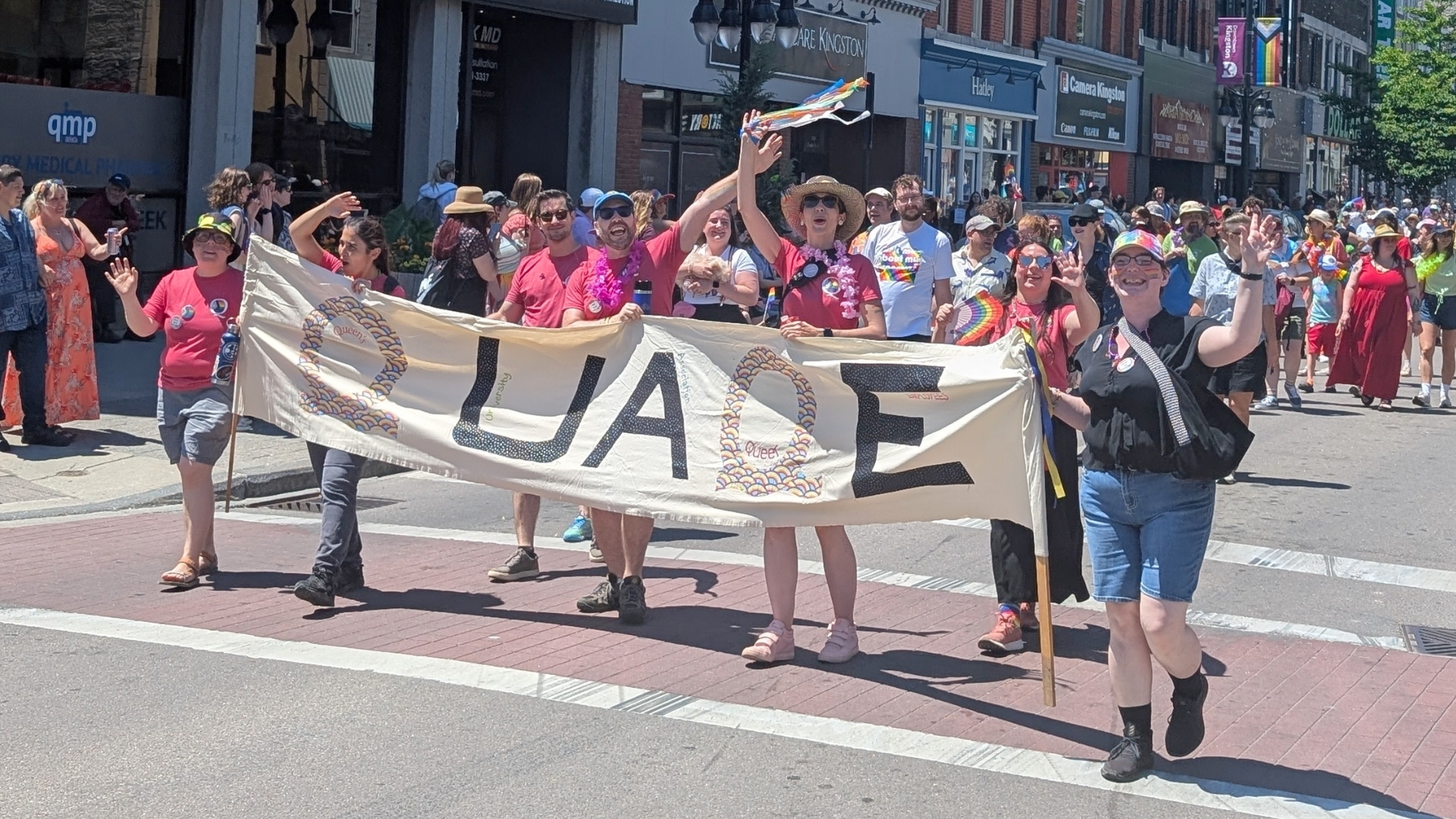
The Queen’s University Association for Queer Employees (QUAQE) began as a social network for Queer employees in 2005.
The group was originally created to serve as a professional social network for Queer faculty and staff before employee resource groups were formally supported by the University, according to QUAQE organizing committee member Indigo Bunting.
In interviews with The Journal, Bunting explained the group held social events in its early years and created an email list and website, both of which continue to connect members today. Stacy Kelly, co-founder of QUAQE, said the group was created in a different campus climate, when being publicly visible as a Queer employee could feel more difficult.
According to Bunting, the original group became less active after some of its main organizers left Queen’s or moved on from the institution. By the time Bunting returned to Queen’s as a staff member in 2017, QUAQE had gone dormant.
However, in 2019, Bunting began working to restart the group. “I thought, I’d really like to get a Queer employee resource group up and running,” they said.
Bunting reached out to the Human Rights and Equity Office and helped organize lunchtime events for employees interested in seeing QUAQE return. After those conversations, organisers applied for formal employee resource group recognition and funding from the University.
QUAQE became a formally recognized employee resource group in 2020.
Since then, Bunting said they have focused on building community among Queer employees, especially during the COVID-19 pandemic, when the group’s early programming took place virtually.
The group continues to hold regular social events, including monthly happy hours and in-person gatherings. Bunting said QUAQE has also publishes a monthly newsletter highlighting both its own events and broader Queer community programming.
QUAQE’s mandate includes faculty, staff, and students who have an employment relationship with Queen’s. The group’s Microsoft Teams space is for Queer employees, while its email list is open more broadly, including allies.
While the group began with a social focus, Bunting said formal recognition has allowed QUAQE to take on more advocacy work.
The group has a seat on the Principal’s Action Group for Gender and Sexual Diversity (PAGGAS), which gives the group a direct line to raise concerns affecting Queer staff and faculty.
“Having a representative on PAGGAS has been really great for us to be able to advocate for issues that we’re seeing with staff around gender and sexual diversity,” Bunting said.
One issue QUAQE previously advocated for was Queen’s name-change process. Bunting said employees who changed their names could still be required to log in using NetIDs based on their initials tied to their previous name.
“That can be traumatizing,” Bunting said.
QUAQE advocated for changes to the process, and NetIDs are now assigned as random combinations of letters and numbers.
Beyond policy issues, one of the main reasons people join QUAQE is the sense of connection it provides across a large and sometimes siloed institution, according to Bunting.
“Sometimes you can only work within your own team, and there might not be any other Queer people on your team,” they said. That emphasis on connection has stayed central to the organization.
Although he is no longer involved in QUAQE’s day-to-day leadership, Kelly said seeing QUAQE continue today is meaningful because the group served an important purpose when it was founded. “They’re carrying the baton, or torch, in a great way,” he said.
QUAQE’s upcoming programming includes Queer and Ally Song Circle: Singing for Connection and Wellbeing, a Thrive 365 program open to students and employees.
“Queer voice can be silenced so often, either by ourselves or by others,” Bunting said. “Having a space where you can come and bring your voice in a safe way […] is a really important piece.”
Looking ahead, Bunting said they hope to continue building community while exploring mentorship, intersectional programming with other employee resource groups, and more events open to allies.
Tags
Pride month, QUAQE, Queer alumni, Queer students
All final editorial decisions are made by the Editor(s) in Chief and/or the Managing Editor. Authors should not be contacted, targeted, or harassed under any circumstances. If you have any grievances with this article, please direct your comments to eic@queensjournal.ca.