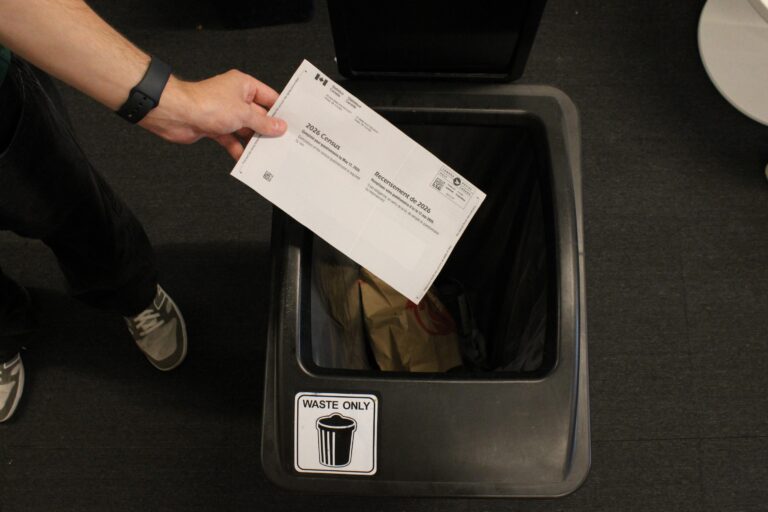
As thousands of post-secondary students left Kingston after their April exams, the start of the 2026 Census coincided with many student renters returning to their hometowns for summer.
According to Statistics Canada, invitation letters were sent through Canada Post on May 4, encouraging households to complete the mandatory questionnaire online by Census Day, May 12. While responses continue to be accepted until the end of July, the timing of the Census coincides with the post-exam departure of Kingston’s student population.
According to the “Why Queen’s” page, more than 90 per cent of Queen’s students come from outside of Kingston, and, by early May, many have returned to their hometowns for summer jobs, leaving student neighbourhoods less populated.
Conducted by Statistics Canada every five years, the mandatory Census of Population survey collects demographic data used to allocate funding, draw electoral boundaries, and plan essential infrastructure. Under the Statistics Act, Canadian households that fail to complete the questionnaire can face fines of up to $500.
In an interview with The Journal, Robert Stephenson, Statistics Canada’s regional director for the central region, said the agency prepares for communities like Kingston before questionnaires are delivered.
Ahead of Census collection, field operations managers conduct what Stephenson called “area familiarization,” working with property managers, condominium boards, municipalities, and other community organizations to gather as much information about the area.
Property managers may work with Statistics Canada to help identify vacant dwellings so the agency can code them appropriately, while enumerators follow up on units where occupancy remains unclear.
Stephenson said the process is particularly important in Kingston because of its “big student population.”
Christian Honig, ArtSci ’29, has worked as a census enumerator in Halifax since June 1. His work consists of conducting door-to-door interviews and determining the occupancy of residences, with much of his work concerning student housing surrounding Dalhousie University.
In a statement to The Journal, Honig said when an enumerator encounters a seemingly vacant student rental, they don’t simply assume it is unoccupied.
Instead, enumerators speak with neighbours, landlords, or property managers to determine whether anyone usually resided in the dwelling on Census Day. If they confirm the dwelling was occupied — or that its usual residents were only temporarily absent — enumerators continue attempting to contact the household. If they determine that no one usually resided in the dwelling on May 12, it is coded as a “312” ¾ Statistics Canada’s designation for an unoccupied dwelling.
Honig explained how the job can become frustrating after multiple attempts to determine whether a student rental was occupied. He said many students are unfamiliar with the Census process, why it needs to be completed, or where they should be counted. Some assume their parents would complete the Census on their behalf, not realizing they must be included at their student address if they ordinarily lived there on Census Day.
While Statistics Canada has procedures for verifying occupancy, Honig believes communication with student renters could be improved.
“One improvement would be to send a notice to residences that are already known to be student housing, perhaps based on the previous Census,” he said.
According to Statistics Canada, the agency will begin releasing 2026 Census geographic and reference products on November 18, 2026. The first Census results, including population and dwelling counts, are scheduled for release on February 10, 2027.
Tags
Census of population, Kingston, Student renters
All final editorial decisions are made by the Editor(s) in Chief and/or the Managing Editor. Authors should not be contacted, targeted, or harassed under any circumstances. If you have any grievances with this article, please direct your comments to eic@queensjournal.ca.