From the very first time I was asked, “What do you want to be when you grow up?” the endless possibilities left me awestruck without an answer.
In elementary school, I would’ve told you I wanted to be a doctor. But it all started in grade one, when I was assigned a school project about my future career. Leading up to the deadline, I changed my mind short of a hundred times about what I wanted to proclaim as my dream job. I wanted to be a teacher … and also a scientist … and a lawyer, and detective, and doctor, and author. Although the stakes truly couldn’t have been lower, declaring my dream job on a poster board felt like sending a crucial message into the universe—like placing a bid on my destiny.
Eventually, after days of ruminating on what felt like the most important decision of my life, I landed on wanting to be a doctor. My uncle was a doctor, and my time on the family computer was limited, so I relied on his expertise and the few glimpses I caught of House M.D. to make this monumental decision. Being six years old, my criteria for my dream job were comically simple. Doctors helped people, and doctors were smart. I wanted to help people, and I wanted to be smart—so I would be a doctor.
I stuck with wanting to be a doctor for a while after having announced it to the cosmos in grade one. But a few years later, I changed my mind again, as many kids do. Each time I changed my mind, I was overwhelmed by the sea of options—each option led to a completely different life, and I wanted to live them all.
This dilemma followed me through elementary, middle and high school. Until grade nine, I yo-yoed between wanting to be a lawyer, epidemiologist, professor, journalist and doctor. At this point, my dream job criteria was more advanced. I wanted a career that would be intellectually stimulating, that would contribute something positive to the world and would pay enough for me to afford a house with a garden. Today, I find myself returning to this criteria when I reflect on my future.
In high school, a new criterion entered the mix—I wanted a job that would be impressive. At this point in my life, I constantly felt I had to prove myself to my peers, my family, and even my closest friends.
Like many teenagers, I was deeply insecure about every facet of my existence. But of course, I couldn’t admit that to anyone. In my mind, I had to prove that I was smart enough to make up for what I believed I lacked in looks and social prowess.
Throughout high school, I sought to craft the most impressive resume possible, complete with sky-high grades and awards recognizing my potential. I dedicated substantial time and effort to studying, often at the cost of my own well-being. While I acknowledged the intrinsic value of education, I cared more about other people’s reactions to my success. Whenever I started to tire in the midst of studying, I’d imagine what my peers would think if I got anything below an A. I believed good grades would ultimately lead to a good career, and if I achieved that, I would be proving myself to those around me.
Looking back, I’m not quite sure what exactly I was trying to prove. On the surface, I wanted to prove anyone who doubted my abilities wrong, from my toxic high school “best friend” to an older relative with antiquated views about women’s roles in society. At a deeper level, I think I was trying to prove myself wrong—to shut up the inner voice that minimized my accomplishments and exaggerated my mistakes.
This desire to impress dominated my thoughts about my future. I wanted people to be in awe at my ambitions and regret any of their preconceived notions about my capabilities. I chose my dream job accordingly.
I enjoyed and did well in both my science and English classes, but I quickly realized that one was valued more than the other. Jokes about arts majors becoming overqualified baristas and the prestige around STEM careers steered me away from the arts and social sciences. My sights returned to the dream job I had decided on when I was six—becoming a doctor.
What seemed to be a full-circle decision was really a sign I hadn’t matured as much as I thought. I was drawn to the allure of a prestigious career, and my guiding compass spun in whatever direction I believed would impress the people around me. Approaching the end of my high school career, I started to think more deeply about the career and life that I desired.
Despite starting to get cold feet, I hesitated to make any drastic changes to my life plan. After all, I had spent four years working towards this one goal. It’d be ridiculous to just throw that all away. So, I applied to university programs based on this plan.
Soon after, I started to receive acceptances to my “dream programs.” Rather than being elated, however, I felt numb. I had a sinking feeling that something was wrong, and I couldn’t shake this feeling for months. Planning my future based on other people’s expectations had finally caught up to me. Eventually, I decided to take a gap year—mainly because of other reasons, but I was relieved to have more time to figure out what I wanted to do with my life. I thought about my future, the one I chose from a sea of possible futures.
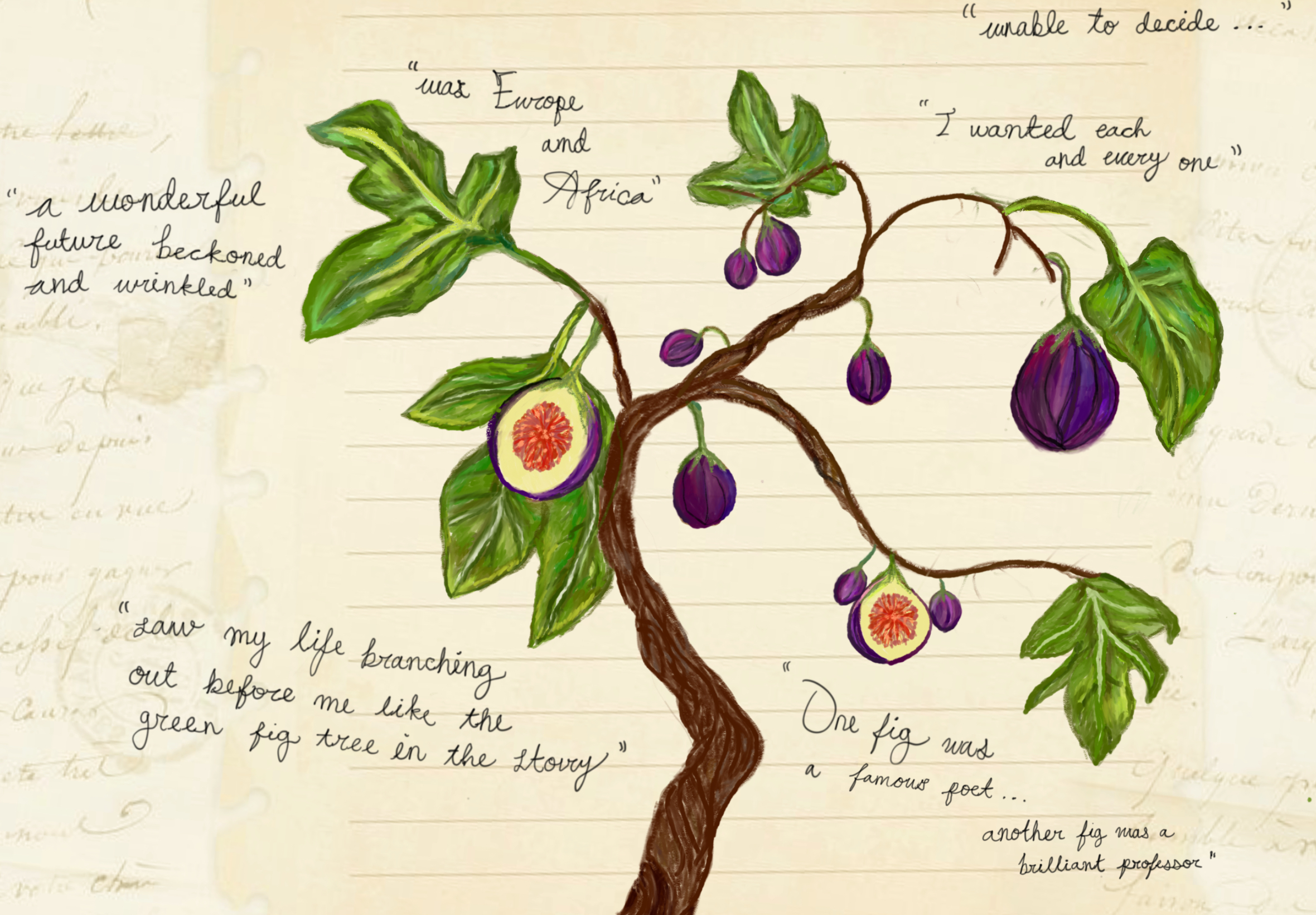
I found myself relating far too much to Esther Greenwood, the protagonist of Sylvia Plath’s The Bell Jar. I was stuck staring at a giant fig tree, each plump fig representing a different future—a different life. “I wanted each and every one of them, but choosing one meant losing all the rest, and, as I sat there, unable to decide, the figs began to wrinkle and go black, and, one by one, they plopped to the ground at my feet,” Plath wrote.
I ultimately decided the doctor pathway wasn’t right for me. Now, I’m pursuing an arts degree, something my high school self wouldn’t understand at all. There’s no way to know whether I made the “right” decision, and that’s what makes choosing such a hard task. But what Esther Greenwood overlooked is that life isn’t subject to the fate of a single fig tree. Life’s a series of fig trees—each decision important, but not the last fig we’ll ever pick.
To this day, I find myself wondering about what my life would look like if I had made one decision over another—if I’d stuck with my aspirations to become a doctor, or if I had decided to try out engineering like some of my peers. Through all this deliberation, I’ve learned that my life is worth more than appealing to other people’s expectations, and that I’m allowed to make mistakes.
When I graduate, a new fig tree will sprout before me, and I’ll be forced to pick just one. I might pick the wrong fig, but its seeds will bear the fruit of infinite futures.
Tags
Academics, coming of age, Postscript
All final editorial decisions are made by the Editor(s) in Chief and/or the Managing Editor. Authors should not be contacted, targeted, or harassed under any circumstances. If you have any grievances with this article, please direct your comments to eic@queensjournal.ca.