SUNSHINE CLEANING
Love or hate the indie film, we’re continually surprised at its hip style and eccentricities.
The truth is, “indie” films rake in big bucks at the box office and have quickly become just as tailored to financial success, and by extension, cliché, as any other genre of popular film. As mainstream audiences get used to watching quirky twenty-somethings battle angst and cynicism while listening to The Shins, it is surprising that Sunshine Cleaning was not the new darling in the cinematic spotlight.
Rose Lorkowski, a cash-strapped single mother, and her directionless younger sister Norah, start Sunshine Cleaning, a maid service dedicated to the unappealing task of sanitizing messy crime scenes. Just imagine all the crazy situations these quirky kids could get into! Director Christine Jeffs refuses to let the story get lost in its own eccentrics, shying away from the cutesiness of the genre. Sure, there’s playful banter between Adams and Blunt, and Alan Arkin basically reprises his role from Little Miss Sunshine as the rebel grandfather to Rose’s sickeningly cute son Oscar, but there’s a darkness here that won’t let these quirks become the film’s central concern.
The title sunshine seems to scorch Albuquerque instead of warm it, creating a backdrop as lifeless and bleak as the stagnating crime scenes the sisters are recruited to clean up. At the same time, Sunshine Cleaning’s soundtrack fights the “indie” temptation to turn the film into an extended music video, relying more on the original score of Michael Penn. These characters don’t have time to be hip; they’ve got work to do.
With a far less romanticized portrayal of relationships, Rose carries on a hopeless affair with her married high school boyfriend and Norah becomes involved in her own unfulfilling and ambiguous relationship. Commerce takes precedence over Rose’s personal desires, and familial love (the kind that is rough, unspoken, but always there) becomes far more important than romantic love. It’s this notion of family that provides the optimistic backbone of Sunshine Cleaning without letting the film fall into the naiveté and romanticism of many of its predecessors.
STAR TREK
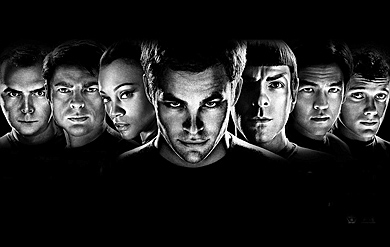
I suppose I should start by admitting I’ve never sat through a full episode of Star Trek. I did, however, have a Star Trek action figure collection complete with cardboard bridge and two-way mirror teleporter. It doesn’t really matter that, as a six year-old suffering through the discontinuation of Hasbro’s GI Joe line, I referred to Kirk as Falcon or Chekov as Chuckles. Nor is it a problem that, in a play set lacking any definable enemies, Spock quickly became my King Cobra (he had pointy ears!). Why don’t these massive inaccuracies matter? Because this movie is as much for people who grew up mocking, hating, or simply not caring about Star Trek as it is for hardcore Trekkies. Being the former, and having already read far too many reviews comparing the film to the television series, I’m choosing to view Star Trek as an independent entity, and director J.J. Abrams (who, himself, has admitted he was never a big fan of the series) as a kid who simply misses his GI Joes.
Abrams tries to eliminate the possibility of completely screwing up the Trek canon and igniting the inevitable fan-boy war by setting his film in an alternate universe, a plot device that seems a little too convenient. Even if necessary to keep the die-hards happy, the explanation of how a future version of Spock made his way into this alternate universe is quick and dirty, hoping audiences will focus more on the visual pleasure of time travel than its actual scientific parameters. This is fine as long as you don’t think about it too much. The problem is that’s the way it is through most of the movie. Abrams is so intent on turning Star Trek into a sleek, sexy, action-packed film that when philosophical and moral dilemmas do pop up, they feel like obligatory cool—down periods standing between the audience and more CGI lasers. Not only is any sort of overriding theme lost in all of this action, but the energy level of Star Trek seems more suited to an episode of World’s Wildest Police Chases than a coherent and unified film. Abrams has the action turned up to 11 for so long that by the time he’s ready for the climax, there’s nowhere else to go.
I’m probably being too hard on Star Trek, because it was an enjoyable—if mostly mindless—experience. I feel like there were enough inside jokes to make Trekkies feel respected, and enough explosions to tide the rest of us over until the next Transformers movie. And for all the problems I had with Star Trek, it has prompted me to try something new. In about six hours, the first season of Star Trek will finish downloading onto my computer. If nothing else, maybe now I can get the names right.
All final editorial decisions are made by the Editor(s) in Chief and/or the Managing Editor. Authors should not be contacted, targeted, or harassed under any circumstances. If you have any grievances with this article, please direct your comments to eic@queensjournal.ca.