This article was updated on March 7 at 11:42 a.m.
With few student-housing options near campus—partly due to the University Districts predominantly low-density zoning—Madison Donnelly, ArtSci ’26, felt pressured to sign the first lease she was offered.
“We didn’t really have any other options than to sign the lease we have now, I’m just happy it worked out,” Donnelly said in an interview with The Journal.
Donnelly recalls the first-year student experience of feeling pressured by the market to sign a lease before having even had the chance to settle into life in Kingston. She recalls being told to secure housing by October, months ahead of any May move-in date hastening an already frantic process.
“It feels like we’re swimming with sharks, and Kingston landlords are just waiting to take a bite out of our wallets,” Alex McDonald, ArtSci ’26, said in an interview with The Journal.
For some students, landlords’ constant presence can feel inescapable.
The University District, which surrounds Queen’s main campus, is officially bounded by Nelson and Collingwood St. to the west, Princess St. to the north, Division and Barrie St. to the east, and King St. to the south.
The heart of these confines is a housing crisis infused with chronic scarcity where too few vacancies drive rent higher with each passing year.
READ MORE: Future first-year students face off for off-campus housing amid interest rate cuts
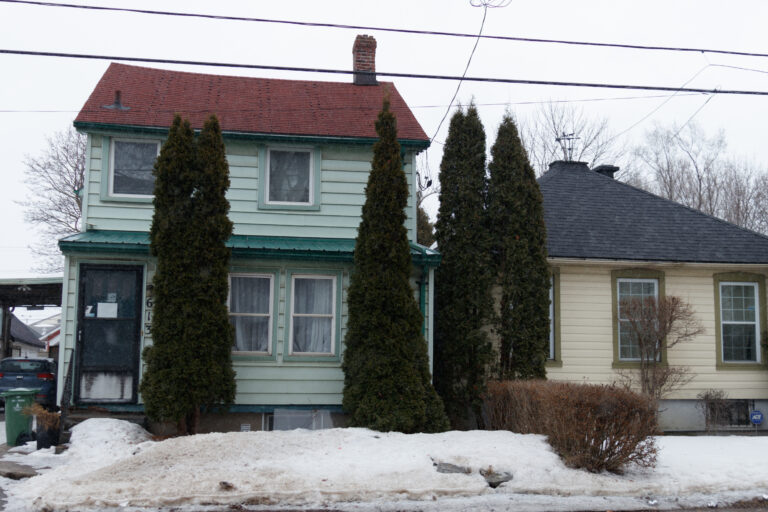
Already forking out thousands of dollars in tuition per semester, Kingston students are stuck paying median rent rates of $1,800 a month for centuries-old homes surrounding campus.
Maya*, Comm ’25, whose name has been changed as she continues to rent from her landlord, paints a picture of how cheap rent is paid in the currency of surveillance.
“She [landlord] would charge cheap rent, but then sort of just like, watch over you,” Maya said in an interview with The Journal.
The Kingston housing market has seen a notable rent increase over the past three years, continuing a steady year-over-year rise. Average rent rates in Kingston have increased by 19 per cent annualy for the past three years. In May 2021, the average cost of rent was $1,709 per month. One year later, rent prices rose to $1,888 per month in May 2022.
Students see a Kingston landlord’s approach—capitalizing on rising real estate prices—as a calculated mastery of speed and timing. The rush to secure leases leaves students feeling pressured, often signing quickly before they have time to seek advice or support from their parents.
“She asked us to [sign quickly] so quickly, or like, we couldn’t sign the contract, like our parents couldn’t come down, so it was just us kids in first year trying to sign and figure out a contract,” Maya said.
Behind polished branding and professional websites, property management companies often leave student renters chasing promises that never materialize.
The ability to profit from the competitive housing market hasn’t gone unnoticed by property management companies. Isabella*, Sci ’24, shared her experience renting from Portsmouth Residential in an interview with The Journal.
Portsmouth Residential is a property management company which specializes in family and student housing. Portsmouth Residential doesn’t appear in Yelp’s “Top 10: Best Property Management in Kingston”.
“It’s stressful to sign a lease in Kingston, and everything is pushed at you. You need your co-signer, you need your insurance, like everything they want by the end of the day,” Isabella said.
Amid the frantic rush of signing their lease, Isabella and her roommate were the first to catch the subtle yet telling shift in their property managers’ demeanor when Portsmouth Residential was initially trying to sell them on the property.
At first, property managers dazzled Isabella with promises of included Wi-Fi, utilities, and laundry—only for these perks to vanish when it came time to sign the lease they were rushed into.
Isabella claims Portsmouth told her that as a rental company, Portsmouth doesn’t manage the utilities in the building and were unable to include them in the lease.
Yet, after moving in, Isabella spoke with her neighbours to find Portsmouth managed utilities for over half the units in the building.
In an e-mail to The Journal, Portsmouth responded to this claim, stating they take resident concerns seriously and are committed to addressing any issues that arise in a fair and transparent manner. While they acknowledge misunderstandings can sometimes occur in lease agreements, they ensure all lease terms are clearly outlined in writing before signing.
For Isabella, she experienced promises being far from guaranteed. Promises from property management companies may be legally enforceable, dependent upon the extent that a promise has insured substantial costs.
According to Blair Crew, executive director of Queen’s Law Clinics and director of Queen’s Legal Aid, says the primary concern for students is proving the agreement was made.
“Even a verbal agreement is still enforceable,” Crew said in an interview with The Journal.
As director of the Queen’s Legal Aid Clinic, Crew is an experienced lawyer who facilitates the clinic’s provision of legal services to low-income residents of Kingston and the surrounding areas.
Though utilities were a no-show, Isabella’s lease did come with an unexpected perk: a cleaning person.
What initially felt like a small luxury quickly became a source of frustration. Isabella and her roommate soon found themselves asking her to stop coming altogether—each visit felt less like a courtesy and more like surveillance, as if the cleaner was reporting the tenants’ behaviour back to Portsmouth.
Isabella and her roommate also found themselves footing the bill for laundry and parking—another quickly broken pinky promise.
Portsmouth Residential realized their mistake in promising Wi-Fi and utilities, which, according to Isabella, was rectified with a slight rent deduction.
Yet, for Isabella, issues with utilities and a watchful cleaning lady were the least of her worries.
According to Isabella, the worst of her experience with Portsmouth started with a harmless mistake—her car was parked in a spot that was supposed to be reserved for her unit. But the cleaner called in a tow truck.
Isabella said, at first, the cleaner denied any involvement. In a frantic panic, the tenant scoured Kingston’s towing companies, frustration building with each unanswered call. It wasn’t until the fifth company where she found a towing slip with the cleaner’s signature.
With Isabella’s car gone, she waited for a towing reimbursement she felt was rightfully owed to her.
Portsmouth Residential wrote a statement to The Journal that parking at their properties is designated, clearly signed, and regulated to ensure fair and authorized use. According to Portsmouth, they encourage all residents to review their lease terms and posted signage to avoid any issues. They acknowledged unauthorized parking may result in enforcement action in accordance with property guidelines.
Still, Isabella’s lease concerns are far from over—she’s frequently left chasing reimbursements and requesting repairs for malfunctioning appliances like the laundry machine, dishwasher, and kitchen sink.
Portsmouth stated they remain dedicated to addressing maintenance requests promptly and ensuring all aspects of the tenancy are met with professionalism and care.
Far from the “hassle-free renting experience” promised, Isabella and her housemate are thoroughly dissatisfied with a company they claim fails to deliver on its promises
In the same vein as students being dissatisfied with management companies, exploitative landlords have been operating in Kingston for decades.
“Many landlords totally rely on the fact that students are unaware of their rights and how to enforce them,” Crew said.
Maya remembers her lease was “very crazy.” Her landlord enforced a 9 p.m. limit for guests, a zero-tolerance noise policy, and didn’t allow her tenants to keep their garbage bins outside.
According to Maya, her landlord administered a rule where renters were allowed only in the house itself and not the attached yard.
“We have a small backyard, but we can’t, like, sit there—we can’t do anything, we’re not allowed to touch our backyard,” Maya said.
While landlords are allowed to add clauses to the Ontario Standard Form of Lease, they’re unenforceable if in violation of the Residential Tenancies Act.
“One of the fundamental things in the Act is the landlord can’t substantially interfere with the reasonable enjoyment of the unit for all usual purposes,” Crew said.
The concept of reasonable enjoyment, which guarantees renters the right to use and enjoy their property, makes many of these clauses unenforceable—especially rules restricting guests after 9 p.m.
“It’s a fundamental right of any tenancy that you’re allowed to have visitors,” Crew said.
According to the Advocacy Centre for Tenants Ontario, tenants have the right to peaceful and reasonable use of their rental unit without unnecessary disturbances, including the right to host guests. However, the right is curtailed if a guest commits, after an invitation to one’s home, an illegal act, impairment of safety, causes damage, or substantially interferes with a tenant or landlord’s enjoyment of the premises or legal rights and privileges under the law.
According to Maya, her landlord enforced rules restricting guests by enlisting a contractor to keep up with her properties. For the first year and a half of their lease, Maya and her housemates had to put up with the contractor coming by nightly to check on the property. Occasionally, he would show up to the unit unannounced, using his key to enter.
“He’s just like a forty- or fifty-year-old man just in our home, we’re four girls, and he didn’t let us know ahead of time that he’s going to be in our home,” Maya shared.
There are certain circumstances where landlords can come and go from their properties for cleaning, maintenance, or house showings, but they’re still expected to provide 24 hours’ notice.
“One of the things landlords fundamentally don’t understand is that when you lease out a place, the landlord is giving up their right to go and be there,” Crew said.
As Isabella and Maya’s experiences illustrate, student renters in Kingston often find themselves at the mercy of landlords who push legal boundaries, take advantage of limited housing options, and operate with little accountability—leaving many to navigate a system that feels stacked against them.
*Name changed due to safety concerns
Corrections
A prior version of this article indicated Madison Donnelly felt pressured by her current landlord to sign a lease. In fact, Donnelly felt pressured by the Kingston housing market to sign a lease, not her landlord.
The Journal regrets the error
Tags
landlords, Rent increase, Student Housing, University District
All final editorial decisions are made by the Editor(s) in Chief and/or the Managing Editor. Authors should not be contacted, targeted, or harassed under any circumstances. If you have any grievances with this article, please direct your comments to eic@queensjournal.ca.
Isaac
It is unfortunate that landlords and renters are set against each other in this city…students want privacy and cheap rent, while landlords bought their property to make a profit, and are cautious with every stranger that promises to pay rent, which often leads to hiring management companies as third party negotiators which increases costs. This city is bordered by a lake, we are stuck here together, the only way to decrease costs is to work together, and walk a mile in another’s shoes
Truth
It is amazing how this article did not bother to check any actual facts and based it all off what they were told by some tenants.
Person
Stop paying the landlord’s…they can’t kick you out and things will get done properly.
This article is bias and false
Maybe tell the truth about the Queens students and the current Housing market instead of students word of mouth which is false?