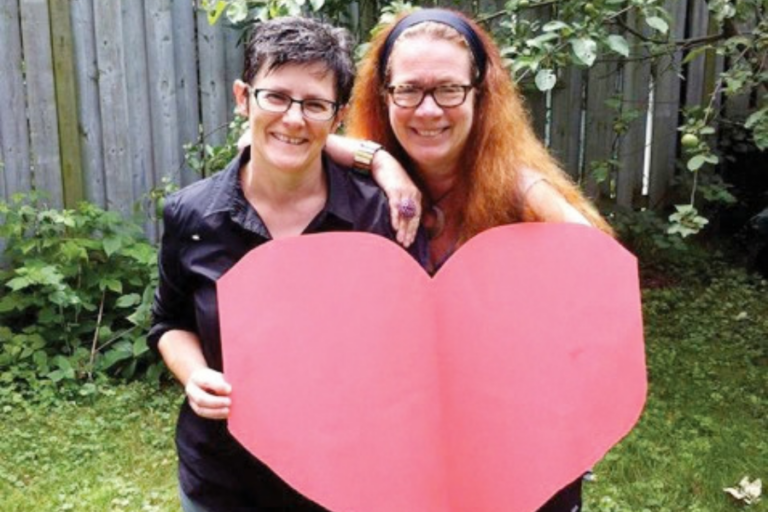
Karen Dubinsky spent more than three decades teaching at Queen’s, but those who knew her say her influence was never confined to a classroom.
A professor emerita of History and Global Development Studies, Dubinsky died at her Kingston home on Sept. 4 following a brief battle with an aggressive form of lung cancer, according to an obituary published by her family. She was 68.
Across 32 years at Queen’s, Dubinsky taught thousands of students, supervised 47 master’s and 28 doctoral students, authored five books, co-edited five others, and built relationships stretching from Kingston to Havana. She retired from Queen’s in July 2025, according to a Queen’s Gazette article.
Yet, in interviews with The Journal, colleagues repeatedly returned not to the number of books she wrote or students she supervised, but to how she treated the people around her.
Scott Rutherford, associate professor in Global Development Studies and acting director of Cultural Studies, had a unique relationship with Dubinsky.
Rutherford first encountered Dubinsky through her writing, including Improper Advances, her 1993 book examining sexual violence and heterosexual relations in Ontario between 1880 and 1929. He came to Queen’s in 2005 to pursue his PhD in history specifically to work with her.
What began as a supervisory relationship became a 20-year-long mentorship and friendship. They eventually became colleagues, wrote books together, and organized conferences together.
The mentorship, Rutherford said, never really ended.
“She’s the type of person who, when they say you’re their friend, or they’re your friend, that wasn’t a throwaway line,” Rutherford said. “That meant you were tied to each other in profound ways.”
“She lived friendships as a form of politics,” he added, explaining that meant showing up for people and treating relationships as reciprocal commitments. An approach he said extended into Dubinsky’s academic work.
“She was larger than life,” said Kristin Moriah, associate professor in the Department of English Language and Literature.
“She had a boundless intellectual curiosity, lust for life, and kindness,” Moriah said.
Moriah first came to know Dubinsky before the COVID-19 pandemic, when she noticed her regularly attending events where Moriah was speaking — including the Queen’s Black Students Association’s annual conference.
The two later became friends during the pandemic after frequently encountering each other while walking through their neighbourhood, eventually coming to spend time together in Dubinsky’s backyard.
“There is absolutely no reason that she had to take me under her wing like that, but she did,” Moriah said. “She is one of the reasons that I was able to see myself in the McBurney Park community in Kingston.”
Her dedication to students earned her the Queen’s University Award for Excellence in Graduate Supervision in 2007. Marcus Taylor, head of the Department of Global Development Studies, said her relationships with students frequently extended far beyond their degrees.
“Karen provided sort of holistic support services that spread from academia through to their personal lives,” Taylor said.
He said former students’ enduring loyalty to Dubinsky was unusual. And nowhere did Dubinsky’s approach to teaching, relationships, and research intersect more clearly than in Cuba.
Her research interests shifted throughout her career, ranging from gender and sexuality in Canadian history to transnational adoption, and eventually Canadian-Cuban cultural relations.
For 15 years, Dubinsky co-taught Cuban Culture and Society, a collaboration between Queen’s and the University of Havana. More than 350 students travelled to Cuba through the course, while more than 20 Cuban scholars, musicians, filmmakers, artists, and curators came to Queen’s and Kingston through the exchange.
Taylor said there was “literally nothing like this course before.”
“It really couldn’t run without this special energy that both her and Susan Lord brought into it,” he said.
Moriah came along with Dubinsky to Havana during the final two years the course ran.
At Fábrica de Arte Cubano in Havana, Moriah remembers watching the club’s managers greet Dubinsky “like they’d just seen their long-lost best friend.”
“She had such a way of seeing people, meeting people where they were, and just being profoundly interested in the details in their life,” Moriah said. “That was really genuine.”
Dubinsky met Susan Belyea in 1991, and the two built a life together over the following 35 years. Their son, Jordi Belyea Dubinsky, joined the family in 2000.
On Aug. 17, less than three weeks before Dubinsky died, that home hosted one final party: Dubinsky and Belyea’s wedding.
At her retirement celebration last year, Rutherford joked that the conventional definition of retirement didn’t seem to apply to her.
“She wasn’t withdrawing from any kind of life,” Rutherford said. “That’s what’s so hard about her being gone, is that it’s a life that hadn’t been finished living.”
Tags
Cultural Studies, global development, Karen Dubinsky, Mentorship
All final editorial decisions are made by the Editor(s) in Chief and/or the Managing Editor. Authors should not be contacted, targeted, or harassed under any circumstances. If you have any grievances with this article, please direct your comments to eic@queensjournal.ca.