For people in Kingston living with an irregular heartbeat, getting treatment has meant waiting. A wait that could last up to 18 months.
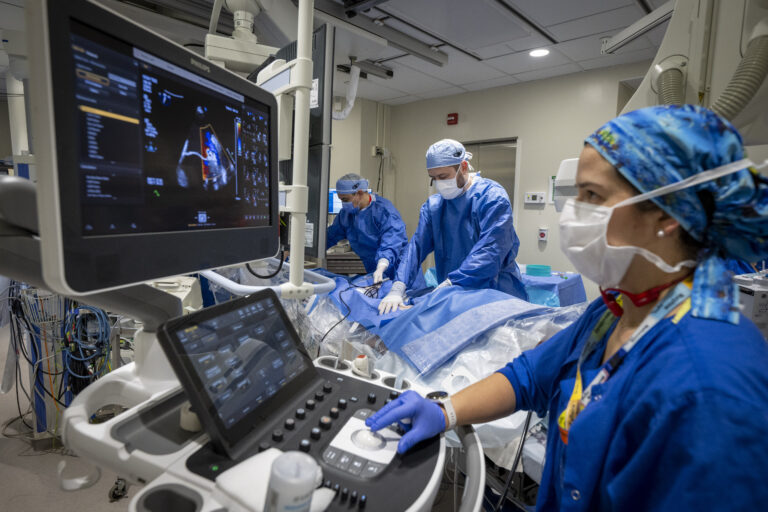
A new operating room at Kingston Health Sciences Centre (KHSC) is changing that, while simultaneously putting Kingston on the map for cardiac care in North America. The new space is located in the Kerr wing of Kingston General Hospital.
The lab is entirely dedicated to a heart procedure known as cardiac ablation. The method works by using energy to destroy tiny areas on the heart tissue that are sending abnormal electrical signals, ultimately causing an irregular heartbeat.
Common conditions like atrial fibrillation, where the heart beats chaotically instead of in a constant, steady rhythm, are often caused by structural changes to heart tissue as a result of high blood pressure, heart disease, and past surgeries. These conditions are the most common reasons a patient would require cardiac ablation. Demand for ablations has grown as the technology improves and more patients become eligible.
The problem was that KHSC’s existing operating rooms couldn’t keep up.
Before the lab opened, the cardiology team was working out of three fully booked operating rooms, leaving patients waiting for up to a year and a half for treatment.
“The team expects weekly ablation volumes to eventually increase from about 12 to 14 procedures to as many as 20, helping reduce wait times and allowing patients to receive treatment sooner,” KHSC wrote in a statement to The Journal.
However, the more significant benefit from the new operating room is not just how many procedures can be done. It is how these procedures are performed.
Traditionally, surgeons used a medical imaging test known as fluoroscopy to navigate the heart and tissues during a procedure. It is effective, but because the X-ray runs for a longer time, the radiation dose is higher than a standard X-ray, exposing staff and patients to radiation every time it is used. The new lab eliminates this.
“In the new lab, physicians can use intracardiac echocardiography and other advanced technologies to guide most ablations without fluoroscopy, eliminating routine radiation exposure for patients and care teams,”
Unlike X-ray imaging, which captures the heart from outside the body using radiation, intracardiac echocardiography uses a small ultrasound probe and is placed in the heart to provide real-time imaging, making the procedure safer for everyone in the room.
Many hospitals have done ablations free of radiation for years, but it has always been alongside X-ray capabilities and has not been the fully implemented standard, meaning if doctors needed X-ray equipment because of difficulties with ultrasound, they had it available.
KHSC, however, has dedicated itself to removing X-ray procedures entirely.
“Fluoroscopy-free ablation is not new, but KHSC’s approach is distinctive,” KHSC said. “The new lab is dedicated for zero-fluoroscopy procedures, and all of KHSC’s electrophysiologists who perform ablations are trained in this approach, making KHSC unique compared to other hospitals in North America.”
At most hospitals, a couple of physicians are trained in the radiation-free method, and the procedure takes place in rooms with X-ray equipment on standby. KHSC is cultivating a new standard by having the entire team trained and creating an entire operating room exclusively for this approach.
This change is significant not just for the patients, but for the staff performing these procedures over their careers. Constant radiation exposure is the norm for cardiology teams in traditional labs, but a hospital and room committed to eliminating this risk completely changes the standard for good.
As the program grows, KHSC is investing in the future.
“KHSC is also preparing to train the next generation of specialists through a new electrophysiology fellowship with Queen’s University, with a focus on zero-fluoroscopy ablation techniques,” the hospital said.
Tags
Health Sciences, hospital, KHSC, Medical
All final editorial decisions are made by the Editor(s) in Chief and/or the Managing Editor. Authors should not be contacted, targeted, or harassed under any circumstances. If you have any grievances with this article, please direct your comments to eic@queensjournal.ca.