A catch-all genre, speculative fiction summons readers to step beyond the boundaries of our world through the vessels of horror, sci-fi, and fantasy.
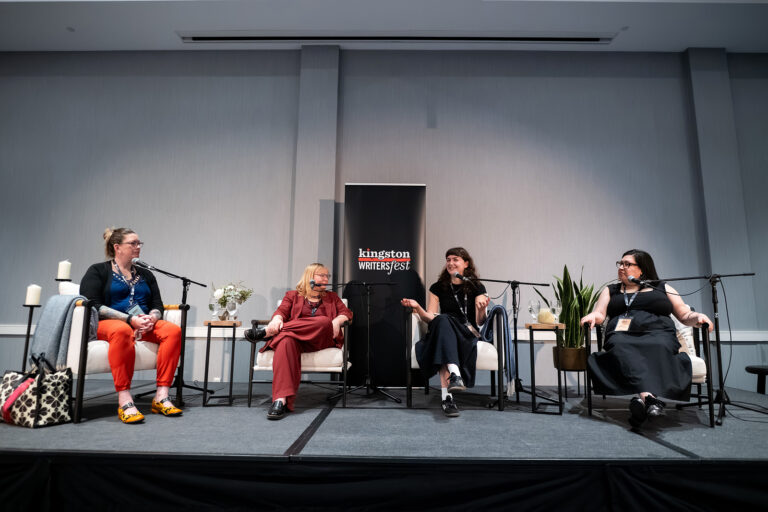
On Oct. 1 at 10:30 a.m. at the Kingston Marriott, the Kingston WritersFest speculated how fiction breaks boundaries at the panel, “Beyond the Veil of Things.” Executive Director of the Kingston Arts Council Nicole Daniels introduced the moderator, Kimberly Lemaire, alongside three panelists: Kate Heartfield, Rebecca Hirsch Garcia, and Sophia Hannan.
In August, three-time Aurora Award-winner Heartfield released her historical fantasy, Mercutio, a prequel to Shakespeare’s Romeo and Juliet. On the battlefield, Mercutio’s encounter with poet Dante Alighieri breaks the boundaries between their world and the Faerie realm, beginning a journey of star-crossed love.
Hirsch Garcia debuted Other Evolutions last year in October. A love letter to Ottawa and her Mexican-Jewish roots, her speculative fiction novel explores the themes of “Vanishing,” “Absence,” “Loss,” and “Homecoming,” in four parts through the main character, Alma, after an accident leaves her grief-stricken.
Kingston-born writer Hannan came out with her first young adult speculative fiction novel, We Were Never Here, in July. A haunting debut, the story follows Georgia and the other remaining members of a YouTube ghost hunting show after the death of their beloved co-host, Jules, leaves them estranged.
READ MORE: Kingston writer discusses the English student to published author pipeline
Other Evolutions is inspired by her own family, with Garcia explaining that family is integral to her story.
Growing up, she sought books with similar dynamics to her Mexican-Jewish interfaith and interracial family, but she only ever came across racist depictions. When writing her own book, Garcia wanted to reclaim those dynamics by exploring how a family like hers exists with both love and complications.
Hannan explained We Were Never Here is more of a “found family situation.” Hannan found that she could push the ghost hunting show’s found family to their limits since the characters were not rooted in reality.
“The really nice thing about writing about kind of complicated relationships in fiction is that there is kind of a safe distance from what you’re writing about,” Hannan said.
Since it’s inspired by Romeo and Juliet, Mercutio explores family as an obligation by questioning what we owe and do not owe them. Heartfield explained that her story follows “inherited vendettas and feuds,” but it digs into the consequences and benefits of choosing exile after defying family.
Then, Lemaire asked the panelists about how their works explore othering.
Hannan explained that as the genre of extremes, horror is the perfect vehicle to examine marginalization. When writing We Were Never Here, Hannan explored othering through Georgia, who is “othered by her queerness, but also othered because she doesn’t want to come out.”Georgia is further “othered by her grief,” which leaves her estranged from her found family.
For Heartfield, it was “non-negotiable” to explore Mercutio’s queerness as explicit rather than implied. She mentioned Will Tosh’s Straight Acting as a “great exploration of queerness in Shakespeare,” as the book analyzes Mercutio’s unrequited love for Romeo.
Garcia explained that the title, Other Evolutions, is a play on being the Other in terms of the racial bigotry that Alma faces. Yet, Garcia bounded off Hannan’s point on grief and expressed that Alma is also “othered by grief.”
Building on the shared conversation, Heartfield asked Garcia if it was uncomfortable to write a book set in her hometown, as she is currently writing a novella set where she grew up in Manitoba. Garcia explained this setting comes naturally to her and that she was inspired by speculative fiction writer André Alexis because how touching it was to experience Ottawa through his perspective.
The panel evolved into a question-and-answer period where the writers discussed the Gothic’s influence on speculative fiction. While Hannan is drawn to haunting returns of the dead, Heartfield is inspired by the uncanny third man phenomenon, and Garcia expressed her writing is influenced by supernatural Victorian literature.
Although the panel concluded at 8:30 p.m., these speculative fiction works will certainly linger in the reader’s minds, much like Gothic ghosts.
Tags
Fantasy, horror, Kingston WritersFest, Literature, Sophia Hannan
All final editorial decisions are made by the Editor(s) in Chief and/or the Managing Editor. Authors should not be contacted, targeted, or harassed under any circumstances. If you have any grievances with this article, please direct your comments to eic@queensjournal.ca.