Story updated March 25 at 9:13 a.m.
A legendary Canadian singer-songwriter was honoured for his lyricism and flair at a recent event.
Hosted by academic Mehmet Karabela and the department of Jewish studies on March 13, the event started with a short introduction video giving the audience a taste of Leonard Cohen’s personality by showing him onstage presenting his poetry. The video included anecdotes from Suzanne Verdal, the muse of one of Leonard Cohen’s most touching songs, “Suzanne.”
After briefing the audience, Karabela introduced Ottawa-based singer and pianist Kimberley Dunn. She was joined by a Cellist Greg Weeks and Kyle Briscoe, who represented Leonard Cohen’s ties to McGill.
The three of them played a variety of Leonard Cohen’s songs, such as “Dance Me to the End of Love” and “I am Your Man.”
Perhaps my favourite song of the night was the last performance, when the three on-stage artists were joined by Gideon Zelermyer, cantor at Montreal’s Shaar Hashomayim Synagogue, where Cohen and his great-grandfather were members of the congregation.
Performing “Hallelujah,” Cohen’s most famous and most covered song, the four singers harmonized gracefully over the choruses, and an impromptu Yiddish verse that was said to have been a nod to Cohen’s Jewish roots, Zelermyer later explained.
Met by a large standing ovation from the crowd, the artists gracefully bowed, and Karabela took the stage once again, this time to formally welcome back Zelermyer, who had worked closely with Cohen towards the end of his life on songs like “You Want it Darker.”
Zelermyer spoke about the role religion plays throughout Cohen’s songs, bringing forth examples from “Hallelujah” and “You Want it Darker.” Each of Cohen’s songs showcase a deep knowledge of religious texts and the forces of life, his music communicates intricate emotions related to life, death, and love.
Initially, I was worried I wouldn’t be able to connect with anything shared on stage, either during the performance through Zelermyer’s words; however, disregarding how long ago many of Cohen’s works were written, they’re all still relevant.
Zelermyer touched on the importance Judaism played in Cohen’s personal identity. Through times of volatility and conflict, it was his faith that gave him strength.
Cohen actively grappled with death through his poetry, and in his faith, he found the comfort and strength to find peace.
When Cohen was working on one of his final songs, “You Want It Darker,” he connected with Zelermyer, working on lyrical choice when implementing “Hineni, hineni; I’m ready, my lord” at the end of his chorus.
Hineni is Hebrew for “Here I am,” and comes from the story of the Akedah, or the binding of Isaac. Here, God calls upon Abraham to sacrifice his son and Hineni is the name of a prayer of preparation and humility addressed to God, and chanted by the cantor on the holiday Rosh Hashanah.
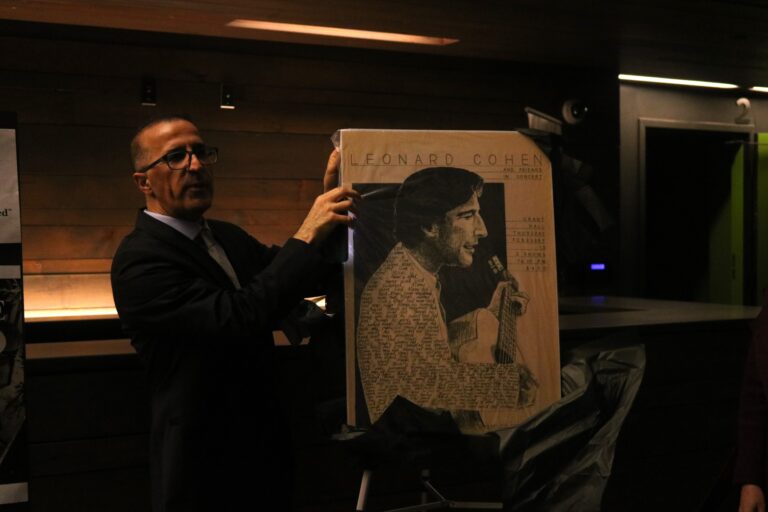
In a small reception outside the theatre, there was a never-before-seen painting dedicated to the last time Cohen visited and performed at Queen’s.
With many members from the Kingston community gathered around the painting, Cohen’s impact transcended outside Montreal, reaching beyond demographical boundaries one might imagine.
In listening to a sliver of Cohen’s work, I learned a lifetime about life, death, and love, and what it means to approach the world with your heart open—and in the most human way possible, to live.
Tags
legendary, Leonard Cohen, musician, Singer Songwriter, video
All final editorial decisions are made by the Editor(s) in Chief and/or the Managing Editor. Authors should not be contacted, targeted, or harassed under any circumstances. If you have any grievances with this article, please direct your comments to eic@queensjournal.ca.