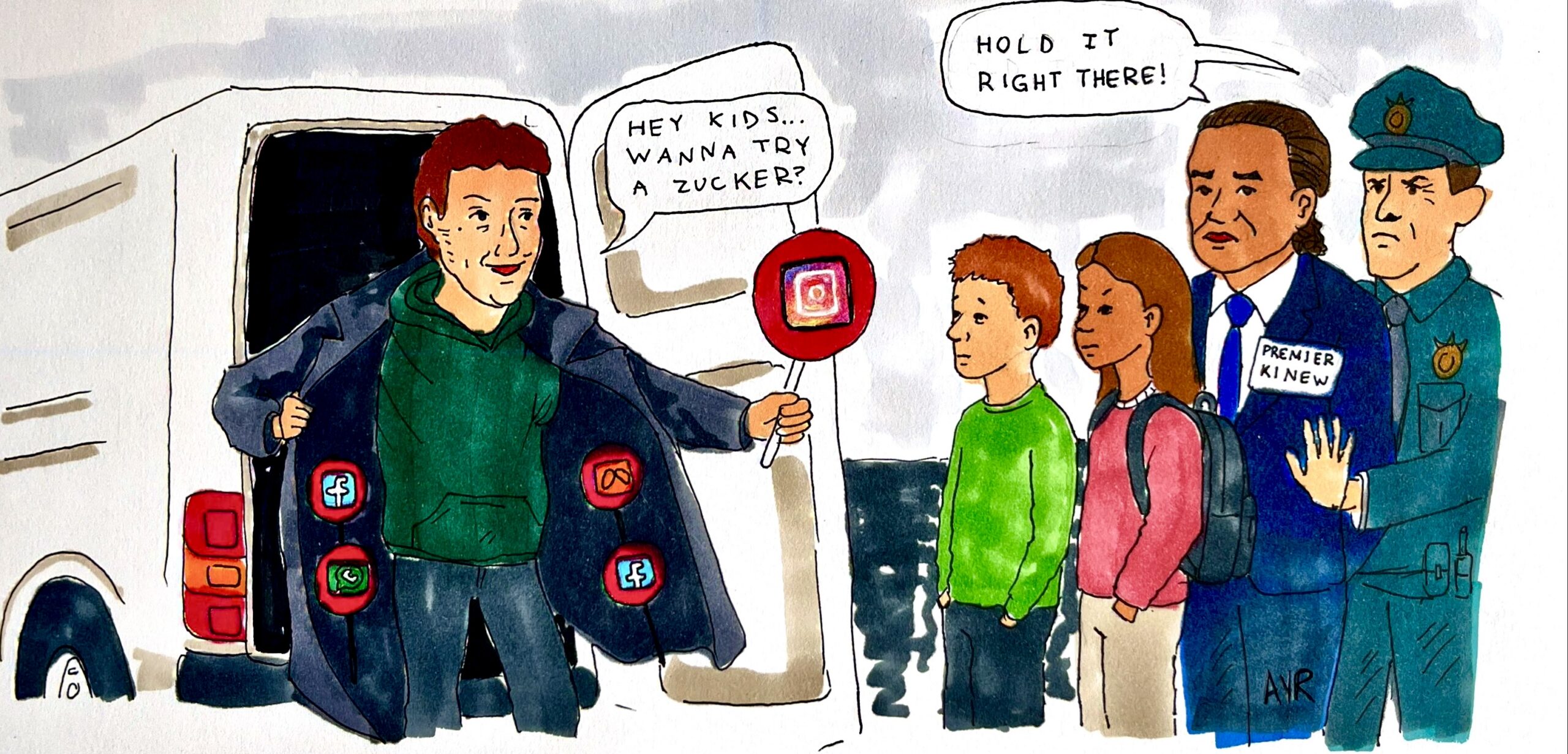
Good intentions do not make bad policy work, and Manitoba’s proposed social media ban is proof of that.
Announced on April 25, Manitoba Premier Wab Kinew has proposed legislation that would ban all social media and AI platforms for anyone under 16. It is the first systemically oriented attempt to regulate these technologies in Canada, and the concern motivating it is not unreasonable. However, its implementation is.
Young Canadians are increasingly addicted to these platforms, and the consequences are well-documented: diminished attention spans, heightened anxiety, and a growing inability to engage meaningfully outside a digital context. Some form of regulation is necessary, and Kinew deserves credit for being among the first Canadian legislators to take that seriously. Parents may also find relief in knowing peers face the same restrictions—removing the social pressure that makes opting out feel impossible for any individual family.
The problem is that an outright ban treats a complex policy question as if it has a simple answer. 16 is an oddly specific threshold for a problem that does not sort neatly by age — this generation is already so thoroughly embedded in these platforms that the cutoff reads rather arbitrary.
It also does nothing about the uneven way a ban lands. Families with private tutors and monitored devices will navigate it differently than those without, widening the gap between students who get supervised digital literacy and those who simply lose access.
Consider YouTube. Under the legislation, its autoplay function classifies it as an addictive platform, meaning it would be banned from Manitoban classrooms entirely. The evidence that YouTube is harmful to learning is thin, and for neurodivergent students who struggle within conventional classroom structures, video-based learning is often the opposite.
The same logic extends to social media and AI. These technologies are not incidental to how young Canadians learn and communicate; they are woven into it. Teachers already assign YouTube videos, educators use AI tools to personalize instruction, and students use social platforms to collaborate, share notes, and organize study groups.
The curriculum, often unknowingly, has been shaped around the digital environment these students grew up in. A ban removes the supervised context in which students encounter these tools — and that is precisely the context worth protecting.
Social media platforms are engineered to be addictive — a conclusion now upheld in court — with researchers identifying specific design features like infinite scroll and autoplay built to maximize compulsive use. AI tools can undermine independent thinking when used uncritically, but the answer to that is not less exposure in controlled settings. Instead, it is more deliberate engagement with them.
Students denied critical engagement with these platforms in school will still encounter them everywhere else. The ban does not eliminate exposure; it ensures that exposure happens without any institutional support, leaving students vulnerable to exactly the algorithmic manipulation, misinformation, and compulsive use patterns the legislation is trying to prevent.
Good regulation is harder to legislate than a blanket prohibition, and that difficulty is probably why Manitoba landed where it did. The ban is also reactive in a way that sidesteps the harder question: these technologies are not going away, and a provincial government cannot make them disappear by raising the age of access.
What Manitoba needs is not a wall but a framework. Canada’s needs curriculum frameworks that teach students to recognize platform manipulation, evaluate sources critically, and engage with AI tools without outsourcing their thinking.
Where the ban treats exposure as the problem, a nuanced solution treats it as a starting point. Students need to learn how to identify the design features built to hook them, interrogate the sources their feeds surface, and develop the habits of skepticism that no age restriction can instil.
Manitoba is right that these technologies pose real risks to young people. What the province has not reckoned with is that students will encounter these platforms regardless of what any provincial government decides.
— Journal Editorial Board
Tags
AI, Education, Manitoba, Phone ban
All final editorial decisions are made by the Editor(s) in Chief and/or the Managing Editor. Authors should not be contacted, targeted, or harassed under any circumstances. If you have any grievances with this article, please direct your comments to eic@queensjournal.ca.