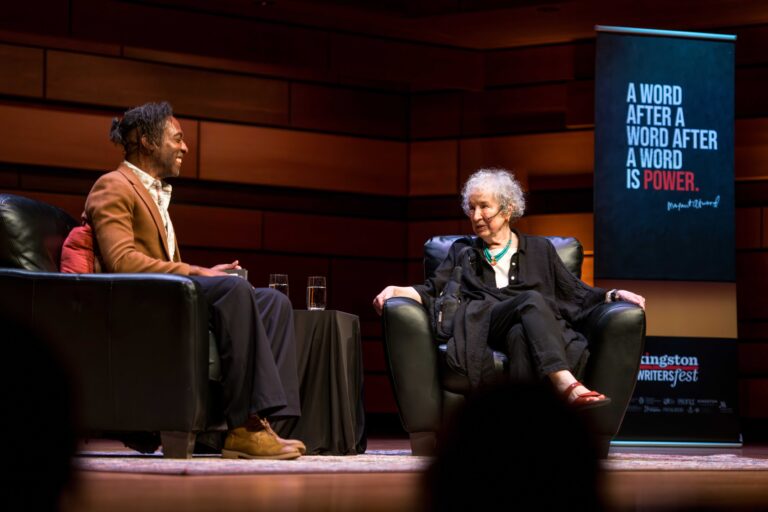
There’s power in the way humans stand behind their beliefs in writing, and Kingston WritersFest ’25 is putting this power in the spotlight.
On Aug. 24, award-winning Canadian author Margaret Atwood kicked off the festival with a discussion featuring acclaimed Canadian poet and author Ian Williams. They discussed what makes a good conversation and silence’s place as a powerful tool.
WritersFest ’25’s theme, “A Word After a Word After a Word is Power,” is taken from Atwood’s poem, “Spelling,” published in the ’81 collection True Stories.
Sarah Tsiang, WritersFest Programming coordinator, explained in an interview with The Journal that “Spelling” is about Atwood’s daughter learning to communicate. “How a child finds words is from listening—they understand so much more when they begin to speak than they can [express] themselves. [It’s] that building of power,” Tsiang said.

Tsiang teaches poetry and creative writing at Queen’s, and will host WritersFest’s “Play With Poetry” event on Sept. 19 as well as the “Poetry 2 Go” event on Sept. 20. She emphasized the significance of this year’s theme being chosen from Atwood’s poetry.
“Poetry was [humanity’s] first language,” she says, citing popular children’s author Dr. Seuss as an example. “We understand [poetry] when these are our first words and then we come away from it.”
Through poetry, writing is a powerful form of expression relevant to the current moment. “We’re living in politically uncertain times. I think a lot of people are feeling there’s not much [they] can do,” Tsiang said. “The theme really speaks to the basics: that we do have power, and that power lies in the ways that we express ourselves with the written word.”
This year’s theme is especially important for young writers learning to express themselves, Tsiang explained. Feeling powerless in the face of modern politics can limit young people’s involvement. By exploring power in writing, WritersFest puts the “focus of control back on the individual,” examining “the basics of, ‘What can we do? How can we be active?’” Tsiang said.
Last week, Alberta’s education ministry moved to ban a number of books containing “sexually explicit material.” They’ve since paused this order, which included Atwood’s 1985 novel The Handmaid’s Tale. Tsiang argues book banning is “the ultimate acknowledgement of the power of writing.”
“Governments don’t get scared of things that aren’t going to affect the populace. They know that knowledge and literature [affect] the way people think [and] behave,” she said.
Atwood responded to Alberta’s ban with a satirical short story on social media, a unique expression of resistance through writing. “Satire has been used to speak truth to power, historically,” Tsiang said.
“The people who are currently in power want so badly to be taken seriously, but they’re not serious people. Pointing out the hilarious ridiculousness of their ideas wounds them more deeply than saying,‘Oh, your ideas have legitimacy. Let’s debate them,’” she said.
On Sept. 19, WritersFest will host an event on the topic of book banning, “You Can’t Read That!”. Tsiang recommends it for anyone interested in learning more about censorship in literature. “I think we can get complacent about our freedoms,” Tsiang says. “We live in Canada, we have this idea that we’re so different from [America]. But we’re not, really.”
For her, Alberta’s proposed ban is a reminder that governments and citizens aren’t “always reflecting the same desires. Our power as citizens is in standing up,” Tsiang said.
Tags
book ban, Kingston WritersFest, Margaret Atwood, Poetry, power, writing
All final editorial decisions are made by the Editor(s) in Chief and/or the Managing Editor. Authors should not be contacted, targeted, or harassed under any circumstances. If you have any grievances with this article, please direct your comments to eic@queensjournal.ca.