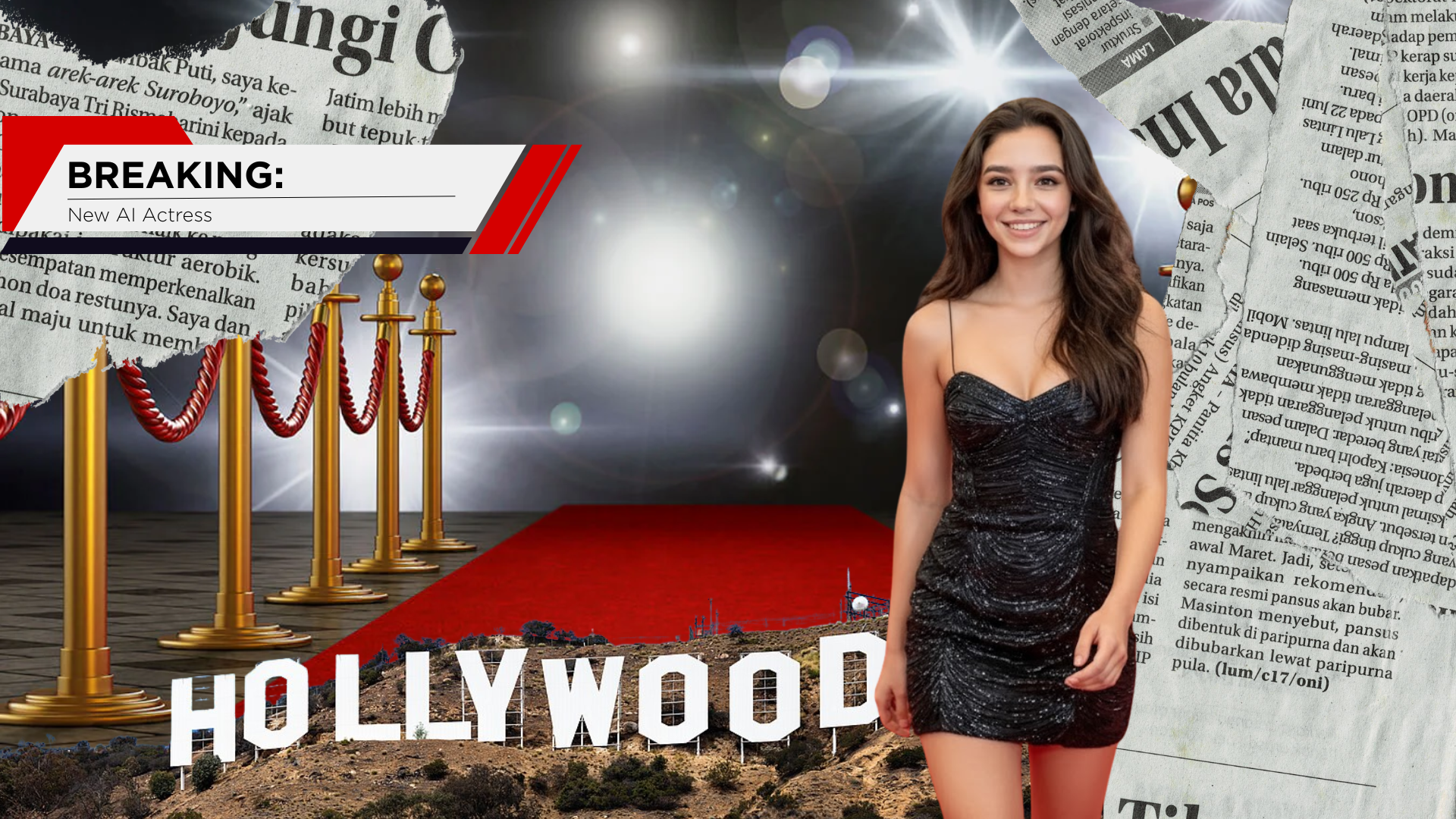
Hollywood’s next rising star is destined for success—in fact, she’s been coded to perfection.
On July 30, artificial intelligence (AI) actress Tilly Norwood made her Hollywood debut in the AI generated comedy sketch, AI Commissioner. Two months later, Eline Van der Velden, Norwood’s creator, posted a public statement to Instagram on Sept. 28, saying, “just as animation, puppetry, or CGI opened fresh possibilities without taking away from live acting, AI offers another way to imagine and build stories.”
AI Commissioner gives an undeniably uncomfortable feeling to viewers. The sketch begins with AI actors speaking directly to the camera about the superiority of AI in entertainment production in terms of cost, efficiency, and quality. Norwood quickly becomes the subject of interest, described as a “100 [per cent] AI-generated” actress, the protagonist of a series of AI-generated films from the company Particle 6. In one scene, a young man sits alone in a dark room describing why he supports Norwood: “She will do anything I say,” he explains.
Effectively, this sketch emphasizes a societal shift into consistent and daily AI interaction. According to a 2025 national survey performed by the Toronto Metropolitan University, two thirds of Canadians have used generative AI to some capacity. While the position generative AI takes in academics has been thoroughly discussed, AI’s place in film and art has not been as deeply addressed.
After Norwood’s debut, multiple Hollywood actors expressed their outrage at Van der Velden’s creation, including Jameela Jamil, the star of The Good Place. “The whole point of acting is to emulate the human experience, and so having something that isn’t human trying to emulate our experience isn’t possible,” Jamil said at a technology conference in Lisbon.
Jamil poignantly added the harmful exploitative potential of AI actresses like Norwood. Without clear regulations on use in sexual scenes and an inability to advocate for one’s needs, actresses like Norwood become easy targets for misuse.
Norwood isn’t the only AI artist who has taken their place on the public stage. AI musician Xania Monet reached number 30 on the Billboard Pop Airplay chart on Nov. 1. Since her debut in July, she has released 44 songs and has gained over a million monthly listeners on Spotify. Monet’s popularity displays that, despite the visible opposition of many against AI artists like Norwood, many consumers are still willing to give AI a monetized platform in art.
Despite an increasingly technological and socially disconnected world, it’s important to recognize the power of the collective voice in protecting and standing up for one’s beliefs. If these beliefs include preventing the infiltration of AI into innately human fields like music and film, it’s imperative to fight for these beliefs and preserve the irreplaceable humanity within creativity.
Tags
acting, AI, artificial intelligence, Film, Hollywood, Movies, Tilly Norwood
All final editorial decisions are made by the Editor(s) in Chief and/or the Managing Editor. Authors should not be contacted, targeted, or harassed under any circumstances. If you have any grievances with this article, please direct your comments to eic@queensjournal.ca.