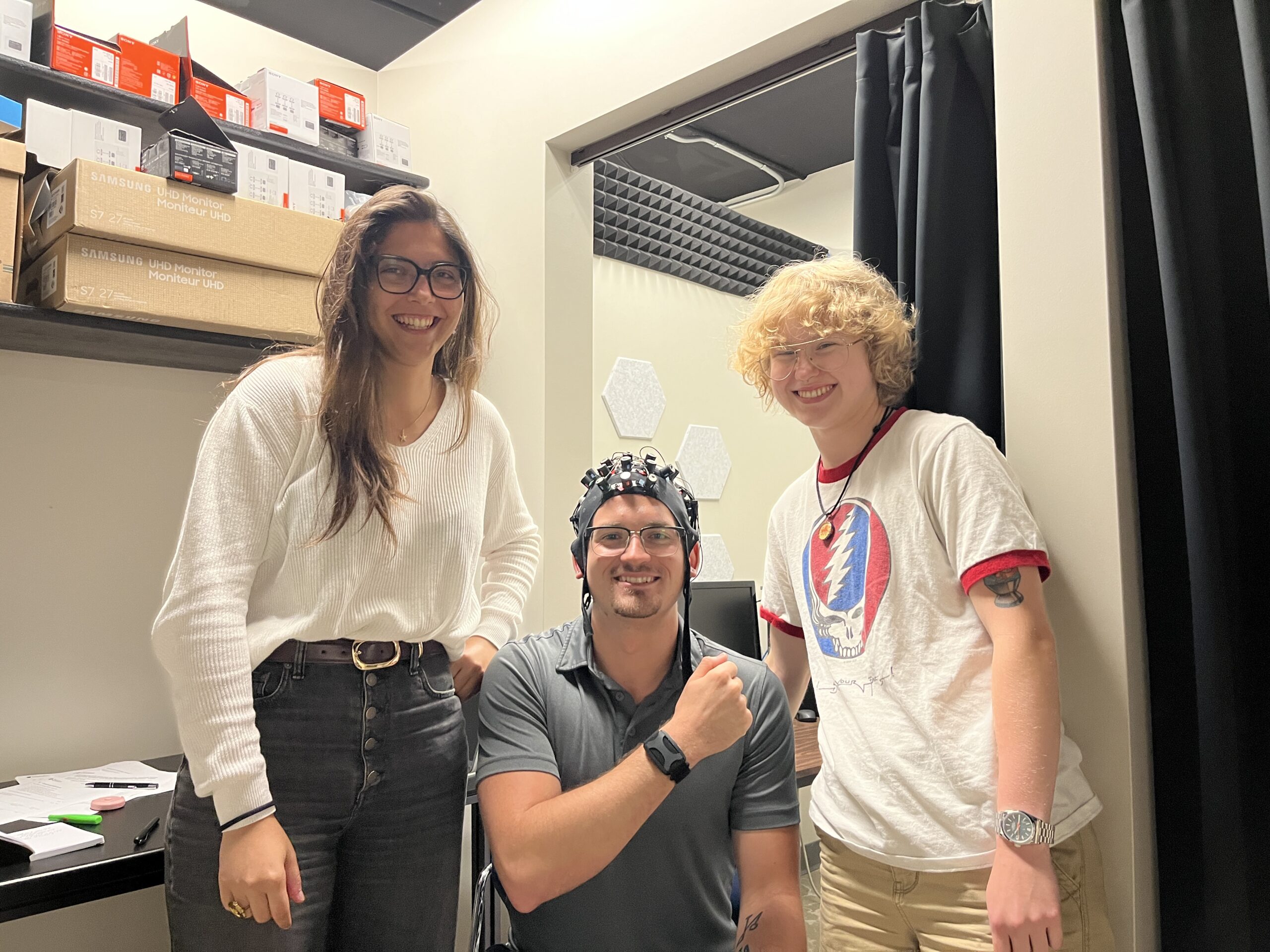
From Aug. 9-22, 15 students from around the world embarked on a two-week-long, intensive in-person Capstone Course as part of the Neurotech Micro-credential Program at the Centre for Neuroscience Studies (CNS) at Queen’s.
Neurotech includes “brain sensing, imaging or modulating technologies,” which are rapidly going from research prototypes to being deployed in clinical trials and consumer wearables.
“The idea there was to bring in teams of students, put them together, have them ideate and execute a research project in that short period of time,” Dr. Susan Boehnke, an associate professor at the CNS and the program’s lead developer, told The Journal.
Boehnke had been tracking the industry for years as part of the curriculum for a fourth-year course called NSCI 444/844: Controversies in Neuroscience. In 2021, she organized a conference called “A Neurotech Future: Ethical, Legal, and Policy Issues,” in collaboration with the Centre for Surveillance Studies, the Faculty of Law, and key industry partners.
“It was probably pretty innovative for back then,” Boehnke said. The overwhelming response led to discussions of developing a certificate.
The micro-credential received an initial $1.3 million grant from the Ontario Government’s Micro-Credential Challenge Fund and Community Impact Award to upskill people for emerging industries.
The introductory course, the Neuroscience and Neurotechnology Primer, was launched online in summer 2023. Students who complete the primer could apply for the capstone, held once a year in the Neurotech Discovery Lab in Abramsky Hall in August.
Designed to help students gain hands-on experience with cutting-edge neurotech through a collaborative research project, students were placed into groups of three based on their research project ideas before arriving.
The first week consisted of interactive workshops on technologies like electroencephalogram (EEG), functional near-infrared spectroscopy (fNIRS), and brain-computer interfaces (BCI) led by industry experts. Towards the end, students finalize their research protocols and get a fast-tracked Research Ethics Board Approval for their projects, Boehnke explained.
Since the capstone takes place during the summer, Boehnke also takes the students to her cottage for a weekend.
“They get to experience Canada and all the beauty of Kingston,” she said.
The second week is devoted to data collection and analysis, often involving long days, a steep learning curve, and rapid problem-solving. Students typically participate in one another’s experiments and recruit friends who happen to be in the city.
The Journal spoke with participants including Laura Miltchin, a fourth-year Chemistry student at Queen’s, Claudia Severi, a neuropsychologist from Spain, and Jack Tiller, an MD/PhD student from the University of Texas, who worked together on their project.
Unlike other groups, Tiller brought the device used in their project.
“I have this wearable device called Apollo […] It’s a transcutaneous vibratory nerve stimulator. Basically, it’s just like a smartwatch with no screen, and it vibrates in different modes to trigger different mental states,” Tiller said.
The group decided to put the device to the test. Users can use the Apollo app to adjust the vibrations to different modes, like energy, focus, or sleep. The team used an fNIRS headset to experiment with whether different modes affected subjects’ brain activity while sitting down, compared to a control. They hope to publish their results after the course.
For Severi, the best part of the workshops was access to cutting-edge devices. “I love the workshops […] something special about this course is the devices they have,” she said.
For Miltchin, “it’s been really interesting to learn about all the ethical issues surrounding BCIs and neurotechnology.”
Gaining hands-on experience and conducting an experiment stood out most to Tiller.
“For me, being able to bring a device I use every day and turn it into a real scientific project, learning tools like fNIRS and seeing all the analyses we can do, has been really cool,” he said.
The Journal also spoke with Prishil Bhavsar, a neurotech content creator and third-year biomedical engineering student at the University of Guelph. Bhavsar’s project compared EEG signal quality using three different electrodes for a virtual-reality BCI headset.
“If you put yourself in a room with researchers, founders, students, you’re going to gain more information about a certain field than you will reading any paper or even throughout a job,” said Bhavsar, who chose to pursue a more unconventional path rather than pursuing an internship this year.
For Bhavsar, the highlight was presenting his research to a panel of founders and industry representatives on the final day. He also founded Myelin, a community for neurotech enthusiasts and founders.
The capstone typically has a 75/25 mix of domestic and international participants, despite an initial huge influx of applicants from outside of Canada. However, an unexpected source of participants was patients, Boehnke said.
One of this year’s participants was Tristan Cezair, a film-industry professional and coder who developed Reach, an interactive one-on-one rehab “therapy coach” after suffering a stroke following surgery for glioblastoma. Reach uses markerless motion capture and open-source tools to overlay a virtual skeleton on the body and provide patients with individualized, real-time feedback on their exercises.
From his hospital bed, Cezair mentored two groups of students who improved and experimented with Reach using different neurotech tools.
This patient involvement is not new.
One of the capstone’s first participants was Mark McAuley, the former CEO of Astronomy Australia and a Parkinson’s patient advocate. McAuley, who has a deep-brain stimulation (DBS) device implanted in his brain, worked with other participants to conduct an experiment on himself using the device at different frequencies. The study led to two publications.
“What this really showed us was including patients in the research process is important, and a lot of times labs will do this as a very token way […] This is probably one of the few cases where I literally let a patient lead a research project on himself,” said Boehnke.
The program’s unique structure lets patients pursue their research ideas without committing to a graduate program, she said.
Applying to graduate school and completing a master’s degree would mean working on a lab’s existing projects, not pursuing their own, Boehnke explained.
“For people like that, a traditional graduate program for advanced research study would not work. This opens it up and allows everyday people from different backgrounds to be able to come and learn to be scientists for two weeks,” Boehnke said.
Tags
micro-credential, neuroscience, Neurotech, Student research
All final editorial decisions are made by the Editor(s) in Chief and/or the Managing Editor. Authors should not be contacted, targeted, or harassed under any circumstances. If you have any grievances with this article, please direct your comments to eic@queensjournal.ca.