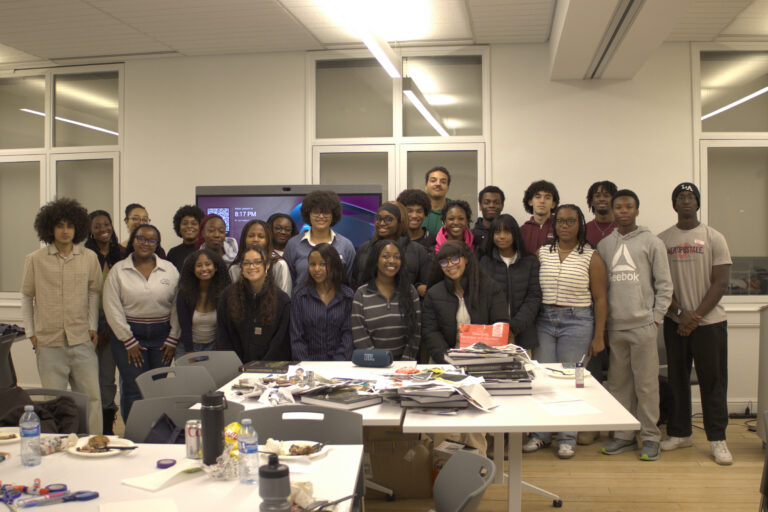
A new mentorship program is trying to change who sees themselves at Queen’s.
The Social Issues Commission (SIC) has launched The Black Legacy Mentorship Program, an initiative dedicated to connecting Black youth in the Kingston community with student mentors from the University. In partnership with Queen’s Black Clubs Caucus and Queen’s Black Academic Society, and with help from the University administration, the program has already set up 22 mentees with 15 mentors.
The program was created based on the Scarborough Charter, a document Queen’s signed onto in 2021 that promotes anti-Black racism and Black inclusion in Canadian universities. The program was also designed to align with the United Nations Sustainable Development Goals and the Ontario Dreams Delayed report.
The Journal spoke with the Social Issues Commissioner (External) Mujeedat Lekuti, HealthSci ’26, and the SIC’s Black Initiatives Lead Estelle Ngwa, HealthSci ’27, about their goals for this program.
“What we’re really hoping for with this program is to build empowerment for Black local youth in Kingston,” Ngwa explained. “We all made it through navigating the educational system in high school and middle school, but now that we’re empowered by being in University, we’re able to provide students with the resources they need to navigate their social, academic, and personal lives.”
The program’s first session already took place on Jan. 30, offering the mentors and mentees their first opportunity to meet each other.
“We’d already paired them based on similar interests, their background, their culture, and languages they speak,” Ngwa said. “In this session, they did scrapbooking and vision boards. So, we had lots of images of life at Queen’s, and some magazines with Black representation. We also had a document printed out with different affirmations you’d want to see as a high schooler.”
Lekuti shared that she was very happy with the turnout and energy at the first session, with some mentee-mentor pairings staying even after the session had finished to continue chatting and bonding.
“You could see this atmosphere of people being cheerful, people laughing, people making handshakes already,” Lekuti said. “It was just beautiful to see that there’s that connection, and that they were able to make that connection so quickly and so naturally.”
Ngwa shared that having this program is especially important in spaces like Queen’s and Kingston, considering the University’s history of systemic racism, which included a ban on Black students from Queen’s medical school that was implemented in 1918 and only formally repealed in 2018. Accordingly, she explained that many Black students from both Kingston and the Greater Toronto Area and Kingston feel uncomfortable coming to Queen’s.
“We want to ensure that people have the opportunity to look at Queen’s, andQueen’s and see that [they] can come to a university like Queen’s, or just a university in general,” Ngwa said. “Or provide them with the information that they need to make an informed decision on whatever they want to do within their future.”
While the mentorship program is at capacity for the remainder of this school year, through continued collaboration with local school boards and Kingston Family and Children Services, continued partnership with Queen’s clubs, and word-of-mouth advertising, the SIC hopes to expand the membership and reach of the program in years to come.
Tags
black history month, Mentorship, QBAS, QBCC
All final editorial decisions are made by the Editor(s) in Chief and/or the Managing Editor. Authors should not be contacted, targeted, or harassed under any circumstances. If you have any grievances with this article, please direct your comments to eic@queensjournal.ca.