Queen’s saw a 19 per cent increase in non-academic misconduct (NAM) cases despite a 12 per cent decrease in student respondents from 2024-25 to 2025-26.
According to the 2025-26 Non-Academic Misconduct Annual Report, 2024-25 saw 1,079 NAM cases, whereas 2025-26 saw 1,287 cases, accounting for the 19 per cent increase. 93 per cent of incidents related to residence conduct.
NAMs includes incidents or student behaviours that violate the Queen’s Student Code of Conduct, which all students commit to following when they register for a Queen’s course or program.
According to the report, the increase in total cases is “largely driven by ongoing efforts to hold students consistently accountable to the expectations outlined in the Residence Contract.” The report also said the decrease in student respondents is the result of fewer cases having more than one respondent.
The report, provided by the University Culture Committee, was discussed at Queen’s Oct. 2 Board of Trustees meeting and provided details on the student NAM cases ranging from May 1, 2025, to April 30, 2026.
READ MORE: Board approves $160.4 million surplus as Queen’s reports rising student financial need
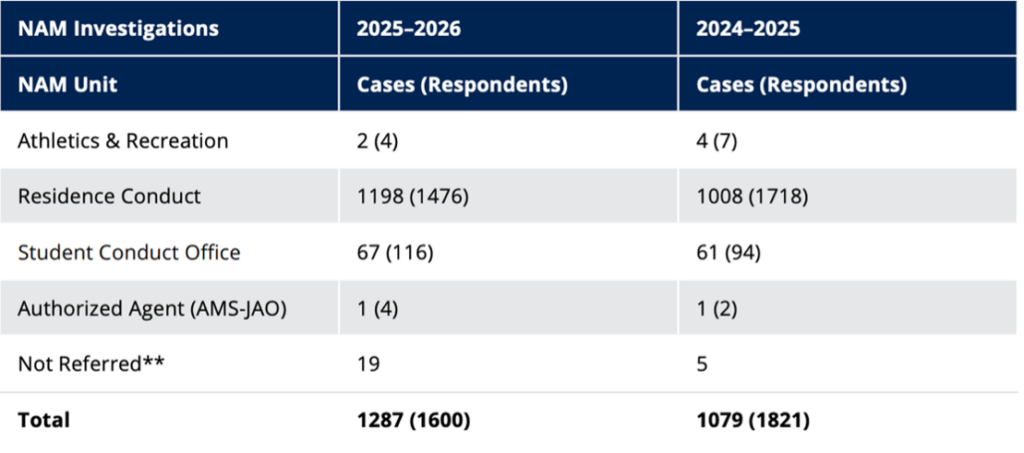
Table from 2025-2026 Non-Academic Misconduct Annual Report.
The total number of students involved in NAM processes represented 5.6 per cent of the total student population. Many of the respondents were under the Residence Contract, with out-of-residence respondents accounting for 0.4 per cent.
NAM cases fall under two categories. According to the Student Code of Conduct, while “Category 2 is generally considered to encompass relatively more grievous types of misconduct than Category 1, the demarcation between these Categories is not absolute.”
Male students were responsible for 70 per cent of serious NAM incidents, falling under Category 2, and represented 40.2 per cent of Queen’s student population, according to the report.
The report also noted that 60 per cent of serious NAM violations were attributed to first-year students, with many of the cases related to residence violations.
NAM violations falling under Category 2 are addressed by the Student Conduct Office (SCO), whereas violations falling under Category 1 are addressed by the Non-Academic Misconduct Intake Office (NAMIO).
According to the report, the SCO issued 109 outcomes. Of these, 79 per cent were educational or developmental sanctions, including workshops, seminars, meetings with SCO campus partners, and reflection assignments.
A further 15.5 per cent of the sanctions issued were corrective, with students being handed no-contact directives, a loss of priviledges, suspension, notices of prohibition, and behavioural agreements. The remaining 5.5 per cent of sanctions were restorative, including community service, apologies, and restitution.
In a statement to The Journal, Queen’s said that 80 per cent of students in residence met the expectations of the Residence Contract, noting that most residence-related NAM cases involved “lower-level behaviours,” with noise related violations remaining the most common.
The University said violations related to guests and failure to co-operate rose, but alcohol-related violations decreased. The report also shows a 40 per cent decrease in residence damages.
In 2024-25, residence damage costs totaled $396,039. In 2025-26, the damage costs totaled $219,836.
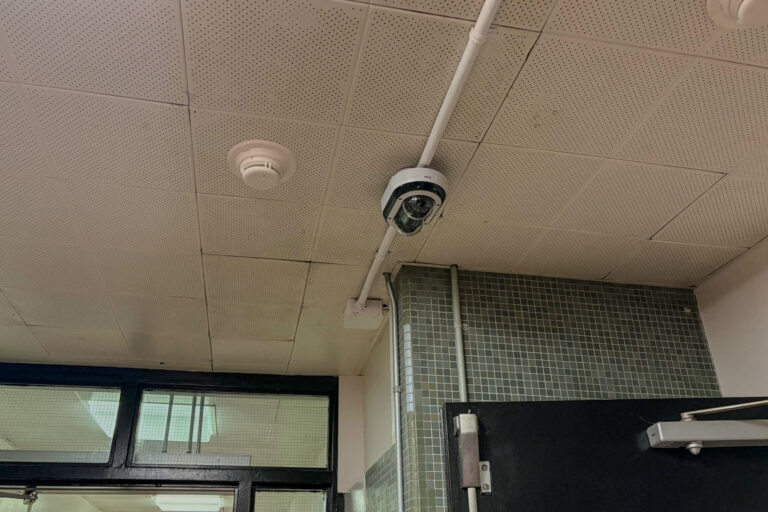
The University attributes this decrease to the investment in video cameras in common areas in most residence buildings. In 2024-25, more than 700 security cameras were installed across residence buildings.
READ MORE: More than 700 security cameras installed across residences last year
The report states that a review of the Student Code of Conduct will occur in 2026-27 and will include community consultation. A specific date of the review was not specified.
Tags
non-academic misconduct, Queen's report, student code of conduct
All final editorial decisions are made by the Editor(s) in Chief and/or the Managing Editor. Authors should not be contacted, targeted, or harassed under any circumstances. If you have any grievances with this article, please direct your comments to eic@queensjournal.ca.