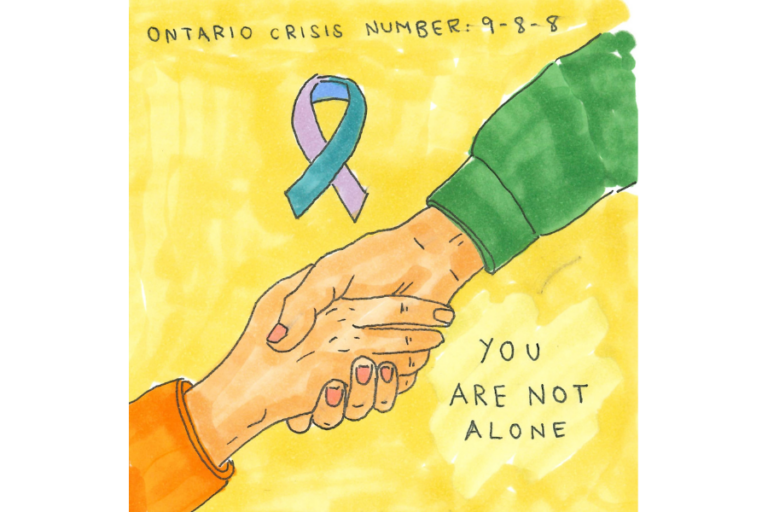
This article may be distressing to some readers.
One in 10 Queen’s students reported experiencing suicidal thoughts in the previous year, according to the University’s latest student well-being survey.
According to Queen’s 2025 Canadian Campus Wellbeing Survey (CCWS) results, 10 per cent of students reported experiencing suicidal thoughts in the previous 12 months, down from 13 per cent when the survey was last conducted in 2022.
As Queen’s recognizes Suicide Prevention Awareness Month this September, the University said in a statement to The Journal it’s continuing efforts to connect students experiencing mental health challenges with resources on and off campus.
The month coincides with World Suicide Prevention Day, recognized annually on Sept. 10.
Among students who reported suicidal thoughts, 25 per cent said they had made a plan to seriously attempt suicide.
The survey also found 29 per cent of Queen’s students scored in the severe range for psychological distress, compared to 35 per cent of postsecondary students nationally. Meanwhile, 76 per cent of Queen’s students reported knowing how to access mental health supports, up from 67 per cent in 2022.
In an interview with The Journal, Queen’s Rector Niki Boytchuk-Hale said the results show progress while demonstrating a continued need for mental health resources on campus.
In the Rector’s office, the issues they deal with are often multi-faceted. Boytchuk-Hale said students frequently approach her for help with a specific financial or academic problem, while mental health challenges are intertwined with what they’re experiencing.
“Nothing is more stressful than when you are worried about paying your rent, or buying groceries, or supporting loved ones,” she said.
“I often see students come to me when I’m their last resort,” Boytchuk-Hale said. Uncertainty about where to seek support can itself become a barrier to students asking for help.
She encouraged students who don’t know where to turn to begin with someone they already know, such as a residence don or teaching assistant, who may be able to direct them to the appropriate resources.
In a statement to The Journal, Queen’s described its approach to student mental health as “strength-based, person-focused,” and campus-wide, combining health promotion, education, early intervention, crisis response, and connections to community services.
The University said peer-led initiatives are part of that approach, including the AMS Peer Support Centre, Health Promotion’s Peer Wellness educators, and Campus Observation Room volunteers.
The University also offers suicide prevention and mental health training throughout the year. More than 600 members of the Queen’s community completed Identifying and Responding to Students in Distress, safeTALK suicide alertness, or Applied Suicide Intervention Skills Training (ASIST) during the 2025-26 academic year, according to the University.
Boytchuk-Hale pointed specifically to ASIST, which teaches participants how to recognize and respond to people who may be at risk of suicide.
She said responsibility for supporting student mental health extends beyond senior University administrators.
“We all have a role to play,” Boytchuk-Hale said, pointing to students, faculty members, staff, student governments, and campus organizations as part of the broader support system.
For Boytchuk-Hale, that responsibility also extends to recognizing that students’ mental health doesn’t exist separately from the rest of their lives.
“It doesn’t matter if a student is struggling with something personally, academically, or financially,” she said. “There are resources at Queen’s that will support you no matter what.”
She said students shouldn’t feel the need to wait until a problem becomes severe before asking for support, whether their concerns are personal, academic, financial, or a combination of three.
“There are some pretty significant mental health challenges that students were facing, and I do think we’ve advanced tremendously,” she said. “But we are still ultimately, you know, losing students, so still lots of work to be done.”
“I hope that students feel empowered that they can reach out if they are struggling and that it’s never too early to do that,” she said.
She also reflected on the pressures experienced by students who take on public-facing leadership positions, saying those roles can involve supporting others while receiving criticism or feedback themselves.
She encouraged students to stay active in the parts of their lives outside of their positions.
“At the end of the day, we are people first,” she said.
Tags
Canadian Campus Wellbeing Survey, Mental health care, Suicide Awareness Month
All final editorial decisions are made by the Editor(s) in Chief and/or the Managing Editor. Authors should not be contacted, targeted, or harassed under any circumstances. If you have any grievances with this article, please direct your comments to eic@queensjournal.ca.