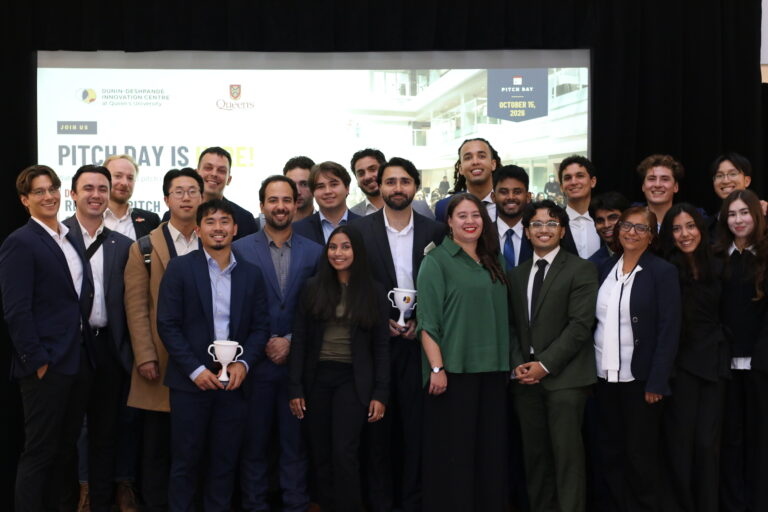
Six early-stage startups received $105,000 in seed funding and $30,000 in additional prizes at this year’s Regional Pitch Competition.
The Dunin-Deshpande Innovation Centre at Queen’s (DDQIC) celebrated its 15th annual Regional Pitch Competition on Oct. 15 in Mitchell Hall during Kingston Innovation Week.
This year’s event was the largest yet, drawing 110 attendees and 15 pitches from Queen’s and the community.
The day was split into two blocks, with life sciences pitches in the morning and sector-agnostic pitches in the afternoon, alongside a panel on local startup funding and two medical innovation talks presented by Kingston Health Sciences Centre (KHSC).
The majority of participants came from the Queen’s Founders and Innovators Initiative (QFII), which is “a pre-ideation accelerator and incubator to figure out what you want to do, who do you want to do it with, and build out that team,” Simon Denford said in an interview with The Journal.
Denford is a program coordinator at the DDQIC and oversees its entrepreneurship programs, including QFII, Build2Scale Life Sciences, and the Queen’s Research Commercialization Fellowship.
The centre provides non-dilutive seed funding, meaning it takes no equity in the companies, explained Denford. It also provides support to founders to figure out how to spend their money.
“One of the big things with seed funding, especially [for] early-stage entrepreneurs, is they don’t know how to invest their money yet in their company, and so we’re here to help them steward that,” Denford said. “Early-stage companies typically have little or no revenue and are still developing their products, leaving them with few funding options, especially in research-heavy industries like life sciences and deep-tech ventures.”
Each pitch was seven minutes long, with a seven-minute question period, judged by Queen’s alumni and industry experts. Three companies won in each block, along with the “Wisdom of the Market” audience-choice award and the $30,000 Market Validation Prize presented by the Saunders Entrepreneurship Fund.
The group behind myLyme, which is developing a point-of-care tick test, won the $25,000 top prize in the life sciences category. Brigid, which uses AI calls to monitor patients’ recovery after surgery, placed second, receiving $15,000.
A platform that helps women understand hormonal blood test results, named weterus, placed third in life sciences and received $10,000. It also won the $5,000 Wisdom of the Market audience choice award.
In the sector-agnostic category, MercSentAI won the $30,000 top prize. The company, which helps payment companies identify and monitor high-risk merchants, also received the $30,000 Saunders Market Validation Prize for its understanding of its market and engagement with customers.
Corax, which uses AI to detect suspected shoplifting through existing security cameras, placed second in the sector-agnostic category, receiving $15,000. KynTrack, a platform that helps athletes and coaches track performance and wellness, placed third, receiving $5,000.
Several alumni attended and served as guest judges, including serial entrepreneur Carl Saunders, Sci ’78, Astronav CEO Anton Tudov, ArtSci ’11, mDETECT co-founder Keira Frosst, ArtSci ’20, PhD ’26, and venture capitalist Peter Fenwick, Sci ’93.
DDQIC is “faculty-agnostic,” attracting students from a wide range of backgrounds, including undergraduates, graduate students, and faculty members.
“I’ve always known that I wanted to use science to try and help other people,” said Justin Lasrado, ArtSci ’26, who co-founded myLyme with Professor Robert Coulatti in the Department of Biology.
Lasrado participated in the QFII program this year, initially focusing on commercializing the Bacterial Amplicon Tick Test (BATT), which uses next-generation sequencing and machine learning to identify bacterial pathogens and their genetic variants in ticks.
Tick-borne diseases have increased 49-fold in Canada since 2009, affecting both humans and pets, he said.
While conducting market research, the company decided to pivot to developing a rapid, cheap, and easy-to-use test, whereas the BATT can take up to 24 hours and requires specialized lab equipment and training.
“It won’t be a diagnosis, but it will be a much quicker and better understanding of what exactly was in the tick,” he said, which can help inform clinical decisions and prevent the overprescribing of antibiotics.
The prize money will support ongoing research and development of the new tick test, which Lasrado will continue working on when he returns to Queen’s for his master’s.
“[QFII] is an amazing opportunity for anyone who wants to create change or has big ideas and wants to try and work towards solving them,” Lasrado said. “This program is an amazing chance to do that and learn how to do it properly.”
Tags
AI and health, Dunin-Deshpande Innovation Centre, Regional Pitch Competition
All final editorial decisions are made by the Editor(s) in Chief and/or the Managing Editor. Authors should not be contacted, targeted, or harassed under any circumstances. If you have any grievances with this article, please direct your comments to eic@queensjournal.ca.