Long before mainstream publishers opened their doors, Black writers in Canada were already telling their own stories.
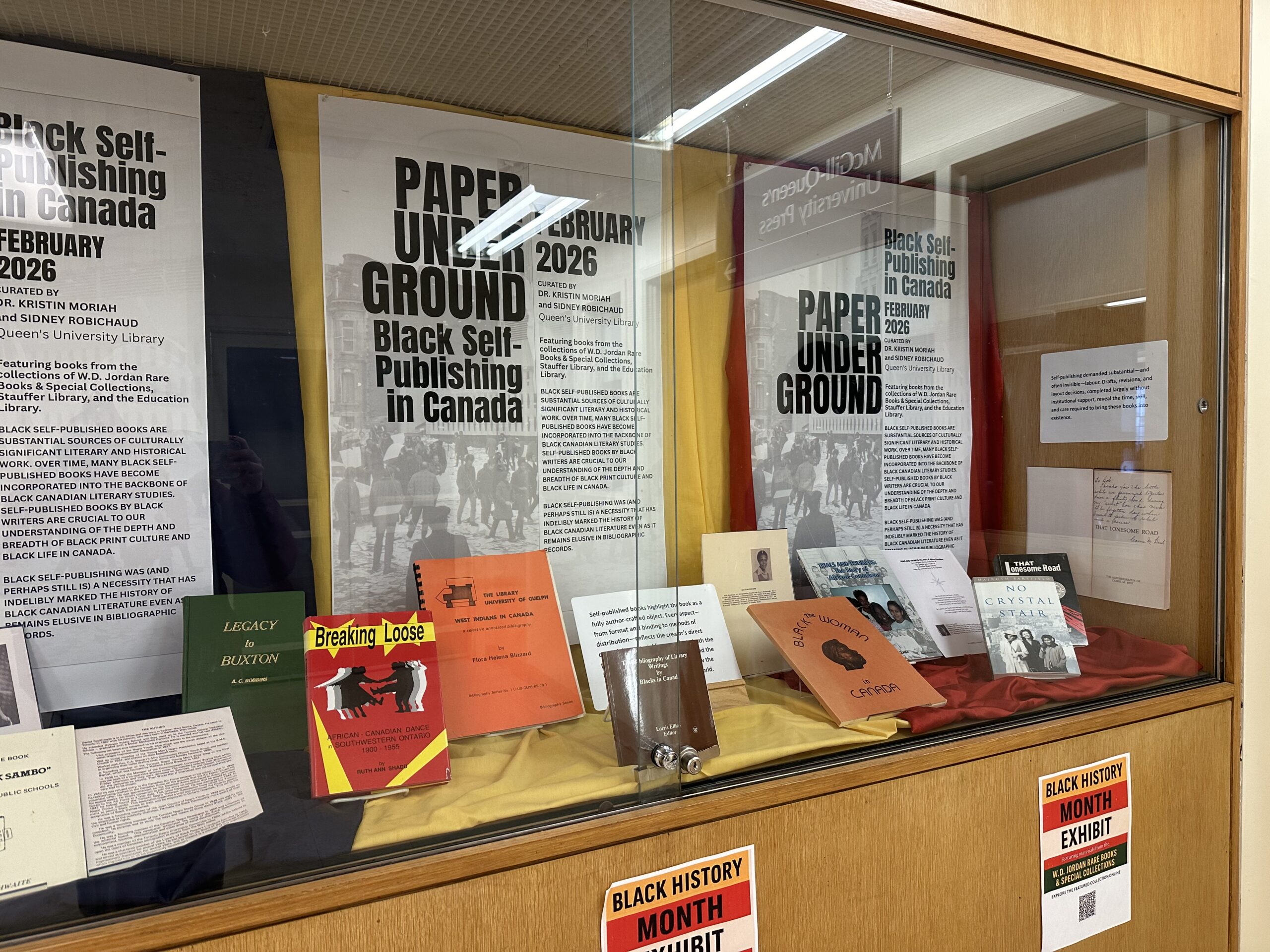
Queen’s Department of English Literature and Creative Writing’s Paper Underground: Black Self-Publishing in Canada exhibition brings that history to the forefront. Curated by Dr. Kristin Moriah and Research Assistant Sidney Robichaud, the exhibition is on display in the W.D. Jordan Library, outside the 1923 reading room, also known as the Harry Potter room.
“I don’t think anything like this display has been mounted in the past,” Dr. Moriah wrote in a statement to The Journal. “The study of Black self-publishing as it relates to black Canadian literature is a relatively unexamined topic in literary studies.”
Dr. Moriah emphasized that within Canadian Black Studies, it’s commonly known major Canadian publishers have only recently begun publishing Black writers’ work. “That doesn’t mean that Black Canadian writers weren’t publishing important work, but that they saw self-publishing as a means of sidestepping mainstream publishing,” she said.
Paper Underground traces a long history of self-publishing in Canada. Dr. Moriah highlighted one of the earliest examples: John Marrant, who in 1785 published the book The Lord’s Wonderful Dealings with John Marrant, a Black (Now Going to Preach the Gospel in Nova Scotia).
The tradition of self-publishing continued well into the 20th century. “We have women like Carrie Best, the author of one of the first Black Canadian autobiographies, That Lonesome Road (1977) who chose to self-publish her work.” Dr. Moriah said. “We have descendants of Mary Ann Shadd Cary, like Ruth Ann Shadd, who go on to chronicle Black life in Chatham-Kent in the twentieth century.” Best’s autobiography, and Ann Shadd’s book, African-Canadia Dance in Southwestern Ontario (1900-1955) (1995) are both part of the exhibit.
The exhibit features books from W.D. Jordan Rare Books & Special Collections, Stauffer Library, and the Education Library.
Bibliographies compiled by Black scholars and librarians are also featured in the exhibition. Moriah noted that these early catalogues treated self-published works as essential rather than peripheral.
“They recognized that self-publishing was central to Black literary studies in Canada,” said Dr. Moriah. “Those bibliographies may not be flashy, but they contain a wealth of information.”
The exhibit runs from Feb. 2 to 27 and is open to all visitors, with no registration required, providing an opportunity for students, faculty, and community members to explore rare and self-published works by Black Canadian authors firsthand.
Dr. Moriah emphasized the collaborative nature of the exhibition. “Working with Sidney Robichaud and the library staff was crucial,” she said. As they identified key texts to display, librarians’ expertise “ensured that the display was both informative and visually engaging,” Dr. Moriah said.
Paper Underground ultimately examines both the historical significance of Black self-publishing and the ways in which libraries preserve these works for future generations.
By bringing these works to light, the display reinforces the value of libraries, scholarship, and collaboration in raising marginalized voices and making their stories accessible.
Tags
black history month, Black self-publishing, books, Library, Literature, Publishing, W.D. Jordan library
All final editorial decisions are made by the Editor(s) in Chief and/or the Managing Editor. Authors should not be contacted, targeted, or harassed under any circumstances. If you have any grievances with this article, please direct your comments to eic@queensjournal.ca.