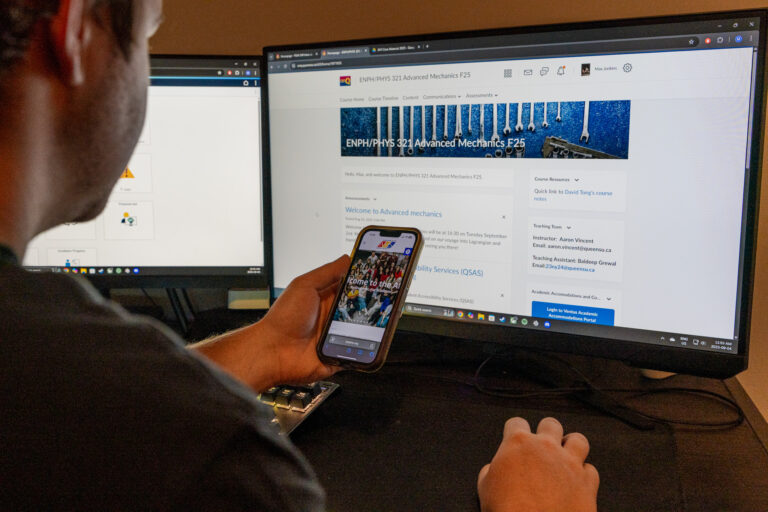
Phones double as alarm clocks, classrooms, and social centres. They’re often the first thing checked in the morning, and the last thing seen at night.
In 2020, Statistics Canada reported that smartphones had become nearly universal among young people: 96.3 per cent of Canadians aged 15 to 24 owned one. 70.6 per cent said they checked their phones every half hour, 75.4 per cent used them before bed, and 20.9 per cent went on their phones during dinner with other people.
In an interview with The Journal, two Queen’s students, Anneka Tracey, Comm ’27, and Rachel Heaney, ArtSci ’26, echoed these habits. Tracey shared that she starts the day with Instagram or Reddit, scanning updates she finds useful, but often scrolling longer than intended.
“I usually get either the best notifications or the most update-worthy information in the morning,” she said. “But in most cases, I’m looking at my phone when I’m supposed to be doing something else.”
Tracey described her phone use as distracting but manageable. “I’m completely aware of and in control of my usage,” she said. “Even though sometimes I get distracted, I can always rein it back. It doesn’t feel like it’s running my life.”
Despite the distraction, Tracey explained that her phone usage hasn’t negatively impacted her student experience or finances. In some cases, she said, it has been practical. “[Apps like] Uber Eats are convenient but expensive, and others save you money. If you’re using the Metro [coupon] app, for example, you can find deals,” she said. “Overall, I haven’t found that my phone makes a difference one way or the other.”
For instance, according to Media in Canada, data reveals that students are the most frequent users of food delivery apps, with 26 per cent relying on them. In 2019, Canadians spent $4.7 billion on online food orders, though 64 per cent reported the cost was too high.
For Heaney, the phone’s tied more to responsibility than leisure. After a summer working full-time in a lab, she said Slack became unavoidable. “Every single one of my clubs and jobs is on there,” she said. “When I get a Slack notification, admittedly, I get a bit nervous—it feels like [work] follows me around wherever I go. It’s hard to separate work and downtime when your phone is constantly buzzing.”
A scoping review of 23 studies across nine countries found that 83 per cent reported a significant link between increased smartphone use for work outside job hours and higher levels of work-life conflict, defined as the clash between demands from home and work that are perceived to be incompatible, making her experience far from unusual.
Beyond Slack, Heaney also relies on Outlook for e-mail, Instagram to stay in touch with friends, and Facebook Marketplace to stretch her budget. “Facebook Marketplace is one of my favourite ways to buy things,” she said. “It helps me find things I could never afford new—like furniture, art, even clothes. There’s a sense of community there too, since you’re buying directly from other people in Kingston, including other students.”
At the same time, Heaney acknowledged the drawbacks of social media. “On Instagram, you’re constantly comparing yourself to everyone,” she said. “Even if you know it’s part of the app algorithm, it’s hard not to measure yourself against it. It can be really discouraging and wear on your self-esteem.”
For both students, phones remain inseparable from how they manage school, work, and daily life. They admit the devices can be distracting but say it’s impossible to give up. “My phone is necessary in so many aspects of my life,” Tracey said. Heaney put it more bluntly: “It’s 100 percent negative—but I couldn’t survive without it.
Tags
Apps, cell phone, Social media
All final editorial decisions are made by the Editor(s) in Chief and/or the Managing Editor. Authors should not be contacted, targeted, or harassed under any circumstances. If you have any grievances with this article, please direct your comments to eic@queensjournal.ca.