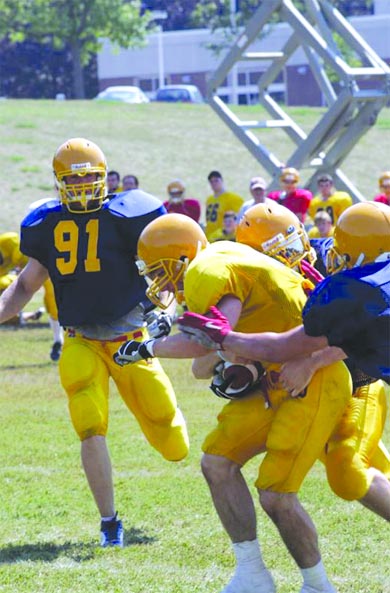
Weeks before most Queen’s students start thinking about going back to the hustle and bustle of Kingston, more than one hundred football players varying in talent and size participate in Queen’s football training camp.
Training camp is a clean slate, a chance for the coaching staff to try new things and to mold each former high school prodigy into the next great thing. This year everything got started on August 22, two days earlier than usual. Ontario University Athletics has recommended extended camp time to decrease the injuries that nag players as the season begins and allow teams to prepare better for the first few games. Training camp for the Gaels spanned 14 days and ended Sunday, the day before the Gaels lost at home to the Laurier Golden Hawks.
The Journal takes an in-depth look into what it is like to go through Gaels training camp with the ups, the downs, the remnants of hurricanes, the pain and the exhaustion. Each player goes through the same process but has a different story to tell.
For 38 first-year students, training camp would be their first difficult experience at Queen’s, but also had the potential to be one of the most rewarding.
On the first day of camp, the students met the coaching staff, received the practice schedule and an overview of what to expect.
From Aug 22 onward, the veterans and hopefuls alike were put through two practices every day, one starting at 8:15 a.m. and the second at 11 a.m. The two practices, each lasting about two hours, were not the only requirements for the players. Each player attended mandatory positional meetings to better prepare them tactically for the upcoming season.
The hopeful rookies lived and breathed football. Unlike the upper year players—who could sleep in the comfort of their own homes—the first years were put up in West Campus. All the first-year players and many of the veterans would start the day together in the West Campus dining hall at 7:15 a.m.
This meant that many of the players living at home woke up every day around 6:45 a.m. to put themselves through brutal workouts in heat that rose above 30 degrees Celsius. After breakfast, the players proceeded to the taping tables where they got their ankles, wrists and other tape-able body parts ready for a day of work, sweat and pain.
After a full morning of practice, in the evenings there was still plenty of work to be done. Each individual had meetings from 4:45 p.m. to 6 p.m. and then again from 7 p.m. until 9 p.m.
Each player reacts differently to the training camp and learns different things from the experience.
First-year quarterback Danny Brannagan came into Queen’s as a highly-touted recruit, with a story well known to Golden Gaels followers. He was a starting quarterback at Assumption High School in Burlington, and then led Team Canada to a championship in the under-19 youth football cup in Jacksonville, Florida. Brannagan had to adjust to being the backup to incumbent Ali Clarkson.
“I was nervous coming in—I didn’t know what to expect,” Brannagan said. “I knew my role was to learn the playbook and work behind Ali.” It can be hard for a star rookie not to be the big shot. All the rookies stay in the same locker room sitting beside guys they have known for less than a week. For Brannagan, some of his surroundings were familiar.
“Coach [Pat] Sheahan has coached me in some games before,” he said. “It is great playing for a coach like him.” Brannagan also focused on the importance of the people around him.
“Guys really want to be at camp,” he said. “People are not coming out just to come out.”
Fellow rookie Jimmy Allin was the starting quarterback for Quinte Secondary School in Belleville, but once he came to Queen’s it did not look like his future was on the offensive side of things. Allin not only switched to a defensive position during camp but switched playbooks, trading in the offensive playbook he had worked so hard to learn for a defensive one.
“Camp was tough—there was lots of stuff to remember,” Allin said. “I wanted to prove to everyone that I deserved to be there.” While learning his new playbook, Allin was expected to overcome physical and mental challenges on the field.
“They are bigger and faster here—I feel like I am at the bottom of the barrel,” he said. “It’s tough playing [defensive back], but all the guys are helpful.” The veterans, on the other hand, also had new challenges. Taylor Morassutti, a former receiver who played two seasons on the offensive side of the ball, trained all summer to enter camp as a member of Coach Pat Tracy’s defence. Morrasutti said he felt that the long camp gave the team a chance to focus on game preparations and getting ready to play the defending OUA champion Golden Hawks. He also stressed that it felt different walking into the locker room as a vet rather than as a rookie. “As a veteran you sit in the locker room with guys that you have played with before, and all the players of like positions are together,” he said.
He said that the atmosphere of the locker room gets the players more excited to go out and practice. For Morassutti part of the excitement was replaced with nerves. Switching to defence led to new challenges and a new coach. “I was a little worried about Coach Tracy,” he said. “He has seen me play receiver, but it is different when you are actually playing for him.” One element which prepared Morassutti to be his best at practice was his relationship with his housemate and teammate Andrew Joyner, a fourth-year receiver.
“It is therapeutic to live with your teammate,” Joyner said. “When you are beat it is nice to have someone to grab a good meal with.” The relationship between football housemates also is conducive to discussion about each other’s play.
“I could help [Morassutti] know what he was doing,” Joyner said.
Joyner was a mentor at practice as well because, as a fourth-year player, he is expected to help the younger players. Without former role models Sean McKinnon and Craig Spear around, he now has to be a leader.
“I try to get people to elevate their game,” he said. “Sean [McKinnon] was a firecracker in practice and Craig [Spear] was really quiet. I try to mold myself as a mix of both those guys.” Joyner, who was recently named a captain, acknowledges the difficulties of camp, but also the merits of it.
“Camp is not fun on your body,” he said. “You are sore and always in pain, yet camp shows that all the work in the gym paid off, that it all came together.” Camp does not get easier for veteran players.
“It is mentally draining,” Joyner said. “It goes beyond football for me. I try to be the best I can, both in school and in football.”
Ian Hazlett, an OUA All-Star and one of the league’s best linebackers, is no stranger to pain. He went through training camp with a herniated disk which had bothered him throughout the summer. Due to the injury Hazlett missed the first week of camp. “It was tough to watch,” he said. “In a way I dread camp but while I was hurt I really looked forward to getting back into it.” Hazlett was eventually cleared by doctors on Aug. 28 and went through camp battling the pain in his back. He was quick to point out that pain is part of the game.
“If you don’t have a bump or bruise you have not played tough enough,” he said.
Toughness is the foremost requirement for any player in training camp. Each player deals differently with the two weeks of camp, and each of the five players profiled displayed different types of toughness. Be it homesickness, pain, frustration, fatigue, or a lack of knowledge of the system, each player fought hard through difficulties and earned the right to call himself a Queen’s football player.
——–
Richard Zussman’s dulcet tones can be heard on CFRC radio covering the Gaels’ football games.
All final editorial decisions are made by the Editor(s) in Chief and/or the Managing Editor. Authors should not be contacted, targeted, or harassed under any circumstances. If you have any grievances with this article, please direct your comments to eic@queensjournal.ca.