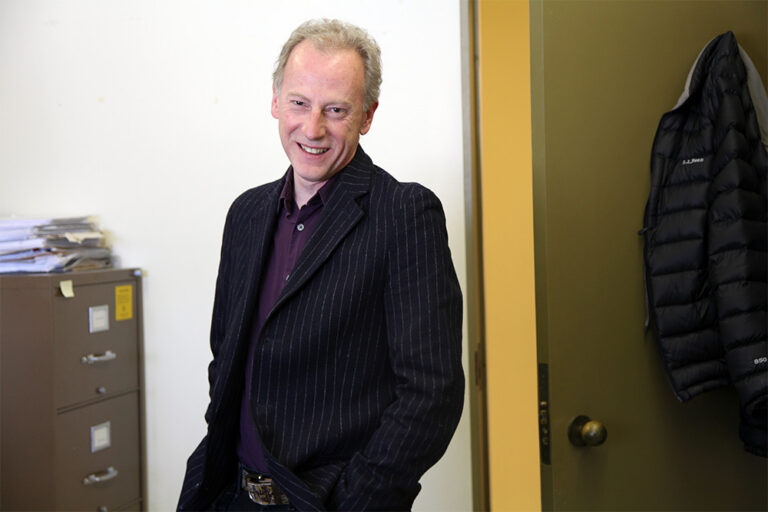
After decades of shaping Queen’s international relations (IR) courses and the IR graduate program, Political Studies professor Wayne Cox is retiring at the end of the 2026 winter semester
Cox began teaching at Queen’s in 2001, where he has opened countless students’ eyes to the world of IR, international political economy, and critical theory. Cox received both his undergraduate degrees in Political Science and History, and his Master’s in Political Science from Carleton University. He later attended Queen’s, where he completed his PhD in Political Studies, researching the Kurdish question in Turkey.
In an interview with The Journal, Cox shared his unconventional path to academia, admitting that he went to school as a backup plan to his aspiring music career, which at the time wasn’t panning out in the ways he had hoped.
“I was a musician and decided I needed a backup plan because you know it’s never a sure thing […] and I kind of thought I need to go to school,” Cox explained.
He shared that at the beginning of his academic journey, he struggled, but in his second year of undergrad, he took a course in IR and found his “calling.” He explained that when he began teaching as a graduate student, it cemented his commitment to academia. Cox added that being a musician shares many parallels to teaching, which he has drawn on throughout his career.
“A good musician practices and rehearses before going on stage,” he said. “The worst thing you can do is walk on stage unprepared. Teaching is exactly the same.”
After arriving in Kingston to pursue his doctorate, about a year into the program, he took a leave to teach at the Royal Military College (RMC). Cox taught full-time at RMC from 1993 to 1999 while finishing his dissertation. During this time, he also taught a few odd courses at Queen’s.
After completing his PhD in 2000, Cox remained at Queen’s, where he was requested to be a replacement professor in 2001, beginning an over two-decade-long career in the Department of Political Studies.
Over the years, Cox became widely known among students for his energetic lectures and deep engagement with IR theories.
Early in his career, Cox co-edited Beyond Positivism: Critical Reflections on International Relations, a book that, according to Cox, has shaped the foundations of IR, the ‘third debate’—a postpositivist theory challenging IR neo-realist and neoliberal theories. Later, he co-authored Locating Global Order, American Power and Canadian Security after 9/11, a book he worked on alongside his first PhD student, calling that collaboration and mentoring one of the most rewarding accomplishments of his career.
Cox shared that teaching and students, rather than publishing, have been the most rewarding parts of his career and are what’ve kept him coming back.
“When you’re teaching, and you’re looking out into the room, and you can see that light bulb go off and the student just gets excited about something, that’s just so satisfying,” Cox stated.
Reflecting on how teaching and students have changed throughout his vocation, Cox shared that technology has been the biggest development, but that the students themselves have “always been really good.”
What has changed, he argued, is the broader structure of universities, noting that underfunding has become an increasingly serious issue. He asserted that financial pressures on universities ultimately affect students and equal access to post-secondary education the most.
He also noted that universities have made important progress in supporting student needs. He pointed to the expansion of accommodations and services as a positive development compared to when he was a student.
Cox himself has dyslexia, a condition he said wasn’t recognized when he was in school. Still, he believes maintaining accessibility and support for students must remain a priority for universities moving forward.
In recent years, Cox has carried a heavy teaching load to help sustain the IR program amid faculty retirements. He has taught as many as six courses a year while supervising graduate students and serving as field convener for the IR graduate program.
He expressed that it has been a taxing workload, but he “loved it,” and after 35 years of academic life, he’s retiring because he wants to go out at the top of his game, spend more time with family, and focus on his music.
Despite retiring, he still plans to stay connected with his field, stating that he has a half-finished book he will continue to work on and isn’t closed off to giving guest lectures.
Looking back on his career, Cox measures success not in years, money, or publications, but in the students who carry the discipline forward.
“If even one of my students went on to have an impact on the field, then my job is done.”
Tags
Academia, international relations, IR, Wayne Cox
All final editorial decisions are made by the Editor(s) in Chief and/or the Managing Editor. Authors should not be contacted, targeted, or harassed under any circumstances. If you have any grievances with this article, please direct your comments to eic@queensjournal.ca.