At Queen’s, a student-run fashion show can be more than a runway.
Established in 2010, Project Red is an opportunity to bring together creative interests while raising money for the Heart & Stroke Foundation. Made up of a collection of students from different disciplines, the club is among the leading student fundraisers for the Heart & Stroke Foundation in Canada. Now in its 16th year, Project Red blends fashion, music, and dance into a single cause: raising money for cardiovascular health research and care.
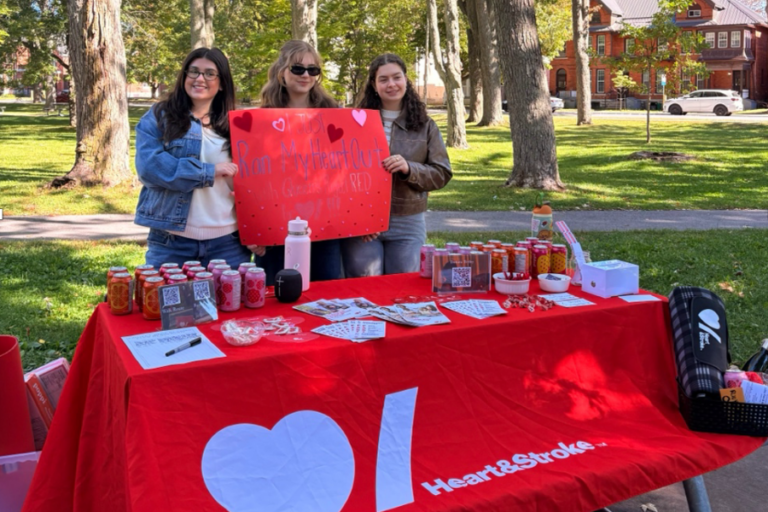
Although the annual fashion show is Project Red’s largest fundraising initiative, the group also hosts events throughout the year. On Saturday, Oct. 3, Project Red held its annual “Run Your Heart Out” fundraiser at Victoria Park where participants could run, walk, or roll along a five-kilometre route in support of the Heart & Stroke Foundation.
As of September 2025, the organization has raised $294,732 for the Heart & Stroke Foundation through its fundraising efforts. According to its co-directors, that value has since surpassed $300,000.
Co-directors Reese Collins and Sam Ruffo, as well as Idea Director Gabriela Lanfranchi, all ArtSci ’27, discussed how Project Red blends creativity and charity in an interview with The Journal.
Collins described Project Red as a collective of students who channel their creative passions into advocacy for healthy living.
“Our biggest fundraiser is the Heart & Stroke Fashion Show. We have a lot of portfolios — model, dance, music — so we use the things we’re interested in to raise money for that,” Collins said.
For the co-directors, the club’s appeal lies in its ability to merge creative expression and charitable work. Lanfranchi commented on the unity and teamwork that fuels the club.
“I feel like we’re all working towards a common goal,” Lanfranchi said. “Everyone has this collective community mindset to help each other and to help others.”
Their annual themed fashion show, held at Grant Hall in February, invites student designers, models, dancers, and musicians for a collaborative production. Members can contribute through performance, design, or behind-the-scenes work, creating opportunities for students to explore interests they might not otherwise pursue at university. This production also emphasizes sustainable fashion, as participants partner with local thrift stores to thrift and reuse materials to create looks ready for the runway.
Lanfranchi pointed to the fashion show as Project Red’s distinguishing feature, which sets it apart from other fundraising clubs on campus.
The directors also explained how effectively the club bridges the gap between the arts and sciences, a quality they see as central to the club’s identity.
“I always found it interesting how we use arts to fund something health related. We use the things we’re passionate about — music, modelling, things like that — as an avenue to raise funds,” Collins said.
All three directors described Project Red as a community built on collaboration, rather than shared skill level or experience.
“I’ve made most of my friends at Queen’s through Project Red, and I’ve been in the club for three years now. It’s just so special to have this shared creativity,” Ruffo said.
Lanfranchi added to that sentiment, pointing to performances by first-year students, including an engineering-student band that took the stage at last year’s show, as proof that the club makes room for newcomers alongside veteran members.
“Last year, we had this band of first-year engineers — they played the whole show, and they did so well,” Lanfranchi said.
For Collins, Ruffo, and Lanfranchi, the allure of Project Red comes from the simple idea that creativity, in any form, brings people together through their shared charitable effort.
Tags
All final editorial decisions are made by the Editor(s) in Chief and/or the Managing Editor. Authors should not be contacted, targeted, or harassed under any circumstances. If you have any grievances with this article, please direct your comments to eic@queensjournal.ca.