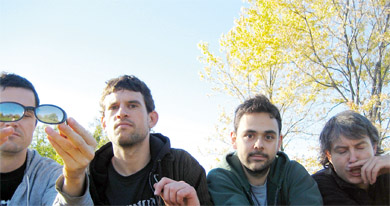
Interview: Propagandhi @ Time To Laugh Comedy Club, Tonight
If you are or have ever been into punk, chances are pretty good you’ve come across Canadian punk legends Propagandhi. Rising from Portage, Man. in the late ’80s, Propagandhi burst onto the punk
scene with a catchy name, ferocious, thrashtinged tunes and the backing of Fat Wreck Chords, owned and operated by Fat Mike of NOFX fame.
Starting with 1993’s How to Clean Everything and blazing on through 1996’s Less Talk, More Rock to 2001’s maelstrom Today’s Empires, Tomorrow’s Ashes, Propagandhi tore through North America, establishing themselves as not only talented musicians and wordsmiths, but also one of the premier politically conscious punk bands on the scene, and a veritable hurricane of live energy. And they managed all of this with tongue firmly in cheek and smiles on their faces.
After a lengthy hiatus, the mighty Westerners launched their newest volley, Potemkin City Limits, in 2005. While the tone of the album is somewhat more controlled than previous albums—delivering its seething rage through clenched teeth—the band is no less concerned about socio-political issues, nor are they any less pissed off. And don’t worry, they’re still smiling.
As the band prepares for their sold-out, early show in Kingston tonight (doors at 7 p.m.), bassist Todd “The Rod” Kowalski claims this more restrained approach wasn’t intentional.
“I think it just happened the way it did I guess, making tunes, and trying to make different textures with the music and whatnot,” said Kowalski in an interview with the Journal.
“The way the lyrics come out, you know, I guess you could say they’re a little more sad or something than [Today’s Empires, Tomorrow’s Ashes’s lyrics].” As for how the record has performed and how they have enjoyed the finished product, Kowalski seems satisfied.
“I think it is what it is—it’s a document of what we were doing at the time I guess, and I think it turned out pretty good. I mean there’s always something you could change but it is what it is and you just go on and make the next batch of tunes.” Kowalski said their tour has been a success so far.
“It has been going really good. The last two shows have been sold out and the other two really well attended. We played four shows in a row that didn’t stink, so that’s probably a first for us, and hopefully Montreal is the fifth,” he said.
“Tomorrow in Kingston, it’ll sound good at least. We’re loadin’ a P.A. up them big stairs, so it better sound good.” Propagandhi’s concern for delivering their fans a quality live show definitely outweighs
their concern for the current state of punk rock.
“To be honest, I don’t really pay attention to it. I like a lot of the smaller bands and I appreciate it but I don’t seek [it] out … “If you try to rehash the old days it’s boring, … and if it’s mellow music I might
as well listen to something from Africa or something—it’d be ten times better sang and better played.”
Kowalski thinks Toronto punk band Fucked Up were mostly correct about the state of punk in a recent interview. Fucked Up claimed that punk was devised as the ultimate marketing tool and the ultimate
commodity, and it wasn’t until the ’80s that people began to redefine its history and do something real.
“Yeah, I’d say that’s sorta right, I think the Bad Brains and whatnot that were inspired or ‘fooled’ by the original marketing ploy were pretty great and honest. As early as 1979 or 1980, when most of those bands started up, they were trying to do something really cool.”
When pressed for what he feels is the most important issue facing us as Canadians and especially as global citizens, Kowalski was quick to respond. “The obvious answer is the environment ’cause we’re all screwed, obviously. I guess, I mean it’s good that it’s in the media a lot … I hope it’s not a little trend everyone’s going through,” he said. “The complete corrosion of the environment is the biggest issue. It’s insane to me. Everything else kinda goes hand in hand, if people can’t wake up to that, they can’t wake up to anything. Who would want to exist without nature? I think if it went that far, to the point that we don’t have nature, we don’t deserve to keep going.”
Finally, grilled about reading material, “The Rod” eagerly plugged Starlight Tour by Susanne Reber and Robert Renaud. A harrowing account of the murder of Neil Stonechild by the Saskatoon Police,
the book provided the basis for the song “Bringer of Greater Things” from the album Potemkin City Limits.
“I’ve been following it for a long time, and now there is the book so it’s really interesting. You see how racist a place like Saskatchewan can be. It’s all true, I know all the streets mentioned super well and one of the people mentioned was actually at my Grandma’s birthday. Saskatoon’s got a huge problem on their hands—one with their police and one with racism.” If you’re lucky enough to have a ticket to the Time to Laugh Comedy Club tonight, you’ll be treated to one of the best live shows in Canada—and hey, you just might learn something too.
All final editorial decisions are made by the Editor(s) in Chief and/or the Managing Editor. Authors should not be contacted, targeted, or harassed under any circumstances. If you have any grievances with this article, please direct your comments to eic@queensjournal.ca.