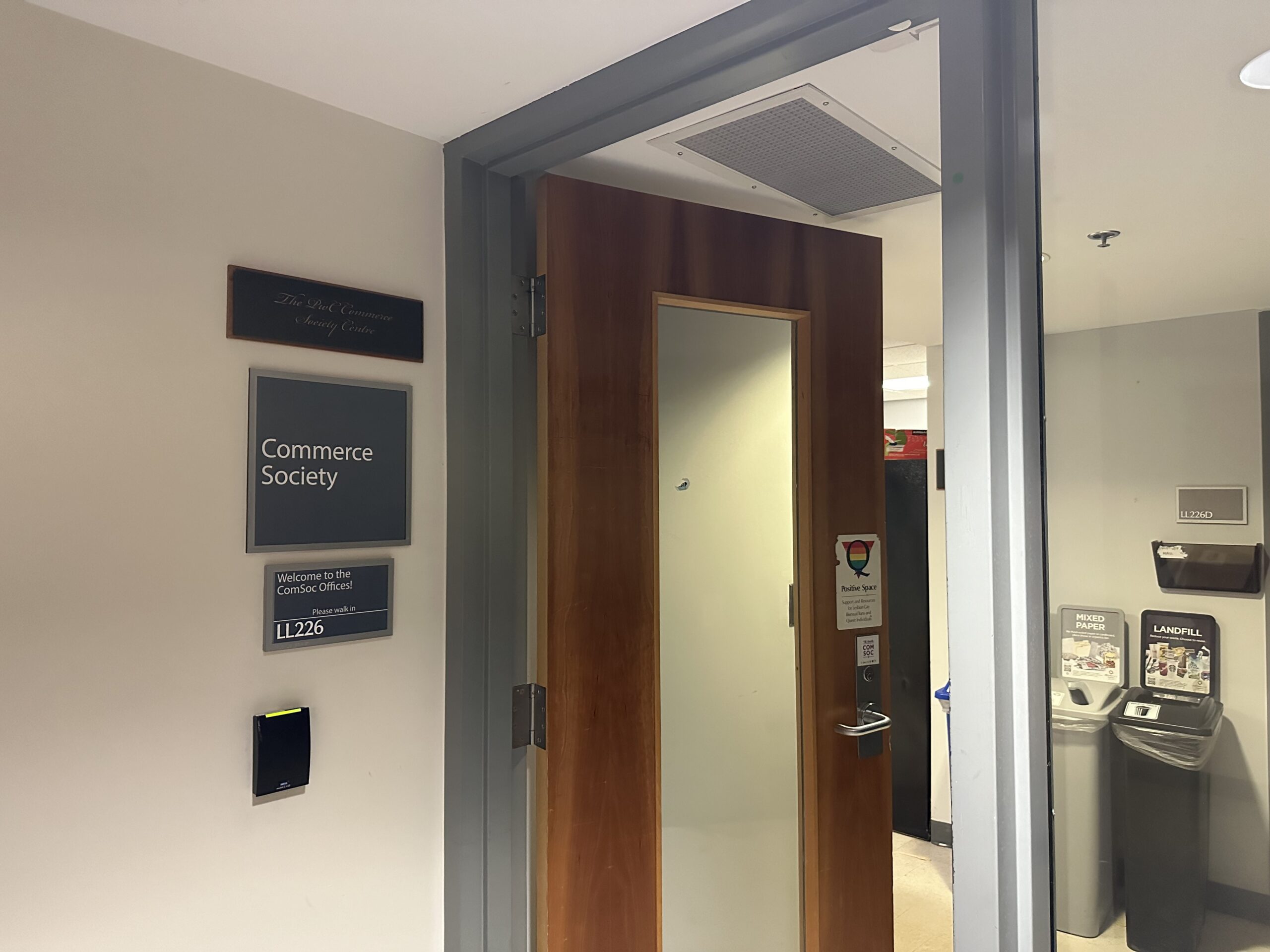
After issues relating to funding received by the Commerce Society (ComSoc), Queen’s Business Review (QBR) members are paying printing costs out of their own personal pockets.
One of QBRs Editors in Chief, Jacob Krajnac, Comm ’27, said the club received just $200 in funding from ComSoc for the production costs of its print this winter—a drop from what they received in print support for previous years. According to Krajnac, QBR has historically received between $2,000 and $5,000 to support the print, which he said typically costs between $3,000 and $4,000.
“This year, instead of a number in any thousand range, we received $200,” he said in an interview with The Journal.
Documents provided by ComSoc to The Journal confirmed the drop. According to the society’s budget records, QBR requested $5,500 for the production costs of its Winter 2026 print launch but was approved for $200. The society also approved $100 for administrative printing costs, $50 for miscellaneous costs, and $320 for food for a launch event.
ComSoc data also showed QBR received $2,300 for its Winter print issue during the 2024-25 academic year.
In an interview with The Journal, ComSoc CFO Alex Chou, Comm ’27, and ComSoc President Prem Mehta-Spooner, Comm ’26, said club funding decisions are determined through a budgeting process managed by its finance team and approved by ComSoc Assembly. Chou confirmed that projected requests from clubs have exceeded the amount available for allocation this year.
According to data shared with The Journal, clubs requested $131,127 in funding during the Fall 2025 semester and $84,809 in eligible funding requests for the Winter 2026 semester, following a change in the club budgeting process.
Chou explained that the total pool of funding available for clubs is calculated from student fees collected from commerce students, minus a reserved portion and the net expenses of ComSoc Assembly.
“When it comes to managing and administering the finances of a Student organization like ComSoc, projections are inherently subject to changing circumstances and evolving realities that can cause actual figures to differ from initial estimates,” Chou wrote in a follow-up statement to The Journal.
In the interview, Mehta-Spooner encouraged clubs to seek diversification of revenue, including through attaining sponsorships, but recognized broader pressures affecting club funding. He explained that the number of commerce clubs has continued to grow, increasing competition for available funds, while sponsorship patterns have shifted in recent years.
“We’re seeing a shift in how sponsors are contributing to our clubs,” he said, noting that firms are increasingly providing expertise and other non-monetary offers rather than direct financial contributions.
He also said funding decisions consider several factors, including the feasibility of requests, previous spending patterns—though he noted that historical spending alone doesn’t justify an expense—and ComSoc’s overall operational capacity when allocating funds across more than 55 clubs.
For QBR, the impact of this funding is immediate. Krajnac said $200 is nowhere near enough to produce the club’s print edition, even after efforts to reduce costs.
“We continue to take steps to decrease any and every cost associated with the event of the print launch and of the print itself. But, with $200, there’s no amount of expense reduction that will allow us to print even one copy.”
He said the club has already explored multiple vendors and formats in an attempt to lower production costs.
“We have checked with multiple vendors. We try different formats. This is the cheapest we can do,” he said.
In an effort to receive funding, QBR brought a motion to ComSoc Assembly on Feb. 23 under the Student Venture Fund, which allows clubs and students to apply for monetary support for their initiatives.
According to an e-mail sent from Mehta-Spooner to Krajnac, which was shared with The Journal, QBR requested funding for 66 printed copies to meet the accessibility requirement under the funds policy that states at least three per cent of Commerce students receive the project’s direct value. The estimated cost for this quantity, using the current supplier, was $2,622 and was presented as the minimum needed to meet that threshold through printed copies.
Despite this, during the voting period, QBR accepted an amendment to reduce its request to $750. It was suggested that QBR look into alternative suppliers, adjust their page length or format, and use other methods to reduce costs. Ultimately, QBR still didn’t pass their funding request.
Now, Krajnac says the club’s moving forward by paying the print cost out of their own personal pockets, cutting two-thirds of their planned print, and ultimately paying $1,800 without external funding.
Tags
Club funding, commerce society, ComSoc, funding, QBR, Queen's Business Review
All final editorial decisions are made by the Editor(s) in Chief and/or the Managing Editor. Authors should not be contacted, targeted, or harassed under any circumstances. If you have any grievances with this article, please direct your comments to eic@queensjournal.ca.