As the National Day for Truth and Reconciliation approaches, the Queen’s Varsity Leadership Council (VLC) reflected on their role in advancing reconciliation in sport.
Since 2015, the Government of Canada has been working to implement the Truth and Reconciliation Commission’s Calls to Action related to sport (87–91). From Sept. 20 to 28, OUA marked Anti-Racism Week under the theme ‘We Are One’ highlighting ongoing efforts to address inequities within athletics. In line with these initiatives, The Journal spoke with VLC Co-President Chris Zimmerman about how Queen’s athletes are approaching reconciliation ahead of the National Day for Truth and Reconciliation (NDTR).
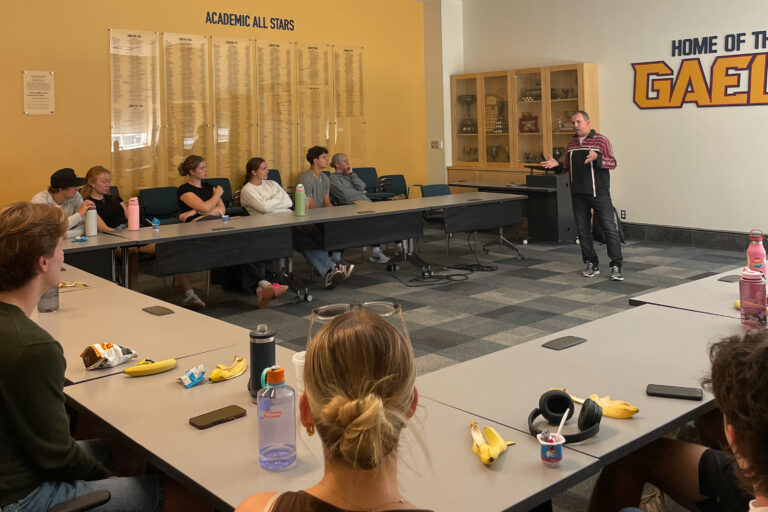
On Sept. 24 from 12 p.m.-1 p.m., student athletes had an open-invite to attend a Lunch & Learn which aimed to connect reconciliation efforts directly to athletics with Jamie McCourt, coach of the 2014 North American Indigenous Games, and conductor of summer camps with the Tyendinaga community. According to Zimmerman, around 35 student-athletes attended the Lunch & Learn.
“We got in touch with [McCourt] because the women’s basketball team works at this summer camp that he puts on,” Zimmerman said. He explained that this year, the VLC wanted a more interactive and connected to sports speaker, that could help provide athletes with information on how they can contribute to reconciliation from an Indigenous member of the sports community.
During the event, the main focus of discussion was each athlete sharing their personal connection to and first memories of sport. “This is something [McCourt] really works to do in his community, is give kids, especially Indigenous youth, a positive first experience with sport which directly ties into the Calls to Action,” Zimmerman said.
For Zimmerman, the importance of reconciliation work in athletics is rooted in his own experience growing up in Prince George, a small town in northern British Columbia which he explains has a significant Indigenous population.
“I’ve worked for Engage for Work, which is a non-profit, and that’s a lot of the work that we do — finding ways to provide resources by going into schools,” Zimmerman said. “We do free summer programming, and it’s about being present in the community in a place you can just walk to.”
Zimmerman described the importance of breaking down barriers to sport for children who may not otherwise have access. “We’d advertise at elementary schools or walk around neighbourhoods and knock on doors and say, ‘Hey, next Wednesday, we’re going to be at this park if you want to play some sports, just try it,’” he said. “Providing these things without any barriers is so important—and people come. Kids want to do that stuff. It’s just about giving them the opportunity.”
At Queen’s, Zimmerman acknowledges that conversations about representation and inclusion can be more difficult. “I mean, as you know, Queen’s is a pretty white school, and I think it’s always a struggle for us to even think about these things and figure out how to have representation in the right ways,” he said. “You don’t want to do things performatively, and I think something that Queen’s and the OUA as a whole does is some performative allyship. I always hope for more inclusion of those voices.”
He said having Indigenous voices like speaker McCourt involvement in sports programming is essential. “Having Jamie there today is so important to us because it’s not like we’re getting a lecture from just anyone—it’s someone who’s working in Indigenous sport,” Zimmerman said. “It would be cool to see the OUA include more of those voices. I know they did a lot of work on their strategic plan in the last couple of years, but making sure voices are present not just around Sept. 30, but all year, is something we should be thinking about all the time.”
Zimmerman said the VLC’s focus on reconciliation is a relatively new development. “I’ve been on the [VLC] executive for the past two years, and before that I was just a general rep, and I don’t remember anything like this happening even two years ago,” he said. “Last year, I was the Vice-President of Community Outreach, so I coordinated last year’s event, and it was really important to me because my assistant coach is Métis and our team does a ton of work around reconciliation.”
He added that efforts are now more sustained and intentional. “We actually do this kind of work all year too—it’s not just a September thing,” he said. “It was really important to me to have this be at the forefront of the VLC’s work. And I think that it’s now a reason that’s pre-existing. We’ve got it in our transition manuals, like, ‘Okay, these are the contacts, these are the people to reach out to.’”
Zimmerman hopes more teams will follow the lead of women’s basketball in engaging directly with communities. “I’d love to see more teams doing what women’s basketball does—helping with camps, going into the community,” he said.
On Sept. 30, Zimmerman says students should watch for the release of a video collaboration with the SHIFT Project, and notes that athletes will take part in the Sacred Fire at 1:00 p.m. to 2:30 p.m. E.T. at Agnes Benidickson Field.
Tags
Chris Zimmerman, Jamie McCourt, National Day for Truth and Reconciliation, Varsity Leadership Council
All final editorial decisions are made by the Editor(s) in Chief and/or the Managing Editor. Authors should not be contacted, targeted, or harassed under any circumstances. If you have any grievances with this article, please direct your comments to eic@queensjournal.ca.