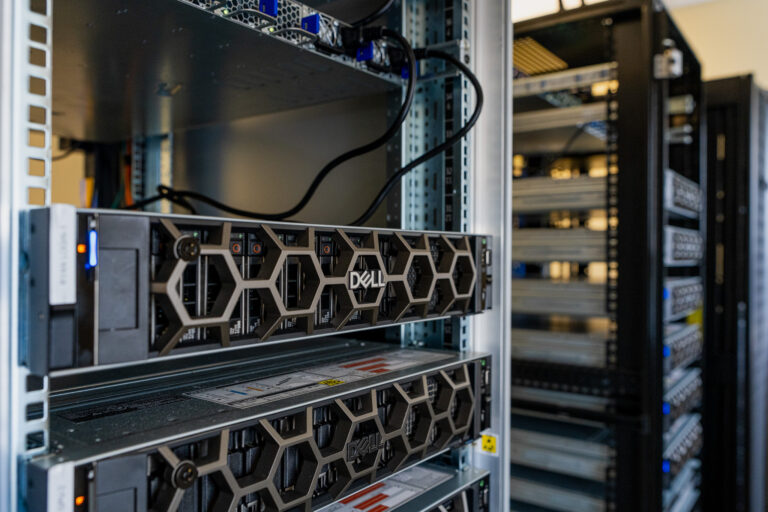
Advanced supercomputing infrastructure may soon be coming to Kingston following a new agreement between Queen’s and Bell.
Queen’s is advancing its role in Canada’s supercomputing and Artificial Intelligence (AI) landscape through plans for a national supercomputing facility and the hiring of new industry expertise. That effort includes the recent appointment of Ian Karlin, an assistant professor with prior experience at NVIDIA and Lawrence Livermore National Laboratory. A memorandum of understanding (MOU) was also signed between Queen’s and Bell supporting the bid to host the facility in Kingston, announced on Dec. 15.
“I wanted to move back into research, and this was kind of the right opportunity at the right time,” Karlin said in an interview with The Journal. “I knew what was being built and worked on here.”
Karlin said his role at Queen’s includes teaching and research, with a focus on applying advanced computing systems to real-world problems.
“I tend to approach a lot of my research from an application perspective,” Karlin said. “What are people actually running on the machine, and using that to motivate how you make it go faster and how you improve their quality of life?”
Strengthening expertise through industry experience
Karlin said his experience in industry informs how he works with students and approaches research.
“It enables me to talk to them [Queen’s students] about what careers could look like,” he said.
Ryan Grant, professor in electrical and computer engineering and head of Computing at the Extreme Scale Advanced Research (CAESAR) Laboratory, said bringing faculty with industry experience into the classroom benefits students.
“All of us who’ve spent some time outside of academia have seen how those things work,” Grant said during an interview with The Journal.
The proposed supercomputing facility
Alongside Karlin’s arrival, Queen’s has signed an MOU with Bell as part of a federal application to host a national supercomputing facility. According to Grant, the project is contingent on Queen’s being selected for funding through a federal program investing up to $926 million in AI and computing infrastructure.
“If we get selected, the facility that we’ll be bringing to Queen’s is two parts,” Grant said. “There’s the building that’s special for the computer, and then there’s the computer.”
Grant said the goal is to house what he described as “a top 10 world supercomputer,” capable of supporting research at a national scale.
“This isn’t a Queen’s supercomputer,” Grant said. “It’s a Canadian supercomputer.”
Bell’s role and sustainability
Under the MOU, Bell would be responsible for the physical infrastructure of the facility.
“What Bell is responsible for in the MOU is building the actual bricks,” Grant said. “What we’re responsible for is designing, building, operating, maintaining, and helping users with a large supercomputer that goes inside that building,” Grant said.
Grant said this division allows Queen’s to prioritize computing power.
“Bell building us a facility means that we can spend more money on chips,” he said.
Grant emphasized the proposed facility would be designed to be environmentally responsible.
“Large supercomputers use water in loops. They don’t consume and throw away water,” he said. “The electricity that you feed into a large supercomputer turns into useful compute, and the by-product is heat.”
Impact on students and campus life
While the facility would serve users across Canada, Grant said hosting it at Queen’s would benefit students directly.
“Having it at Queen’s will present opportunities for research and working with Canadian technology companies and students to work with the centre,” he said.
He emphasized the facility would also support interdisciplinary work.
“Some of the people who use this system are social scientists and philosophers, all the way over to AI professors,” Grant said.
Why supercomputing matters
Supercomputers differ from traditional data centres by applying thousands of processors to a single problem.
“A supercomputer is taking hundreds or thousands of GPUs and applying them all together on one problem,” Grant said.
Grant pointed to examples ranging from pandemic modelling to medical research.
“One of the world’s top 10 supercomputers found the six-foot rule for COVID,” he said.
He added that supercomputers are essential for work in fusion energy, climate modelling, advanced materials, and engineering design.
“These are the things that building large supercomputers unlocks,” Grant said.
Looking ahead
Grant said hosting the facility would attract additional experts, collaborators, and guest speakers to campus.
“It will act as a force multiplier,” he said. “It enables a lot more classes to be taught in this space.”
Ultimately, Grant said the initiative is about supporting innovation at both national and global levels.
“We’re focused on supercharging Canadian research today, as well as Canadian industry,” he said. “And then unlock these new wonderful technologies in the future that help solve global problems.”
Tags
artificial intelligence, Bell, Research, Supercomputing
All final editorial decisions are made by the Editor(s) in Chief and/or the Managing Editor. Authors should not be contacted, targeted, or harassed under any circumstances. If you have any grievances with this article, please direct your comments to eic@queensjournal.ca.