Queen’s is doubling down on its nuclear ambitions with a new research institute.
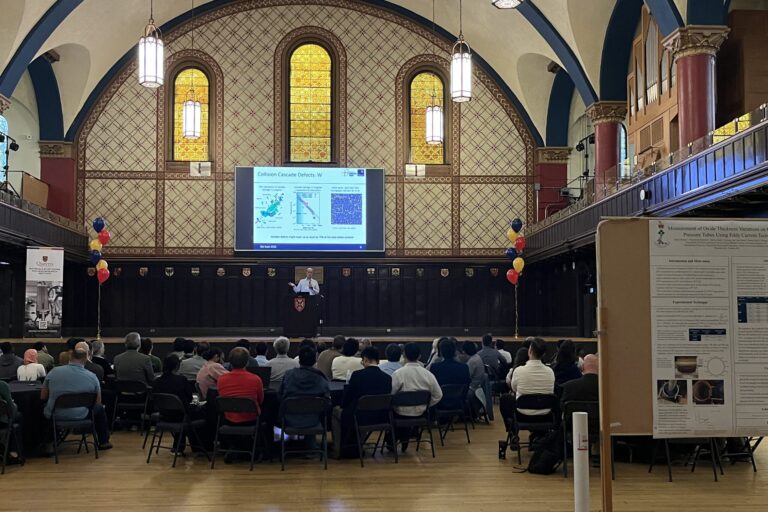
The Materials at Extremes (MAX)-Nuclear Institute was officially launched on Oct. 1 with a full-day reception including three presentations from guest speakers and a research poster day at Grant Hall.
The institute gained approval in March 2025 and appointed Mark Daymond, NSERC/UNENE Industrial Research Chair in Nuclear Materials and Canada Research Chair in Mechanics of Materials as the inaugural director for a term of five years in September 2025.
It brings together 14 core faculty members, 11 from Queen’s and three from Royal Military College (RMC), and two associate members at Queen’s, as well as 52 graduate students and 22 postdoctoral students.
“There’s been a long journey to establishing nuclear materials as a strength at Queens,” Daymond said in an interview with The Journal.
The journey began in 2002 when researcher Rick Holt started the nuclear materials group and led the Reactor Materials Testing Laboratory (RMTL) project until his retirement in 2012. It was then taken over by Daymond and opened in 2015.
The cutting edge $17-million-dollar facility allows researchers around the world to test interactions between nuclear materials using an accelerator, with a high degree of control over conditions like temperature and stress.
Over time, the number of faculty, students, and equipment gradually grew, creating enough momentum to move forward with an institute, he said.
“Becoming a tier-1 institute at Queen’s raises our profile [and] gives us an opportunity to speak with one voice,” Daymond said.
As a tier-1 research institute, it will join the Arthur B. McDonald Astroparticle Physics, Carbon to Metal Coating, and Sinclair Cancer Research Institutes.
The RMTL group’s work is highlighted under Queen’s Strategic Research Plan, and recognized for advancing the University’s contributions to UN sustainable development goals.
Graeme Cook’s, Sci ’27, enthusiasm was palpable as he spoke to The Journal about his research in Daymond’s lab.
“My research pertains to characterizing the radiation that we deliver to material science researchers,” he said.
Cook’s project focused on designing a system to measure and numerically characterize RMTL’s proton beam for materials research.
One of the highlights of the full-day reception was a guest lecture about “armour for fusion reactors,” which is “one of the most important questions we could possibly solve,” Cook said.
“That is a pure materials issue because if we can’t line the inside of the reactor with something strong, we can’t run them,” he explained.
The speakers included William Cook, head of the University of New Brunswick’s Centre for Nuclear Energy Research, and Felix Hofmann, a nuclear researcher at Oxford, as well as Matthew Poloni from Ontario Power Generation.
Kiana Fong, a graduate student at RMC, studied “copper corrosion and the effect of hydrogen absorption in copper for purposes of nuclear fuel waste management in Canada,” she said in an interview with The Journal.
Fong is pursuing a master’s in chemistry and chemical engineering in Lindsay Grandy’s lab, who is a member of the institute and manages RMC’s Slowpoke-2 Nuclear Reactor.
In a deep geological repository, used nuclear fuel bundles would be sealed in copper-coated carbon steel containers, surrounded by bentonite clay to limit groundwater from getting in, and buried roughly 600 metres underground, Fong explained.
“Once those nuclear fuel-based containers that are copper coated go into the ground, they’re supposed to last hundreds of thousands of years,” Fong said. “We want to make sure that it’s safe […] because if the copper does corrode while it’s in the said deep geological repository, what’s going to happen?”
While the institute maintains strong industry ties and funding, Daymond emphasized “the key contribution from university research is typically in terms of underpinning mechanistic understanding of what’s happening.”
This is increasingly important as the industry looks to deploy new reactor designs including fusion reactors and modifications to existing ones, given the sector’s penchant for caution and safety, he explained.
“As we look to very long lifetimes of reactors or new designs of reactors, there’s going to be more research to be done,” Daymond said.
Tags
laboratory, Nuclear, Reactor Materials Testing Laboratory, science
All final editorial decisions are made by the Editor(s) in Chief and/or the Managing Editor. Authors should not be contacted, targeted, or harassed under any circumstances. If you have any grievances with this article, please direct your comments to eic@queensjournal.ca.