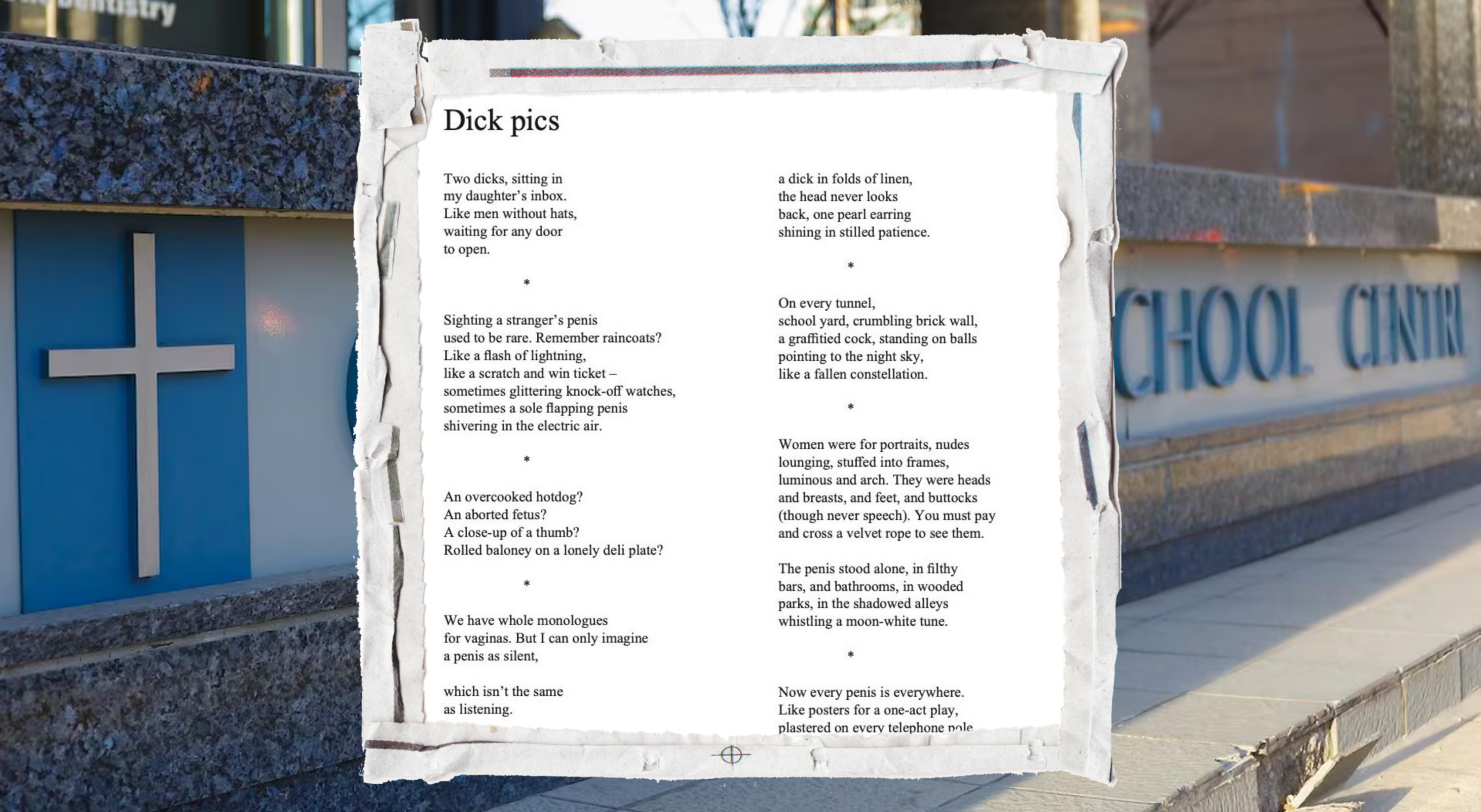
What began as a Calgary-based regional poetry recitation quickly evolved into a censorship controversy that has captured national attention.
Josephine Trigg, a Grade 12 student at Bishop Carroll High School—a Catholic school in Calgary—prepared to recite Queen’s Creative Writing professor, Sarah Yi-Mei Tsiang’s feminist poem “Dick Pics” for the regional Poetry in Voice competition. Despite support from her parents and her English teacher, Tyler Perry, her school administrators forbade her from performing the poem at the recitation because of the poem’s explicit language regarding penises.
The Calgary Catholic school’s decision to ban the poem from the Poetry in Voice recitation has sparked conversation surrounding the importance of intellectual freedom and the rising trend of Albertan censorship that, in this case, directly correlated with Freedom to Read week on Feb. 22 to 28, which is an annual week dedicated to Canadian’s freedom of thought and expression.
Poetry in Voice is a Canadian charity founded in 2010 that encourages students to memorize powerful poems and recite them in various school-based competitions. Trigg has been involved with Poetry in Voice contests for the past three years. Every year, Trigg, a self-identified feminist, chooses a poem about women’s rights and/or sexual harassment. When she found Tsiang’s poem, she knew it was one the audience simply couldn’t ignore.
“Every single year that I’m on the stage, I feel as if I’m whispering into the microphone. It’s a school setting, people aren’t necessarily listening, they’re not grasping the intensity of the poem, but when I read this poem, whether you like it or not, it’s impossible to ignore. This was a way that I felt I could shout my message into the audience,” Trigg said in an interview with The Journal.
Tsiang’s “Dick Pics” is a poem about sexual harassment in the digital age. In the poem, she compares penis pictures to “overcooked hotdog” and “rolled baloney on a lonely deli plate.” Tsiang concludes the poem, writing “you have to push through piles of them/great snowdrifts of dick,/just to reach across the room/and tuck a stray hair/back into your daughter’s braid.”
Inspiration for the poem came to Tsiang when her 15-year-old daughter told her that her friend had been sent penis pictures by two older men. “[While writing this poem,] I was trying to balance that ambivalence of the feelings of alienation. Both when you receive [a dick pic], and you feel alienated from yourself and society, [but I also wanted to capture] the feelings that you have as a mother when you realize that you have so little control over what is happening to your child. You have that desire for closeness and that desire to not let anything like that come between you, and you’re trying to balance that,” Tsiang said in an interview with The Journal.
However, after Trigg performed the “Dick Pics” at her school finals—moving forward to the regional round—Trigg was told by the school principals that she wouldn’t be allowed to recite the poem because of its inappropriate language.
“In our Catholic schools, we also have a responsibility to ensure that language used in school settings reflects the values of our faith-based learning community and age-appropriate. In this instance, school administration reviewed the poem “Dick Pics” by Sarah Yi-Mei Tsiang and determined that it contains explicit language, which wasn’t appropriate to be presented in a setting where children and families would in attendance and the student would be representing the school,” said Calgary Catholic School District in a statement to The Journal.
The school board mentioned that their decision was “based on the language used in the piece, not on the importance of the topic itself.”
Trigg believes the two of these are inseparable.
“Whether it’s the language or the children in the audience, censoring the words will censor the message. We need them to understand that no matter their argument, they’re still censoring a message about sexual harassment,” Trigg said, mentioning that not exposing the youth to these conversations leaves them vulnerable.
As well, Tsiang defends the language of the poem, citing that it intends to subvert the gendered discussions that have become normalized within our society.
“The poem is talking back to the vulgar way in which we talk about women’s bodies…, It’s interesting because so much has been said about the language in this poem, how the language is offensive and vulgar, but people talk about women’s bodies all the time, and nobody bats an eye. There are no slurs in this poem. There are no swear words in this poem,” Tsiang said.
“This is just a description of male genitalia, and the male principal and district supervisor were so uncomfortable with it that they had to shut it down because they can’t stand being described this way. I think it’s really interesting that the reaction by men has been so visceral because they haven’t had that boundary crossed for them,” Tsiang continued.
Within the poem “Dick Pics,” Tsiang writes that women are “breasts, ass, and feet (though never speech),” drawing attention to the trend of silencing women.
Because Trigg found the poem so powerful, she knew she wasn’t going to accept the censorship without a fight.
“If we’re not willing to speak out about book banning and freedom to read and intellectual freedoms, we’re in a really poor position. I think this is an issue that anybody who is interested in intellectual freedom should be speaking out against,” Tsiang said.
For Isabelle Larose, Trigg’s mother, who is a French teacher at a French-language school board in Calgary, the censorship was disappointing, but initially presented itself as an opportunity for productive discourse and learning.
“I truly believed [the barring] would simply lead to a conversation. This was a national contest with vetted material. I assumed that once the poem’s meaning, its intention, and its context were explained, any discomfort would be resolved through dialogue. But when I realized the poem wasn’t just being questioned, it was going to be banned, my heart sank,” wrote Larose in a statement to The Journal.
“As a parent, watching your child pour courage and vulnerability into her art, only to see it silenced, is incredibly painful. I began asking for answers. I wasn’t combative. I genuinely wanted to understand,” Larose said.
Both Larose and Tsiang noted that the administration wasn’t responding to their inquiries, instead the school was prioritizing answering media requests.
“Why can [they] not intellectually engage with us and talk about the reasons behind those decisions?[…] They’re supposed to be in charge of education and they’re refusing to engage in critical discourse,” Tsiang said.
Up until the very last day before the regional recitation, Trigg and Larose held on to hope that the administrators would amend what Trigg calls their “knee-jerk reaction” to the poem.
Both Trigg and Larose noted that in the same competition a poem called “Embarrassed” was performed. In the poem, there’s explicit language such as “billboard of tits,” “breasts,” and “shit.” Trigg believes that “Embarrassed” was acceptable because the language discusses women’s bodies, not men’s, and society is ultimately more comfortable with that.
“[Dick Pics] definitely changes the narrative. It attacks people who are in power, and those people stay in power by dismissing the subjects that could take them out of it. In the case of “Embarrassed,” we’re used to talking about a woman’s body as if it’s a piece of art and in a degrading way as well […] but to talk about a penis this way, changes the narrative and makes them really uncomfortable,” Trigg said.
Larose reached out to the school board to discuss the double standard but was met once more with dismissal.
“I wasn’t trying to diminish the other poem; it’s powerful and deserving. I was trying to understand why one form of bold expression was celebrated and another censored. It felt like a double standard. And no one was willing to engage in that conversation,” Larose stated.
Larose said the decision left her reflecting on the competition’s outcome and how these different forms of expression were received.
“In the end, “Embarrassed” won by a landslide, beautifully performed by a strong young girl, in a Catholic school within the same board. And I applauded her. But I also can’t help believing that Josephine’s poem could have stood there too, not in opposition, but alongside it. Strong girls speaking up, together. Instead, her work was removed before it even had the chance,” Larose stated.
The decision to bar Trigg from reciting the poem took place during Freedom to Read week, which Chief Librarian at the Kingston/Frontenac Public Library Central Branch, Laura Carter, emphasizes is a week for Canadians to celebrate and reaffirm their commitments to intellectual freedom and freedom of expression.
“The tension around censorship in Alberta is still very real and very palpable. We’ve recently witnessed how quickly decisions about banning books can escalate into public debates, and how much public pressure it took for the government to reconsider and step back…The public attention, in some ways, felt necessary. Conversations about censorship only move forward when people are willing to look at them honestly. If anything, this moment reminded me that we have to remain vigilant. The narrative against censorship isn’t abstract, it affects real students, real classrooms, real voices,” Larose stated.
The Government of Alberta under the leadership of Conservative Party Premier, Danielle Smith, has been increasing literary censorship with their recent revision policy banning “sexually explicit” books from schools. Over the most recent winter break alone, Calgary school boards pulled 44 books from the shelves. Alberta’s censorship has been condemned by The Writer’s Union of Canada, BC Teacher’s Foundation, the International Publishers Association, and more, for specifically targeting the 2SLGBTQ+ community with the books that they’re banning.
Laura Carter, the Chief Librarian at the Kingston/Frontenac Public Library Central Branch has noticed this American trend is trickling over to Canada as well, particularly in Alberta. She notes that when it comes to censorship, books and literature surrounding gender and sexuality are disproportionately targeted.
“[Censorship] is a problem we’ve been facing in libraries for a long time. People have always tried to limit what other people are reading, but we’ve seen a huge increase, particularly in the United States, but also in Canada, on books that are either featuring or aimed at 2SLGBTQ+ audiences,” Carter said in an interview with The Journal.
To combat this polarization, she mentioned how the library’s displays try to expose people to different perspectives to offer learning opportunities.
“Libraries are valuable for bringing people together to have conversations and be exposed to points of view that maybe [we] wouldn’t because our social media feeds are basically just validating our opinions and beliefs. We’re all very quick to dismiss somebody with a dissenting belief as stupid, and I think it misses the chance to try and understand each other better, even if at the end of the day we’re not going to agree,” Carter said. “The role of the library is to make the ideas and the books available to people and then readers can make their own decisions.”
Rather than being discouraged, Trigg, Tsiang, and Larose encourage people to continue speaking out, amplifying women’s voices, and fighting for intellectual freedom.
“[Canadians] don’t tend to let things spiral that far. Public pushback matters here. Artistic freedom, especially when it comes to speaking about sexual harassment shouldn’t be something we silence. Not after MeToo. Not after Epstein files. We’ve seen an incredible wave of strong girls and young women finding their voices. Trying to muzzle them doesn’t make the issue disappear, I like to think it just amplifies it. If this small protest contributes to keeping that conversation alive, then it’s a small but meaningful win,” Larose stated.
Despite the frustration of the situation, Tsiang, Trigg, and Larose are reminded of the power of art to make change, to provoke, and to inspire.
“As a mother, what stayed with me most was not the controversy. It was watching my daughter navigate disappointment with more grace and integrity than many of the adults involved. That is what broke my heart and also what made me the most proud. There’s a poem to write about that!” Larose stated.
Finally, Tsiang used this situation to write a brand-new poem regarding the situation that she hopes will be included in future Poetry in Voice competitions as an alternative for when pieces are banned.
The poem has been attached below:
“While the poem addresses serious and important issues, our responsibility is to ensure that content shared in school environments upholds the dignity of the human person,” Calgary Catholic School Board.
I get it. These men, unnamed but
let’s call them Steve or Dave,
have been good Catholic boys
all their lives. They’ve confessed
properly, with a priest, and not
with a poem. They’ve married
women who want to be pleasing
to men. How can they bear
the vulgar they ask,
closing the incognito tabs in
their browsers. Meanwhile,
the world is stained-glass
shards. Meanwhile girls
are deleting unsolicited
pictures, while grown men
reach down their throats
to remove their words.
I can’t say the words
but the men can hold them
in their tight fists, still bloodied
from a girl’s slapped mouth.
Let us live in beauty they say
and all the girls, row on row,
learn silence as beauty
and not violence.
Tags
book ban, Controversy, Explicit language, Poetry, Poetry in Voice
All final editorial decisions are made by the Editor(s) in Chief and/or the Managing Editor. Authors should not be contacted, targeted, or harassed under any circumstances. If you have any grievances with this article, please direct your comments to eic@queensjournal.ca.