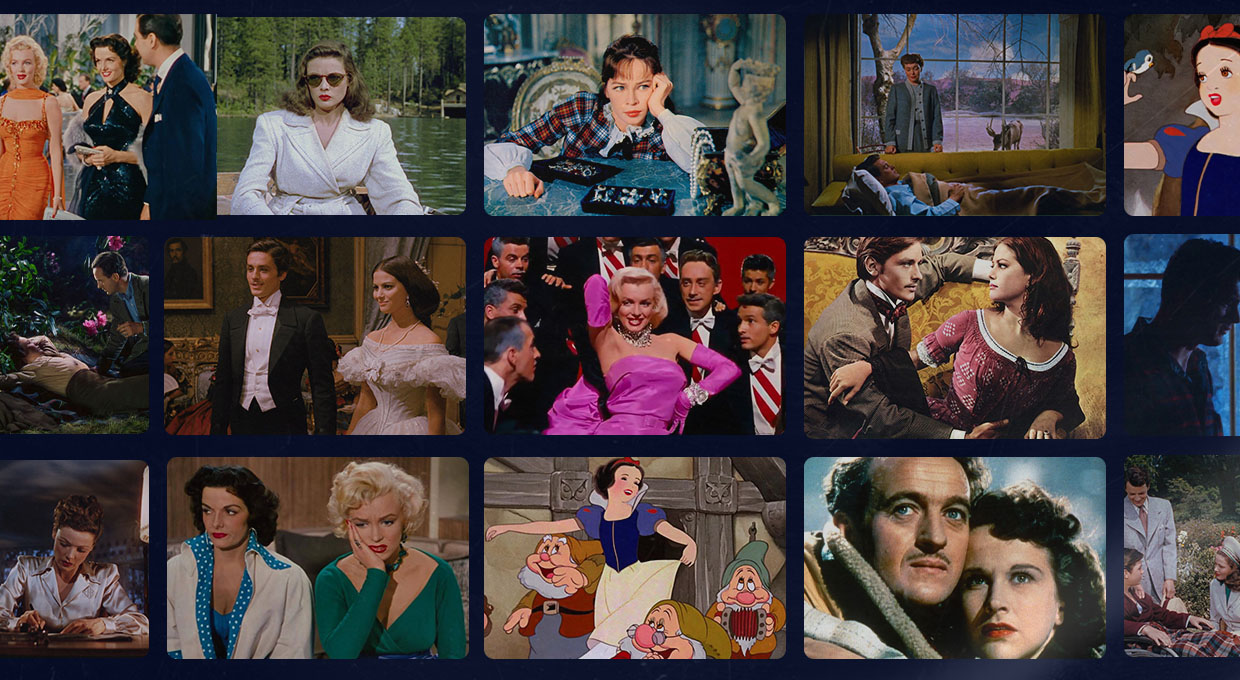
The Screening Room’s about to embark on a seven-week long journey through the world of Technicolour, celebrating of the wonderful medium of filmmaking.
Adam Cook, ArtSci ’26, Hilary Jay, ArtSci ’26 are phD candidates in the Film and Media department. They teamed up with The Screening Room to curate a collection of seven Technicolour films they feel encapsulates everything there’s to love about the golden age of cinema. Films begin screening each Tuesday at 6 p.m. and will be shown from time to time throughout that week. The films being screened are: Gentleman Prefer Blondes (1953), A Matter of Life and Death (1946), Snow White and the Seven Dwarves(1938), The Leopard (1963), All that Heaven Allows (1955), Leave Her to Heaven (1945), and An American in Paris (1951).
Technicolour films were a short-lived, but memorable era in the history of Hollywood cinema. Utilizing an innovative and expensive three colour strip technology, the filmmaking technique produced some of the most mesmerizing and visually stunning films from the ’30s all the way up to the companies discontinuation in ’54.
Some of these Technicolor films were the most memorable performances of many stars of the golden age of cinema like Marilyn Monroe in How to Marry a Millionaire (1953), Gene Kelly in Singin’ in the Rain (1952), Judy Garland in The Wizard of Oz (1939), and Rock Hudson in Has Anybody Seen my Gal (1952).
Cook and Jay pitched the idea to screen these films at the theater as something that could really attract an audience. In an interview with The Journal, Cook reflected on the project as something they’ve “been wanting to do together for a while,” as colleagues in the vulnerable media lab at the Isabel Bader Center.
The idea of this exhibition stems from a joint fondness by Cook and Jay of the colourful golden age of cinema. “I love cinema of all kinds…however, were I forced to pick one era of films it would be classical Hollywood […] the thirties, forties, and fifties are by far the greatest era of film,” Cook said.
Technicolour was selected as the theme of the exhibit because of the medium’s “unique moment in film history…and one that arrives at a time of profound innovation and creativity in an already innovative and creative time,” Cook added.
Though there were some films left on the cutting room floor while curating the exhibit, like the 1948 Alfred Hitchcock film Rope, which had been shown at The Screening Room the month before, the eclectic collection of films being shown over the seven weeks ensure that there’ll be a screening to catch for everyone.
The first film in the exhibit, Gentleman Prefer Blondes (1953), screened Jan. 20 to a sold-out crowd at The Screening Room. Cook spoke before the film on the history of Technicolour. “It was great to see such a wide range of people all coming to celebrate this unique and complex way of filmmaking, and hopefully this enthusiasm will carry on to the later weeks,” he said.
If the turnout of this first screening means anything, it’s that people are still drawn to this now lost form of filmmaking, and the mark that Technicolour made on film history is still felt even today.
While Technicolour’s time in the history of cinema was short, the impact it made was unprecedented, and paved the way for the future of filmmaking.
Tags
cinema, Film, films, Hollywood, Media, Technicolour, The Screening Room
All final editorial decisions are made by the Editor(s) in Chief and/or the Managing Editor. Authors should not be contacted, targeted, or harassed under any circumstances. If you have any grievances with this article, please direct your comments to eic@queensjournal.ca.