A student-backed push for fossil fuel divestment ended with a firm no from Queen’s leadership.
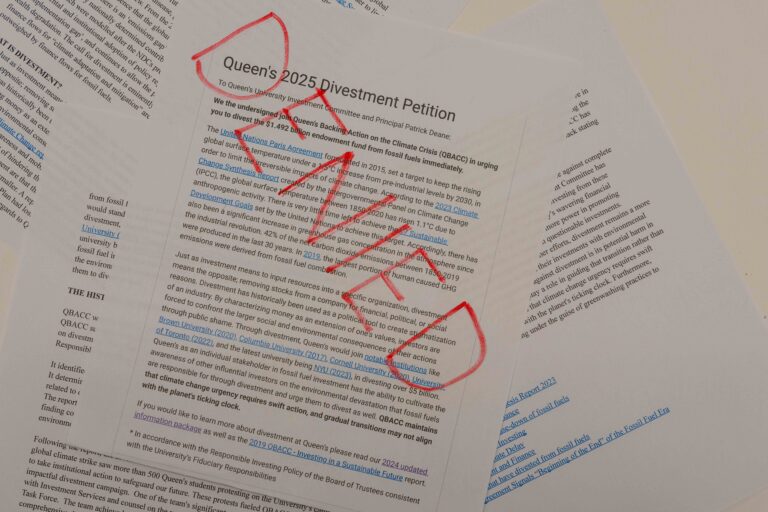
The Board of Trustees (BOT) has approved a recommendation not to divest the University’s Pooled Endowment Fund (PEF) and Pooled Investment Funds (PIF) from fossil fuels. This decision, announced in the Queen’s Gazette on Dec. 16, responds to a Special Request made in March by Queen’s Backing Action on the Climate Crisis (QBACC) calling for the University to completely divest from fossil fuels, and to reduce the 2.2 per cent of their endowment portfolio invested directly in fossil-fuel intensive corporations to under two per cent.
READ MORE: QBACC launches new divestment campaign
In response to the Special Request, which received 630 signatures from students, faculty, and local politicians alike, Queen’s convened a Principal’s Review Committee for Responsible Investing, which met three times before submitting their anti-divestment recommendation to the BOT.
While in their report, the Committee claims that their Chair “met with one of QBACC’s Co-Presidents to discuss the request and subsequently reported back to the Committee” before coming to any decision, QBACC co-presidents, Dreyden George and Liv Winslow, both ArtSci ’26, told The Journal interview that they felt this framing of events was disingenuous.
“The Secretariat and the Chair requested an informal meeting that was just to introduce themselves and go over the process,” George said. “It wasn’t a request to formally gather our arguments or case. […] I was expecting to get to present additional information, or to answer questions from the committee and stuff like that. None of that took place. That one [informal meeting] was the only thing that took place.”
In a written statement to The Journal, the University confirmed the nature of this meeting. “The special request submitted by QBACC was very clear, so the meeting, which included the Chair, the VP (Finance and Administration) and one of the QBACC co-presidents, focused on the process being undertaken to review the request and next steps,” Queen’s said.
The presidents claim the only other communication they received from the Committee occurred months later in December, requesting them to attend another meeting. While they were unable to attend the meeting due to exams, they later learned it was being held only to inform QBACC of the committee results, not to hear further opinions or engage in further discussions.
“We never had a full opportunity to present all of our arguments for divestment,” Winslow said. “There should’ve been clearer communication about if and when we would’ve had an opportunity to actually build that case and present our reasons and explain why we’re working towards this and how this will benefit the University and why it’s a good thing to do.”
Neither of the presidents were surprised by the University’s decision not to divest, but they both expressed disappointment and disagreement with the school’s argument that they’re unable to divest due to a legal fiduciary duty to act prudently and loyally in long-term investments.
“I hope to see from the University a bit more moving forward,” George said. “[…] [In the 2025 Plebiscite survey] students voted directly on [the issue of divestment], and it was a high majority of over 80 per cent approval in favour. There’s a desire, and I think the University should at least be bringing better benchmarks that hold them to a higher account that are above the global benchmarks, understanding that those have been marked as too conservative.”
The University claims that its Vice-President (Finance and Administration) offered to set up a separate meeting with QBACC to “outline other actions Queen’s takes to mitigate climate impacts.”
Tags
Fossil fuel divestment, fossil fuels, QBACC
All final editorial decisions are made by the Editor(s) in Chief and/or the Managing Editor. Authors should not be contacted, targeted, or harassed under any circumstances. If you have any grievances with this article, please direct your comments to eic@queensjournal.ca.