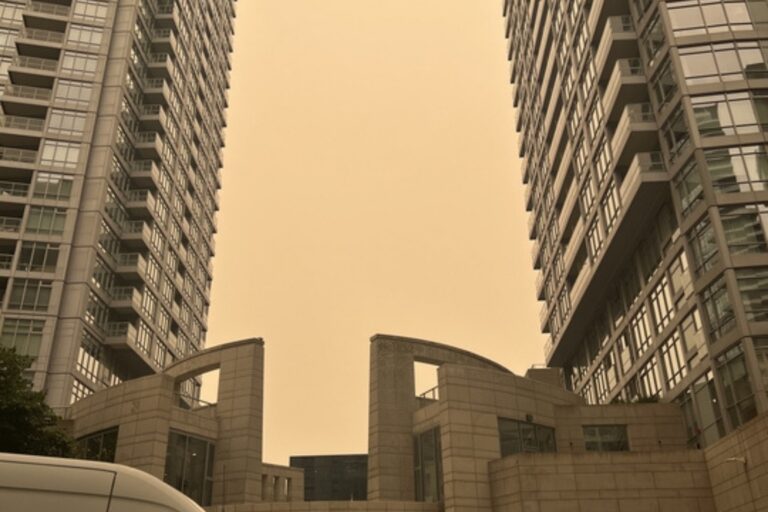
A thick layer of smoke blocked the sun and turned skies orange across Southern Ontario, including Kingston, on July 15.
Environment Canada issued a yellow air-quality warning for the Kingston region on July 14, forecasting worsening air quality and advising residents to stay indoors to avoid smoke from wildfires in northwestern Ontario.
By the following day, Kingston’s Air Quality Health Index had reached 10+, the highest risk category, prompting the warning to be upgraded to orange.
According to David McLagan, an assistant professor in geological sciences and environmental studies, fire and smoke play a critical role in many ecosystems, while climate change, decades of fire suppression, and land-management practices have intensified the wildfire crisis.
McLagan, who leads the Fire, Earth, Water, Air (FEWA) Contaminant Biogeochemistry Lab, spoke with The Journal about the causes and impacts of the fires.
The fires were likely caused by lightning strikes from recent storms rather than human activity, given the low population density in the areas, he said.
“Lightning strikes, you get a little bit of precipitation, but not enough on a dry landscape, and they turn into fires,” McLagan said.
“There are no roads, so getting a response in there is virtually impossible,” McLagan said, adding that the fires that crews are fighting are closer to population centres and infrastructure like highways and railroads.
“Extreme fire weather is driving the rapid increase in the size and spread of these fires,” he said. Fire weather refers to meteorological conditions that can cause wildland fires to ignite, spread, or change behaviour.
These include low humidity, high temperatures, and strong winds that helped the fires spread rapidly through extremely dry, combustible vegetation, he said.
Precipitation over the past few days and less severe fire weather have helped crews make progress on some fires, although several continue to burn out of control.
A key factor behind increasingly extreme fire weather is climate change, which is also making fires more difficult to put out, he said.
“Climate change creates the potential for more extreme fire weather conditions,” he explained. Although these conditions do not ignite fires on their own, they can lead to “much faster fire propagation” and more severe fires. Higher temperatures can allow fires to ignite with less fuel available and return to recently burned areas, McLagan explained.
“What we’re seeing now are fires starting to return to areas that may have burned four or five years earlier, and normally that would be enough to help prevent that fire from occurring again.” he said.
“If you burn down a forest and then another fire burns all those seeds away, that landscape can turn from a forest to a savannah,” he said. Because savannah stores less carbon than forest, this creates a “net transfer of carbon to the atmosphere.”
Another factor is the “negative culture towards fire in our Western societies,” he said. “Since the turn of the previous century, we started down this pathway that all fires are bad,” he said, leading to decades of aggressive fire suppression.
Greater efficiency in suppressing fires has also left many areas with an “overabundance” of vegetation, creating what McLagan called a “fire deficit.”
However, this approach ignores “the critical role that fire plays in the balance of our ecosystem” and in shaping biodiversity, McLagan said.
He added that the wildfire suppression model involves the suppression of Indigenous cultural burning practices, including what he calls “good fire.”
“There are people with the knowledge to kind of put fire back in the land, and they want to practise their culture,” he said.
A third factor is Canada’s forestry management system, McLagan said.
“We turn a lot of our forests into plantation timber,” consisting of dense plantings of fast-growing trees, that tend to be more flammable than slow growing ones, McLagan said. “With all these things coming together, we have this recipe for disaster.”
When it comes to the health impacts of wildfire smoke, McLagan urged a balanced approach to assessing risk.
“Without question, wildfire smoke can cause significant health effects, particularly for vulnerable populations,” he said, including people with respiratory or heart conditions, older adults, young children, and firefighters exposed to extreme smoke.
However, McLagan emphasized the need to avoid the perception that all smoke must be eliminated.
“If all smoke is bad and we need to get rid of all the smoke, the only scenario is that we need to get rid of the fires again,” he said. However, the ecosystem and our landscapes “need good fire.”
“We have to come to this place where we become a bit more resilient to both fires and smoke exposure,” he said. While vulnerable people can be protected through effective indoor air filtration or relocating away from high-risk smoke areas, “there is no scenario where we can have no smoke.”
“We have to invest in new strategies and ways of approaching how we manage our planet,” he said. “This is our planet giving us a lot of warning signs.”
Tags
Climate change, Geology, Health, Indigenous, respiratory illness, smoke, wildfires
All final editorial decisions are made by the Editor(s) in Chief and/or the Managing Editor. Authors should not be contacted, targeted, or harassed under any circumstances. If you have any grievances with this article, please direct your comments to eic@queensjournal.ca.