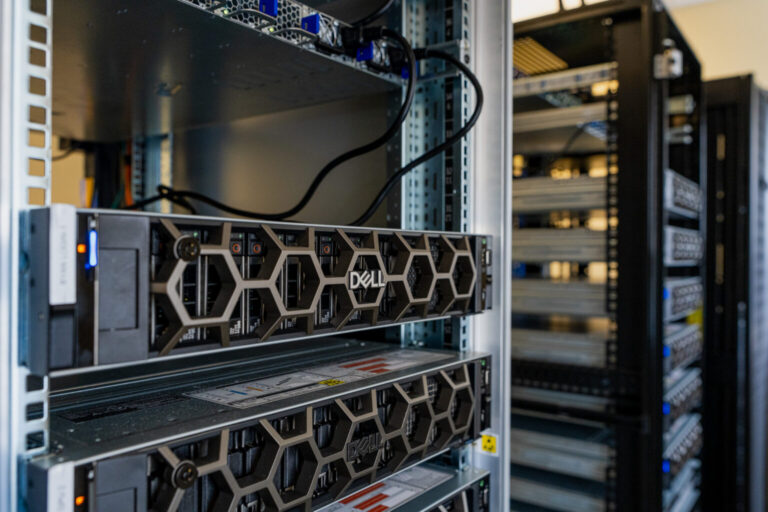
Queen’s has signed a memorandum of understanding (MOU) with the Université de Sherbrooke, marking a step toward building one of the world’s top 10 supercomputers in Kingston.
Signed in June, the agreement adds Sherbrooke to a growing collaboration between Queen’s, Bell Canada, and Simon Fraser University (SFU) that aims to build a Canadian supercomputing network for researchers and organizations to develop and run AI technologies using infrastructure based in Canada.
The MOU is the latest step in a project that has steadily expanded over the past year. Queen’s first signed a MOU with Bell Canada in December 2025 before partnering with SFU in April 2026.
READ MORE: Queen’s, Simon Fraser University partner on bid for national supercomputing system
If the proposal receives funding through the AI Sovereign Compute Infrastructure Program (SCIP), Queen’s could host one of the world’s top 10 supercomputers.
Expanding the Partnership
Bell Canada will act as the lead in design, construction, financing, and maintenance of the physical building that will be supported by the company’s high-speed, low-latency fibre network, while SFU will contribute operational expertise for managing large-scale infrastructure. Queen’s will provide experience in advanced computing systems design.
In an interview with The Journal, Jonathan Genest, associate vice-president (innovation, partnerships and entrepreneurship) at Université de Sherbrooke, said Sherbrooke will bring expertise in operating small-scale distribution centres, complementing the expertise already brought by Queen’s, Bell, and SFU.
“That’s one of the great parts of this kind of partnership,” Genest said, “we all have a roadmap based on our perspective.”
Energy Efficiency
According to a 2026 article by Sherbrooke, Queen’s and Sherbrooke will collaborate in four key areas: post-quantum cyber security, hybrid computing models, distributed data centre infrastructure, and talent development.
Genest said Sherbrooke’s experience operating small-scale data centres allows researchers to test new technology while managing power consumption, energy use, and heat. That expertise is reflected in the university’s Centre for Scientific Research, which, according to UDS Research, operates the Mammouth supercomputer.
Ryan Grant, professor in electrical and computer engineering and head of the Computing at Extreme Scale Advanced ResearchLaboratory, spoke on heat management in an interview with The Journal.
Grant explained how “closed loop systems” have been used on past scientific computers and supercomputers to reuse heat they generate and give back to the community. He pointed to Germany, where heat from supercomputing infrastructure has been fed into district heating systems to provide low-cost home heating.
“We’re all very interested about not only how to make a system more efficient, but how those systems can benefit the communities that surround them as well,” Grant said.
Digital Sovereignty
Beyond the technical collaboration, one of the project’s main goals is ensuring Canadian expertise and innovation remains within Canadian universities and Canada’s public sector.
“If we want to do things right, we cannot import a solution,” Genest said.
Genest also noted how Canada’s geography — with population concentrated in the south and vast distances between northern communities — presents unique challenges for computing infrastructure.
“Canada is not Europe. Canada is not the U.S. We have a very specific territory,” he said. “This brings opportunities. Also, it brings challenges.”
By designing solutions around these realities, Genest believes Sherbrooke’s partnership with Queen’s can help ensure the next generation of Canadian computing innovation is developed and retained in Canada.
The emphasis on Canadian ownership reflects the broader objective of strengthening Canada’s digital sovereignty by ensuring advanced computing infrastructure supports domestic research and the public sector.
Developing Canadian Talent
Asked which of the MOU’s four focus areas he considers the greatest priority, Genest pointed to talent development.
Describing students as the “vectors” of the project, he said training skilled graduates is essential to transferring new technologies from universities into Canadian industries.
“It’s a very good opportunity for us, for our students, and for our researchers to work on a type of project they would not have the opportunity to work on,” Genest said.
Hosting the supercomputer in Kingston would similarly create research opportunities for Queen’s students and faculty. Grant previously told The Journal the project would give students opportunities to work directly on the project while collaborating with Canadian technology companies.
“It’s a first exciting step on us collaborating together,” Grant said about the MOU with Sherbrooke. “We’re looking forward to working with our colleagues to invent interesting new technologies and share them with the Canadian public.”
According to a 2026 Queen’s Gazette article, Queen’s and its partners expect to hear back from SCIP on funding in late 2026.
Tags
AI, Bell Canada, Memorandum of Understanding, SFU, Supercomputing, Université de Sherbrooke
All final editorial decisions are made by the Editor(s) in Chief and/or the Managing Editor. Authors should not be contacted, targeted, or harassed under any circumstances. If you have any grievances with this article, please direct your comments to eic@queensjournal.ca.