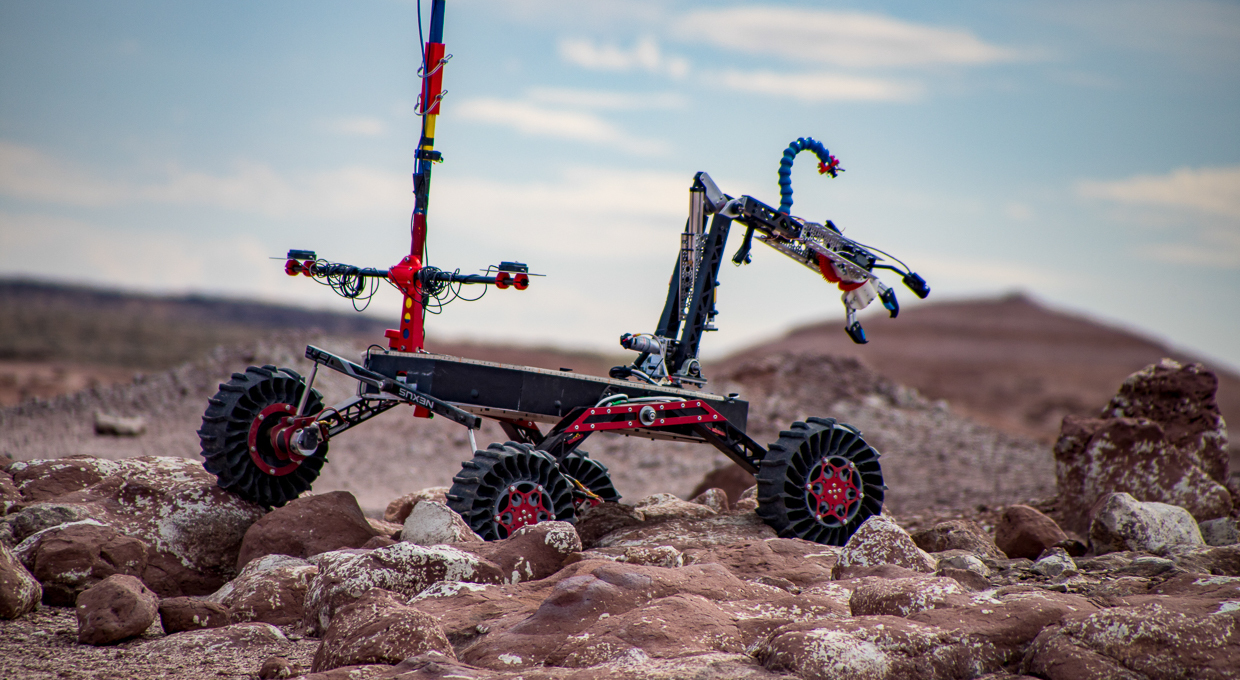
The Queen’s Space Engineering Team (QSET) is representing Queen’s at the highest level
of competition.
As a design team, QSET offers the opportunity for student to gain engineering experience within its two teams: Rover and Satellite. Both teams build from the ground up to compete within their fieldsof specialization.
Team Rover competed this summer at the international stage at the University Rover Challenge (USR) against 37 hand-picked teams from across the globe.
“Our rover needs to be fully mechanically and electrically designed by students and programmed by students as well,” Owen Hooper, Sci ’22 and the CTO of the QSET rover team said in an interview with The Journal.
The team is split into mechanical, electrical, and science sub teams, each of which work together to achieve overall functionality of the rover.
“The competition is basically seeking to cover all aspects of what a rover would want to do on Mars,” Lily de Loë, Sci ’22 and the captain of the QSET rover team stated.
Tasks included looking at rocks and soil to determine whether they host life, while testing the dexterity and fine motor ability of an onboard motor arm.
“Of the four missions, the one we performed most strongly in was science […] the team was able to correctly identify every single one of the rocks, and soil sites,” de Loë said.
Their strong results across the different parts of the competition ensured a seventh-place finish overall, and the highest placement amongst Canadian teams. All despite numerous complications during the competition.
Behind the success of the teams is a design cycle that spans across the school year, with the long-term future of the team in mind.
“It’s essentially based on the scale of what we can do in the year, we, the team chooses a few main points of failure to address in a design cycle. Then every two to three years, you end up with a rover that’s completely unlike the last iteration,” de Loë said.
Hooper emphasized the importance of growing and mentoring members into specific roles as part of their long-term planning.
“We usually try—especially if one of these roles is someone who’s graduating—to onboard someone else into that role. For instance, this year we had a second year, and she was our mission controller for most of the tasks,” Hooper said.
Despite the completive side of the team, both Hooper and de Loë acknowledge the benefit of QSET on their academic career.
“Best thing I did at Queen’s is join QSET, it’s taught me far more than any of my classes have combined. It’s given me an opportunity to gain experience I never been able to get as an undergraduate student,” Hooper said.
Experiences including working with spectrometers and GPS, while learning important engineering concepts such as control theory and computer programming.
“What I say to a lot of people who come up to us and ask about joining is don’t be intimidated by not having these skills. Nobody has any skills when they join. That’s the whole point you will gain them by doing it” Hooper said.
—With files from Asbah Ahmad
All final editorial decisions are made by the Editor(s) in Chief and/or the Managing Editor. Authors should not be contacted, targeted, or harassed under any circumstances. If you have any grievances with this article, please direct your comments to eic@queensjournal.ca.