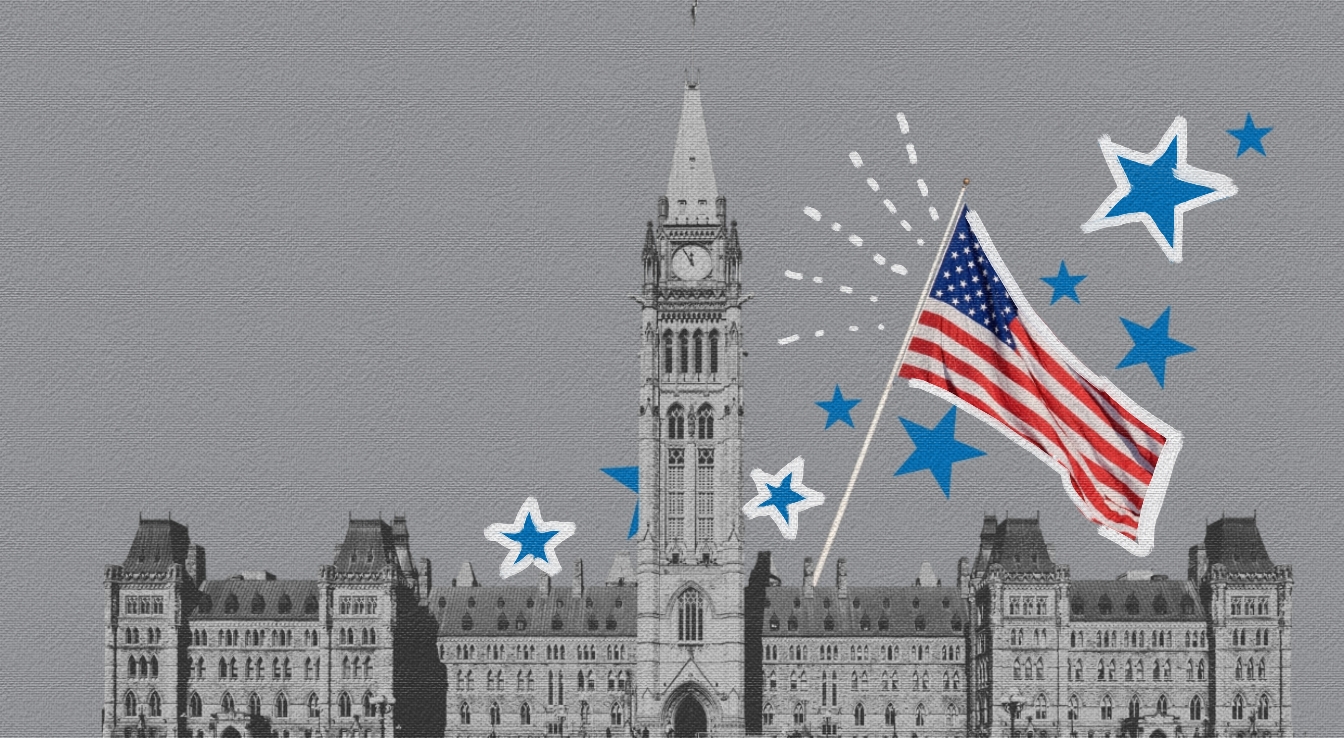
What once felt like a warm welcome has shifted into awkward side-eyes and cold stares. American students at Queen’s, like Lucy Lawson, ArtSci ’26, and Bailey Robson, ArtSci ’26, have noticed a change in how their Canadian peers react to their nationality.
With President Donald Trump’s recent controversial critiques of Canada—such as falsely stating that Canada is in support of becoming America’s 51st state and how Canada is constantly surrounded by Chinese and Russian ships—Canadians appear to have that had long been quiet. For American scholars and students at Queen’s—living with a hyphenated identity feels more complicated by the day—the effects of the two countries’ shifting dynamics have become impossible to ignore.
For Lawson and Robson—American students from New York and Connecticut respectively—the reception to their American identity at Queen’s feels noticeably different now than it did in first-year. The changing variable being the current administration of the U.S. Both of their experiences studying in Canada reflect the ever-shifting dynamic between Canadians and Americans.
“I’m more hesitant now to reveal I’m American because I do feel there’s a judgement that comes along with that. I used to be excited to tell people I’m American, but now it’s something I don’t want to advertise,” Lawson said in an interview with The Journal. “I’m more conscious of how it’s perceived here after the election.”
For Robson, mentioning her American roots now comes with a twinge of discomfort. “When I was in first year, Biden was still president. When I was meeting everyone, all the responses were like ‘Oh, that’s really cool, ” Robson said in an interview with The Journal. “But the past year, when I tell people I’m American, responses are a lot colder.”
Because of many Canadians’ distaste for President Trump, Robson feels she has to openly state her political opinion to avoid confusion and unease. “I feel that I’ve had to explicitly state ‘I voted for Harris’ to feel more welcomed,” Robson said.
Lawson and Robson both point to the pressure American-Canadians feel to distance themselves from Trump’s administration, a pressure heightened by how freely many Canadians critique the President, especially when his remarks target Canada. They noted that peers and professors at Queen’s openly voice criticisms of Trump in a way they doubt would be possible in the U.S. today.
“My professors mention Trump, and everyone laughs and makes fun of him. But in the States, it’s a much more touchy subject,” Robson said. “Here, everyone operates under the assumption that everyone thinks he’s insane. If you did this in the States, it wouldn’t be acceptable because who knows who is a Trump supporter?”
Criticism of Trump hasn’t been limited to classrooms. Ontario Premier Doug Ford famously pushed back with ‘Canada is Not for Sale‘ hats—spending nearly $300,000 on the slogan and wearing one himself—while many Canadians met Trump’s tariff threats with anger and a sense of betrayal.
Paul Gardner, an assistant professor in the Department of Political Studies specializing in American politics, explained that Trump’s rhetoric carries a weight in Canada that many Americans fail to grasp.
“It’s really difficult to express to Americans right now how damaging this has been to the Canadian psyche. Even Americans who think it’s wrong and appreciate that this is offensive to Canadian’s, I don’t think they [Americans] realize how significant it is,” Gardner said in an interview with The Journal. “They often see it as one part of the daily onslaught of politics that they get without realizing how significant it is here.”
Echoing this sentiment, David Haglund, a Political Studies professor specializing in American foreign policy and Canada–US relations, pointed to the imbalance in cross-border awareness. “Even if Canadian students never take any course on American politics or U.S. foreign policy, they will by definition know a lot more about the US than Americans will know about Canada,” Haglund said in an interview with The Journal.
That unrequitedness sets the stage for understanding Canada’s complicated relationship with its closest neighbour.
Understanding Canada’s complicated relationship with the U.S.
Canada’s long, peaceful history with the U.S.—its closest neighbour and ally—has often blurred the line between friendship and dependence, with some noting this relationship complicates efforts to define a distinct national identity.
As Haglund explained, “some scholars say there are no two people so similar as Canadians and Americans. But because of these similarities, it’s necessary to draw distinctions.” That need to differentiate is sharpened by the U.S’ powerful sense of nationalism and firmly rooted identity, which often leaves scholars arguing that Canada defines itself less by what it is and more by what it is not—American.
This tension over defining Canadian identity has long preoccupied scholars, including Professor and Canada Research Chair in Political Philosophy, Will Kymlicka, who argues the search for difference often stems less from pride than from envy.
In his 2003 paper Being Canadian, Kymlicka argues that ‘what defines being Canadian, perhaps above all else, is precisely not being an American.’ He observed that Canadians often seek out and emphasize contrasts with the U.S, a tendency he traced to a lingering sense of envy—not only of America’s wealth and power, but also of the talent drain that sees many of Canada’s brightest leave for opportunities south of the border.
That struggle to define Canada in contrast to the U.S is echoed by Gardner, who notes that Canadian identity is shaped as much by what it is not as by what it claims to be. “Canadian identity is much framed around not being American, as it’s being Canadian,” Gardner said.
Gardner’s point underscores how deeply Canada’s self-image is bound up in contrast with the U.S. Building on this idea, Haglund emphasizes the importance of these distinctions, turning to Social Identity Theory (SIT)—which suggests that people define themselves through the groups they belong to, often casting outside groups in a negative light to preserve a positive sense of self.
That lens becomes especially revealing when applied to Canada and the U.S.
Haglund points to the integrated economy, shared language, and long history that bind Canada and the U.S, noting that it is precisely this closeness that drives the urge to differentiate. “SIT will tell you that you need to have these small marks of differentiation,” he explained. “For Canada, that’s health insurance—even though, when you ask most people about our healthcare, they’ll admit the system is collapsing.” One example Haglund points to is Canada’s universal healthcare system, often invoked as a marker of superiority over the U.S.
While Haglund frames these symbols as small but necessary markers of difference, other scholars suggest Canada’s defensiveness toward the U.S. reflects a deeper sense of insecurity.
The growth of Canadian Nationalism in 2025
As Canada now redefines its place in the world, questions of identity and sovereignty loom larger than ever. Owyn Murray, MA ’26, a Queen’s scholar of fascism’s history, explains how Canada’s insecurity runs deeper than symbolic differences—it reflects a structural reality of dependence on the U.S.
“Canada operates as somewhat of a vassal state that follows the lead of the American Empire. If you want to understand how Canada is run, you have to understand how the American Empire runs too. Frankly, Canada lacks a degree of sovereignty,” Murray said in an interview with The Journal.
Murray’s critique of Canada’s limited sovereignty helps explain why recent provocations from the Trump administration have sparked such a visible wave of national pride.
In response to the Trump administration’s recent jabs at Canada—including offhand remarks about it being the ’51st state,’ threats of economic annexation, and complaints over borders finalized in 1908—Canadians have embraced a renewed sense of national pride. Many took to wearing slogans like ‘Canada is Not for Sale’ and ‘Elbows Up, Canada,’ with even Canadian actor Mike Myers sporting the message on the set of Saturday Night Live, one of America’s popular late-night shows.
This surge of visible patriotism, from slogans to celebrity endorsements, reflects a broader shift in Canadian sentiment that some say Trump has unintentionally fueled. “Canadians are going to discover that Trump has been very good for Canada. Before Trump came along the second time, the dominant mood in this country was that Canada was broken, falling apart, woe is us. Now, Trump, for the moment at least, has created a kind of ’60s sort of nationalism,” Haglund said.
For American students at Queen’s, this boost in Canadian self-esteem was obvious and palpable.
“I notice a lot more Canadian pride than when I first got here in my first year. There are a lot more Canadian flags and just visible Canadian pride after the “51st State” thing,” Lawson said. The increased Canadian nationalism and Canadian critiques of their southern neighbour has opened her eyes to flaws in the US that she’d never considered before.
“Being in Canada has given me a more negative view on the US because I feel like I see how the world sees us, and I see our flaws, and maybe that’s because of the new administration, but I’m definitely able to see America in more of an objective light than before,” Lawson said.
The spike in Canadian nationalism wasn’t only visible to American students but also evident in the outcome of Canada’s federal election on April 28. Before Trump’s inauguration on Jan. 20, Conservative leader Pierre Poilievre held a substantial lead in the polls, running a divisive campaign against the Liberals with slogans like “Axe the Tax,” “Build the Homes,” and “Fix the Budget,” while dismissing Trudeau as a “wacko.” After Trump directly challenged Canadian sovereignty, however, voters rallied behind Liberal frontrunner and now–Prime Minister Mark Carney, who framed the election as a call for national unity against external threats. Poilievre ultimately lost even his own riding, and many argue the Liberals’ victory would have been unlikely without the wave of unification sparked by Trump’s comments.
This moment underscores how external pressures—particularly from the U.S—can reshape Canada’s domestic politics and influence electoral outcomes.
Potential take-aways for Canada
As tensions and provocations ripple across the border, Canadians are being reminded that their closest neighbour isn’t always predictable—and staying informed has never felt more urgent. Gardner says the recent shift in Canadian-US relations can serve as a wake-up call to Canadians to stay informed to avoid further feelings of betrayal.
Gardner reflected on the evolving dynamic between Canadians and Americans, noting that while the relationship hasn’t fundamentally changed, awareness of differing interests is becoming increasingly important.
“I think we’re all experiencing this shift in the perceived relationship that Canadians are having with Americans,” he said. “In many ways it hasn’t changed, it’s just a recognition that interests might not always align but making sure that Canadians are not overly reliant on the US but staying attuned to the political going ons.”
Ultimately, Gardner stresses the importance for Canadians to find a balance between remaining educated on American politics but not letting the American political fervour swallow them whole. He notes that Canada is currently experiencing an anti-immigration moment that’s uniquely Canadian, yet, influenced by American rhetoric. It isn’t uncommon, he adds, to see Canadians debating intensely over American-style political issues, like gun laws.
“Getting sucked into those debates is something that we should avoid. There is a balance that’s created in the end, but we could shift that balance into increased understanding and decreased emotional engagement,” Gardner said.
While Gardner emphasizes stepping back from overly emotional debates about American politics, Murray cautions that Canadians shouldn’t let critiques of the U.S. distract them from addressing their own domestic challenges.
“We do have our own issues and our own issues are unique to Canada. So if we constantly follow American politics then we’ll constantly compare ourselves to that basket fire,” Murray said. “When it comes to our healthcare system and our housing, it’s easy to be like “Oh, look at Trump, he’s being crazy.” Okay, sure, but we can’t do anything about that and we have actual problems.”
Murray recalls that when Trump was first elected in 2024, much of class time was consumed by discussions of the president, his upcoming term, and his remarks—time he feels could have been better spent on scholarly debate adhering to the class content.
While Murray focuses on the classroom impact of Trump’s rhetoric, Haglund situates these comments in a broader historical context, showing that U.S. leaders have long toyed with the idea of absorbing Canada—though never so brazenly in over a century. Similar rhetoric was floated with James Knox Polk and Thomas Jefferson too. The main difference, according to Dr. Haglund, is that no President has had the gall to make comments of the likeness since the late 19th century.
All this to say, Haglund reminds us that the relationship between these two countries ebbs and flows, like most diplomatic and political relationships.
Despite critiques of the U.S., Haglund reminds everyone that the current diplomatic relationship is never permanent and always subject to change.
“The relationship between the two countries is cyclical. Depending on the mood in Canada, the U.S can look great and depending on the mood in the U.S, the States can look awful. So it goes in circles, and who knows what the future might be?” Haglund notes.
***
The perspectives of Murray, Haglund, and Garner highlight the complexity of Canada–U.S. relations, showing that political dynamics are rarely straightforward. As Dr. Haglund notes, the recent rise in Canadian nationalism may foster a sense of pride and unity.
As for the two American students at Queen’s, witnessing these dynamics firsthand has given them a sense of distance from the U.S., highlighting how perceptions of identity and politics shift when viewed from abroad.
For now, strengthening domestic policies appears to be the most practical path forward amid ongoing uncertainty in Canada’s relationship with the U.S.
Tags
Canada, international students, Mark Carney, Queen's, Tarrifs, Trump, United States
All final editorial decisions are made by the Editor(s) in Chief and/or the Managing Editor. Authors should not be contacted, targeted, or harassed under any circumstances. If you have any grievances with this article, please direct your comments to eic@queensjournal.ca.
Angelina Liu
Excellent article!