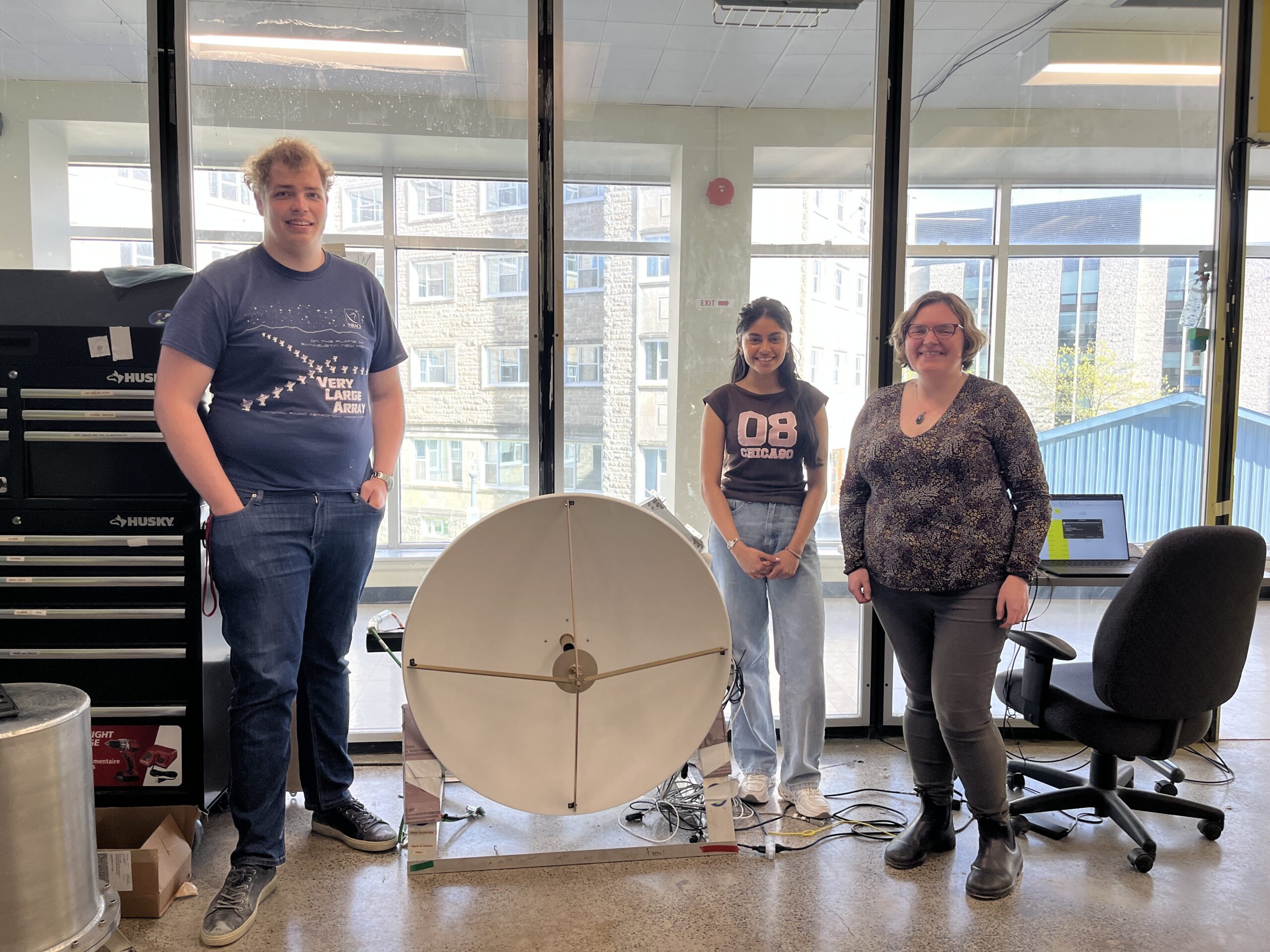
Felix Thiel, MSc ’23, PhD ’27, is one of Stirling Hall’s resident experts on radio astronomy.
Thiel is a PhD student in the Fissel Research Group, led by Queen’s Professor Laura Fissel in the Department of Physics, Engineering Physics and Astronomy. The group is behind the student-led Balloon-borne Very Long Baseline Interferometry Experiment (BVEX), which recently received a $291,000 grant from the Canadian Space Agency (CSA) to support the second generation of its telescope.
“I wanted something that we could build here at Queens,” Professor Laura Fissel, the project’s principal investigator, who has worked on balloon-borne instrumentation for most of her career, said in an interview with The Journal. “Interferometry is a way of combining light from two telescopes. You measure the electromagnetic wave that you’re detecting with your telescope at two different locations and then you multiply it together.”
Very Long Baseline Interferometry (VLBI) allows astronomers to create some of the highest-resolution images in astronomy by linking radio telescopes, typically 10-50 metres wide, across vast distances. “We are trying to show that you can use this Very Long Baseline Interferometry technique to have balloon telescopes join these global arrays of radio telescopes,” Fissel explained.
Since it began in 2021, BVEX has involved 14 undergraduate students, including eight Summer Work Experience Program (SWEP) internships, one Natural Sciences and Engineering Research Council of Canada Undergraduate Student Research Award (NSERC USRA), six honours thesis projects, and two research assistant positions. Four graduate students have also worked on the project, including Thiel, who joined BVEX in March 2022.
The original launch campaign occurred in August 2025 at the CSA’s Balloon Launch Facility in Timmins, Ontario. The group travelled to Timmins two weeks before the launch for rigorous safety testing by the CSA.
“We were actually the biggest payload they ever launched on one of their gondolas, and so it was a learning curve for us, but it was also a learning curve for them,” Thiel said in an interview with The Journal. “The safety documentation alone for this payload was about 300 pages.”
The BVEX looks like a satellite dish mounted onto an aluminum balloon gondola, carried by an ultra-thin plastic balloon filled with helium. The gondola and balloon were both provided by the CSA, which mounted the payload and inflated the balloon.
“These balloon launches are really dramatic once they finally inflate the balloon and then let it go, and it’s really, really exciting,” Fissel said. However, the experiment was cut short by an unexpected helium leak.
“It’s like a sandwich bag, right? It’s really thin, so even the act of inspecting for a leak can cause one,” Thiel explained. “It’s all wrapped up in cloth. When they bring it out, they unwrap it while they’re inflating it to prevent that from happening. So if there’s a defect, there’s no way to know.”
The balloon was intended to fly overnight at an altitude of 32 kilometres but was only able to reach 16.5 kilometres, and the gondola was released after three hours. The gondola carried several research payloads for student projects, of which BVEX was the largest.
“We found out the next day that the telescope landed in a small lake just north of Sudbury,” Fissel said. The CSA sent a team to recover the telescope and drove it back to Timmins that same day.
Because the experiment’s most expensive components were housed in an airtight pressure vessel, a “surprising amount still works,” Fissel added.
This includes the crystal oscillator clock specifically made for low earth orbit applications, worth $30,000. It provides the timing reference for the entire experiment.
The group received the grant in 2026 to upgrade the telescope and fly it next summer during the CSA’s launch campaign in Brazil. The main upgrades include cooling the low-noise amplifier to improve the sensitivity by a factor of four as well as developing more sophisticated telescope controls.
“When I’m not thinking about building stuff, other work I do is to figure out if we do this for real, down the road you would want to […] have this be an outrigger station for the Event Horizon Telescope that’s floating around,” Thiel said.
The Event Horizon Telescope is a network of ground-based radio telescopes around the world that capture emissions from the same source which are combined by a correlator to create an
Earth-sized telescope.
Tags
astronomy, astrophysics, Engineer, Physics, space, students
All final editorial decisions are made by the Editor(s) in Chief and/or the Managing Editor. Authors should not be contacted, targeted, or harassed under any circumstances. If you have any grievances with this article, please direct your comments to eic@queensjournal.ca.