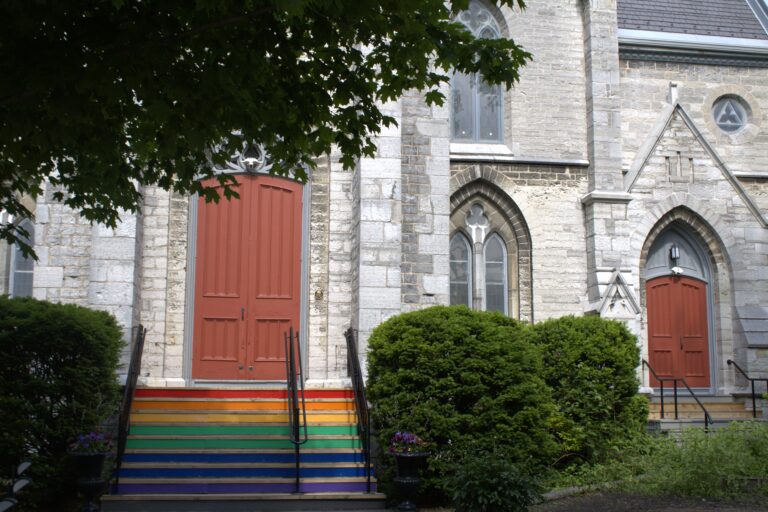
For many queer religious students at Queen’s, navigating faith and identity means confronting tensions that often feel at odds—especially in 2025, as conversations around inclusion and representation continue to evolve both on campus and in faith communities.
One student who knows this struggle firsthand is John*, who grew up in a Christian family. Today, he remains a practicing Christian, but his journey as a queer, religious person hasn’t been without obstacles.
He realized he was queer at a Bible study Christian camp he attended every year from grades four to 12. One day at camp when he was in grade four, campers were instructed to write letters to God and then burn them. The letters could contain anything—a confession, prayer, or diary entry. For John, who had never admitted out loud that he was queer, this was the perfect opportunity to let out this long-held secret. He decided not to burn his letter.
“I wrote about how I felt in my gender and my sexuality, and we were supposed to then burn these letters, but I ended up keeping mine,” John said in an interview with The Journal. “I kept it as a little reminder that God was going to know what I felt, regardless of whether or not I wrote a letter about it.”
Having finally come to terms with his queerness, John sought out a queer community at camp. Though still in the closet, he met other queer Christian campers and started to feel comfortable in his own skin. However, he soon realized that his church—and the camp that defined his adolescence—condemned his very existence.
“The main reason I don’t go to church is because many of the people that go to the church also went to this camp,” he said. “The camp that I went to had a very, very strict doctrine in terms of what we were allowed to talk about and how we were allowed to talk about that.”
He learned as a child attending camp that certain topics simply weren’t discussed, but becoming counselor in grade 12 revealed the true extent of this censorship. John was instructed not to talk to campers about ‘taboo’ topics like gender expression, divorce, and doubts about religion. He and other counselors were also required to sign a contract stating that they would not talk to campers about being queer and Christian.
“It was really discouraging to see the way that they minimized any conversations about[controversial] issues and children’s questions about religion and how that has to do with queerness,” John said.
As a counselor, he also learned that many parents sent their children to this camp to quell any desire to explore their gender identity or sexual orientation.
“Part of the reason why parents would send their kids to this camp was because they weren’t necessarily acting feminine or masculine enough,” he said. “It was really skirted around that was the real reason parents were sending their kids there, thinking that having an immersive experience where you’re constantly talking about the Bible and having Bible study would be the most ‘effective.’”
In his last year at the camp, John himself became the target of homophobia from the camp administration. His superiors noticed he was spending a lot of time with his male cousin and, because they didn’t share a last name, wrongfully assumed there was “something homosexual” about their friendship, he said. They were told they were giving campers “the wrong idea” and were instructed to stay apart.
John reached a breaking point when he saw this happen to several other campers. Campers who bonded because of shared experiences and struggles were separated for getting too close—sometimes even moved to different cabins. They were forbidden from fostering genuine connections and support systems because doing so could, once again, give their peers the wrong idea.
“I didn’t like the fact that I wasn’t able to support [these campers] or be able to show any type of representation within the camp because I wasn’t allowed to talk about [queerness],” John said. “I wasn’t allowed to acknowledge anything or show that people could still be Christian and be queer.”
Ostracized by members of his church, he realized his church stigmatized queerness the same way this camp did. He couldn’t speak a word about his queerness, let alone embrace his identity. John who grew up with communal prayer as his main expression of faith, turned to the Bible for solace and comfort.
“I spent a lot of time looking at the Bible and really just the teachings of Jesus, mostly, and I realized that above all, what [the church] taught that they didn’t really focus on was the fact that you’re supposed to accept everyone,” he said.
Focusing on this aspect of Christianity rather than his church’s views of his queer identity helped John remain committed to faith, without forcing him to choose between religion and queerness. However, losing his community has been an isolating experience.
“I wish I still felt a place in church, and I wish I still felt a place honestly back at this camp,” John said. “I really hope that in the future they can maybe realize some of their practices weren’t very beneficial to most of the kids’ takeaways,” he said.
***
Sasha* felt pressured to choose between her faith and queer identity from internal and external pressures. Growing up, being a Christian was a core aspect of Sasha’s life and identity. She attended a Fundamentalist private school for ten years and was actively involved with Christian youth groups. Never missing a Sunday at church, Sasha’s faith forged her community—raised by devout Christian parents, religion was woven into all facets of Sasha’s upbringing.
Like many adolescents in high school , Sasha had questions about her sexuality and orientation. But the concept of queerness felt both foreign and shameful. In her core community, the youth groups she attended throughout high school, any questions about being gay were answered with advice on how to stop those thoughts through prayer and discipline.
“I don’t think I met a queer person until I was fourteen or fifteen,” Sasha said in an interview with The Journal. “To my knowledge, there weren’t any [queer people] at my school, and any mention of gay people had an undertone of, ‘this is a sin, this isn’t something that God would want.’”
After transitioning to the public school system in high school, Sasha gained more exposure to queer people. She met several gay peers—sparking an internal conflict between her church’s view of the 2SLGBTQIA+ community and her own.
“My religion would tell me that I’d have to feel like these people are sinning and to try to convert them, but how I actually felt was I don’t care what they’re doing, and I just want to be happy for them,” she said.
Around the same time, Sasha realized that she was attracted to women. But, after being told repeatedly by those closest to her that being queer was unacceptable, she abandoned any hope of living—and loving—authentically.
“I treated [my sexuality] as a shameful thing that I was never going to actually explore and that I’d find a way to get over, so I just completely compartmentalized it,” Sasha said. “I didn’t fully accept it until second- or third-year of university, and in order for me to do that, I had to lose my faith.”
During her time as an undergrad, Sasha realized her parents’ religion was incompatible with her core values. Her church’s view of queerness was certainly a point of contention, but
she also disagreed with fundamental aspects of Christianity, including the concepts of sin and hell. Now identifying as an atheist-agnostic, Sasha feels her Christian upbringing impacts her identity to this day.
“I struggled for a long time feeling really guilty over insignificant things because I was raised in the mindset of [believing] everything you do wrong is a sin,” Sasha said. “It just makes
it seem so big and important and kind of tied to who you’re instead of recognizing you’re just a human that made
a mistake.”
“I have a lot to unpack, which I have been doing in therapy, but I don’t identify as a Christian anymore,” Sasha said.
***
For those raised religious, like Omar Bui, CompSci ’27, certain teachings of faith remain relevant to queer identity. Bui was raised in an Arab, Muslim family. Despite no longer being a practicing Muslim, their upbringing has had a major influence on how they view community in queer spaces today.
Growing up Arab and Muslim in a Western country presented a unique set of obstacles, according to Bui. Many Muslim immigrants faced discrimination due to Islamophobia and xenophobia; others were forced to rebuild their lives in Canada after fleeing conflict in their home countries.
Bui witnessed firsthand how a strong sense of community could transform lives for the better. Throughout Bui’s childhood, their father sponsored numerous families’ immigration to Canada and financially supported Syrian refugees in need of surgery, medical care, dental care, and other essentials. They may not have been related by blood, but to Bui’s father, they were family. There was no need to prove their worthiness of assistance—it was enough to simply ask for help.
“Islam teaches community in a way that’s more community-minded and more activist because we need to,” Bui said in an interview with The Journal. As a marginalized group in the Western world, Muslims need to work harder to thrive, and community is an integral part of this, Bui explained. The same applies to queer people, they added.
Now, as an active member of Kingston’s 2SLGBTQIA+ community, Bui tries to support other queer students in the same way his father supported other Muslim immigrants.
“In the mosque and at home, we were taught to be good examples for peers and adults who weren’t Muslim—holding doors open, smiling in people’s faces, always being the first to help out,” Bui said. “[After coming out], I continued doing that stuff but with painted nails, and when I’d smile at people after helping them out, I would do it with painted lips.”
Growing up Muslim taught Bui about civil engagement at a young age. Their mosque regularly hosted sessions where local politicians would share their platforms and answer questions from the community. Ensuring members were well-informed prior to elections and encouraging all members to vote was critical for a community that was already a minority in their riding.
Today, Bui carries this mindset with them as they advocate for queer rights. Bui attends protests for the 2SLGBTQIA+ community, helps queer people in need, and organizes events for queer students in Kingston. Bui created a group chat to connect queer people they’ve met across campus, leading to both planned and spontaneous gatherings throughout the year. Bui is also working to organize “garties,” or gay parties, which they hope to implement in the upcoming Fall semester.
Despite only realizing they were queer two years ago, Bui feels deeply entrenched in the queer community. They largely attribute their comfort in their identity as a queer Arab to the Queer Muslims Collective (QMC). Attending protests and socials through QMC has helped Bui regain a sense of connection to the Muslim and Arab communities.
“Community is a nice thing to regain later in life, meeting people who understand what it’s like to grow up in a mosque, who can understand Arabic and speak it sometimes,” Bui said. “Meeting the QMC marked the change between seeing myself as a singular anomaly, to seeing myself as a single part of a much greater whole.”
***
Ella Deutsch, ArtSci ’27 and Chair of Rainbow Jews—a club for queer Jewish students at Queen’s—has spent considerable time reflecting on the intersection of their Jewish faith and queer identity as a non-binary lesbian.
Deutsch grew up in a somewhat religious Jewish family, attending synagogue on large holidays and celebrating with large family meals, but not keeping kosher or observing Shabbat. After their bat mitzvah at age thirteen, Deutsch began to think more about their role in the Jewish community, and particularly, how their queerness would impact this.
For Deustch, their bat mitzvah became more than just a rite of passage—it marked an early step in exploring their identity. Looking back, they see it as a turning point that reminded them how far they’ve come and how deeply connected they still feel to their Jewish community. As Deutsch continues to explore their identity and the labels that feel most authentic, that sense of community support remains a source of reassurance and strength.
When Deutsch realized they were queer, they were concerned about how their family would react, especially as the first of their siblings to come out. Fortunately, they faced acceptance from both their family and religious community.
“I think it’s easy to assume religion and queer identity don’t mix, but I’ve been really lucky personally in that my Jewish community has been very, very welcoming and open to people with queer identities,” Deutsch said in an interview with The Journal. “That’s allowed me to sort of come into my own, both privately but also publicly, on my own terms.”
As Deutsch explores their own identity, experimenting with labels and seeing what fits, they’re reminded by the teachings of Judaism to be kind and thoughtful in their actions.
“We do things intentionally and with the mind to support others,” Deutsch said. “I’ve sort of taken that and used it almost as a gift to myself, where I’m able to forgive myself and support my development as I figure out my identity in a more thoughtful and deliberate way.”
Rainbow Jews, now under Deutsch’s leadership, has created a space for queer Jewish students to feel at home. Rainbow Jews hosts annual events including an introductory tie-dye event at the beginning of the Fall semester, as well as a rainbow challah bake later in the year. Challah is a traditional Jewish bread that’s tied to religious symbolism and folklore in Judaism. For Deutsch, baking challah with rainbow dough represents the intersection of queer and Jewish identities and is a form of community bonding.
Deutsch hopes to host more events that provide a space for students to explore these intersectional identities. Their goal is to invite allies and students questioning their gender or sexuality to “explore what it means to be queer and Jewish, both or either,” Deutsch said.
***
Queer, religious individuals comprise a colourful mosaic of experiences and perspectives. What they share is an identity tied to controversy and contradiction.
The experiences of John, Bui, Sasha and Deutsch illustrate the power of strong community bonds in tackling this prejudice. By fostering an inclusive space, students who don’t feel welcome elsewhere can explore their intersectional identities with support and guidance.
*Names changed for safety reasons…
Tags
Christianity, Islam, Judaism, Pride 2025, Queer, religion
All final editorial decisions are made by the Editor(s) in Chief and/or the Managing Editor. Authors should not be contacted, targeted, or harassed under any circumstances. If you have any grievances with this article, please direct your comments to eic@queensjournal.ca.