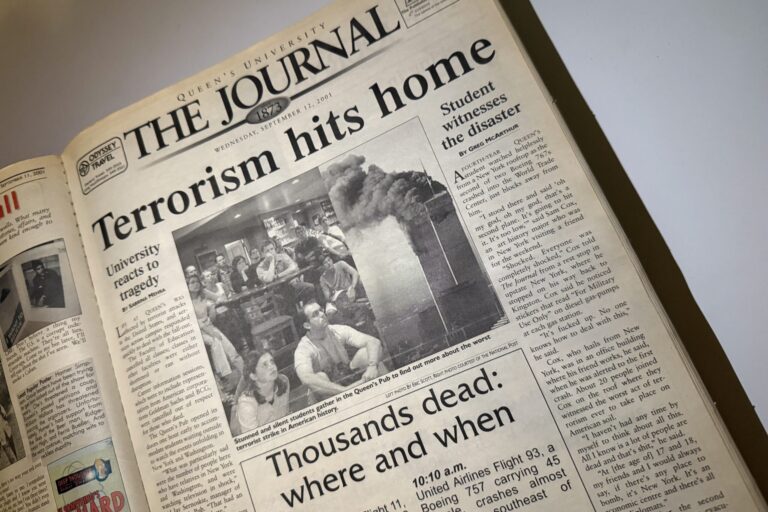
Fifteen minutes into Wayne Cox’s first lecture of the year, a student ran through the door.
It was Sept. 11, 2001. Cox, then a professor in Queen’s Department of Political Studies, was teaching POLS 260, a full-year international relations course, when the late student interrupted him with news from New York.
A plane had flown into the World Trade Center, the student told the room, and CNN was reporting a terrorist bombing.
“And I mean, you know, what am I supposed to say after that?” Cox said in an interview with The Journal.
About half the class left.
Cox finished explaining the course expectations, opened the floor to questions, and tried to console the students who stayed.
“But we really didn’t know fully what was going on,” Cox said.
Twenty-five years later, Cox and four other members of the Queen’s community spoke with The Journal about the day and what followed.
Four were at Queen’s on Sept. 11, 2001. The fifth was beginning university in Toronto and would later come to Queen’s to teach and research religion and political violence.
Their memories trace the questions that followed the attacks, the scrutiny directed at Muslim students and communities, the wars and security culture that came after, and how their understanding changed over the next 25 years.
The morning of 9/11
Nicole Kain, Nurs ’06, was living in residence at the time of the attacks. On the fourth floor of McNeil, students were crowded around the common-room television.
“We were watching the TV when the second plane hit the other tower. I will never forget that, I think, as long as I live,” Kain said in an interview with The Journal.
Across campus, Richard Ascough, who teaches religious studies at Queen’s, was beginning a graduate seminar on apocalyptic literature and movements.
That morning, one of Ascough’s seminar students had a cousin who worked in the World Trade Center and didn’t know whether he had gone to work that day. She later learned he hadn’t.
At the University of Toronto, Amarnath Amarasingam, who now teaches religion and political violence at Queen’s, was in his first week as a university student. Someone brought a television into the quad, and a crowd gathered around it.
“I think the initial question was always, was this an accident or was it not? And it wasn’t until the second plane hit that it became clear,” Amarasingam said in an interview with The Journal.
David Haglund, who was teaching American foreign policy at Queen’s that term, remembers walking out of Mackintosh-Corry and finding students who hadn’t heard the news.
“I said, you know, something big has happened. It’s going to change your future forever,” Haglund said in an interview with The Journal.
Haglund said the attacks were an extraordinary national trauma.
He places them alongside other moments of profound shock in American history.
“It was obviously an emotionally disturbing event, which history has a collection [of], right?” Haglund said. “[But] was it as emotionally disturbing as Pearl Harbor had been for the United States?”
A campus searching for answers
Cox’s course stopped following its outline almost immediately.
“For those first three or four weeks, the course kind of turned into a current events course,” Cox said.
The following year, the class grew sharply. Cox said the first time he taught international relations to Queen’s students, 88 students were enrolled. The year after 9/11, POLS 260 had 400.
“When 9/11 happened, you know, the numbers tell everything,” Cox said.
“People were galvanized to world events based upon 9/11,” he said.
Cox said crises may bring students into international relations, but following the news isn’t enough.
“You cannot turn your course into a course on just current events. You have to teach theories, and you have to teach, like, what is power and what is economics?” Cox said.
Religious studies saw a similar increase.
“What we saw after 9/11 was an increase, a noticeable increase in the number of students taking courses on Islam, taking world religions,” Ascough said.
Ascough said students were enrolling because they wanted to understand Islam rather than condemn it.
“It was people that truly wanted to understand what this religion is,” he said.
“I mean, it’s unfortunate it takes an event like that to pull people into a course, right? Like, we would hope that people would want to,” Ascough said.
Kain’s own questions changed too.
She said she considered herself relatively well-informed before 9/11 but had never heard of al-Qaeda and knew little about Afghanistan.
“That was all brand new, at least to me at the time,” Kain said.
Ascough said the interest he saw in his classrooms existed alongside the risk of blaming Muslims more broadly for the actions of a small subgroup of extremism-fueled terrorists.
“People have a hard time separating particular acts by terrorists from the whole. It becomes a way of vilifying a whole group of people,” Ascough said.
Haglund heard similar concerns at a campus symposium shortly afterward, where students asked whether 9/11 would bring “a tide of Islamophobia” and make university life increasingly difficult for Muslim students.
“For a while, it […] kind of looked like that might happen,” Haglund said.
Cox said the wider political climate intensified those tensions.
“The environment was kind of a tinderbox for a long period of time, and people became quite polarized,” Cox said.
He pointed to the language used by then-U.S. President George W. Bush during the War on Terror.
“George Bush was saying things like, you’re either with us or you’re with the terrorists. I mean, that’s a polarizing tactic,” Cox said.
The polarization extended far beyond Queen’s, Cox said, but the campus wasn’t insulated from it.
“You could feel it on campus,” Cox said.
The post-9/11 world
On his first flight to Europe after 9/11, Haglund felt nervous and suspicious, full of fear of the possibility that someone could try to take control of the plane.
“Back then it was one of the first things in the immediate aftermath of 9/11 that you had to have on your mind. What would I do?” Haglund said.
That fear became part of a broader security culture.
Haglund said the new consciousness surrounding what became known as Homeland Security remains one of the clearest ways 9/11 affects students who weren’t alive for the attacks, particularly at airports and borders.
The attacks also reshaped the field Amarasingam would enter.
“But post-9/11, it was all jihadism all the time, right? That was the only thing that anyone cared about,” Amarasingam said.
Over time, he watched the research broaden again.
Scholars increasingly moved away from trying to identify a profile of the kind of person who becomes an extremist and toward tracing the different pathways that can bring people to violence.
Amarasingam said the earlier emphasis on profiling had consequences. Muslim men who grew beards or became more religiously observant could be treated as suspicious.
“There’s nothing kind of fundamental to Islam or being a conservative Muslim that automatically means that you’re also sympathetic to terrorist groups,” Amarasingam said.
Researchers now examine common pathways across different ideologies, he said, rather than treating religion itself as the explanation.
“There’s nothing special about religion that makes it any more conducive to radicalization than anything else,” Amarasingam said.
The way people encounter extremist movements changed too. Amarasingam said 9/11 unfolded in a largely offline world, while relationships and communities built around extremist ideas can now develop largely or entirely online.
Kain remembers the years after the attacks through fear rather than scholarship.
“There was just so much almost paralyzing fear, like fear of, well, now we can’t travel on an airplane ever again because who knows if it’ll be turned into a weapon,” Kain said.
She also remembers fearing another attack and worrying about how the U.S. would respond.
Haglund remembers the international solidarity immediately after 9/11 as real but brief.
“The shock lasted a couple of weeks, maybe,” he said.
Then public attention moved from the attacks to the response. Haglund said Afghanistan began filling the news as focus shifted to the campaign against the Taliban.
Cox also remembers the initial desire to help. Having previously lived and worked in New York, he watched the attacks knowing the streets around the World Trade Center.
“And I think every Canadian felt that and they wanted to do something,” Cox said.
He remains critical of how the War on Terror developed, but said the response also grew from solidarity.
“We can’t forget the fact that it was motivated by a sense of community,” Cox said.
Twenty-five years later
For Kain, the anniversary still reaches back to how abruptly that sense of safety disappeared.
She described an “instant switch” from generally feeling safe in the world to becoming more weary.
“It was literally like the day that the world changed,” Kain said.
Haglund said hindsight can also make the past appear more predictable than it was. He points to the First World War, whose causes remain debated after generations of scholarship, as an example of how difficult it can be to explain an event even after it happens.
“The thing about the future is no one can foresee it. No one’s been there,” Haglund said.
“Just be alert to the power of contingency,” he said.
For Cox, that uncertainty makes education more important.
“I came to the realization myself when I got the opportunity to go to university that ignorance or a lack of knowledge is often the root of most evil,” Cox said.
He said professors can’t prepare students for every event they’ll encounter, but they can give them tools that last beyond a particular crisis.
“What you want to give them is the tools that they can carry with them for the rest of their lives, which is the intellectual curiosity to learn stuff,” Cox said.
Ascough approaches that responsibility from the classroom, where people with fundamentally different views must find a way to speak to each other.
“I don’t have to agree with you to be respectful of your opinion, but you can’t just yell your opinion at me. You have to give evidence,” Ascough said.
That also means resisting explanations that make violence simpler than it is.
“What I want to avoid is single-issue kinds of things like, oh, religion causes war,” Ascough said.
“And so, we can’t just have a single thing because then we’ll be tricked into thinking we can solve it in a simplistic way,” he said.
Amarasingam’s own effort to understand political violence eventually took him inside extremist movements. He has interviewed ISIS fighters who grew up in the West, went to school and university, and, in some cases, left spouses and children behind.
“But then you talk to them, and they’re just regular kids, right?” Amarasingam said.
“So, it’s like regular people, but they came to a place of believing that this was fundamentally something they needed to do.”
Trying to understand how they reached that point has sometimes brought accusations that Amarasingam is humanizing people who supported or committed violence.
“It’s like understanding them is the point,” he said. For Amarasingam, understanding isn’t the same as excusing.“It’s easy to be like, these guys are crazy, just ignore them,” he said. “But actually, why did they leave Toronto to go to Syria?”
On the morning of Sept. 11, as the news kept arriving in Ascough’s seminar, his class was trying to understand an act whose perpetrators they did not yet know.
“So, then we talked about how we imagine people would want to do this to other people, right?” Ascough said.
Amarasingam has spent much of the 25 years since studying versions of that question. His answer doesn’t place the capacity for political violence entirely on the people he studies.
“I think any one of us put in the right conditions, in the right injustices, with the right framing of us versus them, can become a violent person, can very quickly dehumanize other people,” Amarasingam said.
“These aren’t like special people over here that are like genetically different from us,” he said. “Everyone has this capability and potential.”
“I think political violence and terrorism and extremism are the same,” Amarasingam said. “We all have this capability; we just haven’t been tested in the same way.”
Twenty-five years later, the five accounts leave unique answers about what 9/11 changed, but none treat remembering it as an end in itself.
Cox said the point of returning to tragedies like 9/11 is to remember them “with the hope that they will never happen again.”
“A part of what we should take away from this is that we’re all in this together,” Cox said, “that we should not default to the tactics of divide and hatred.”
Tags
History, Politics, Remembrance, September 11
All final editorial decisions are made by the Editor(s) in Chief and/or the Managing Editor. Authors should not be contacted, targeted, or harassed under any circumstances. If you have any grievances with this article, please direct your comments to eic@queensjournal.ca.
Peter
Informative & compassionate read that reminds us of the need for understanding. People are people with the same problems everywhere . Thanks for this article!
Alexandra
Thank you so much for taking the time to read and leave such a thoughtful comment. I’m really glad the piece resonated with you, and I truly appreciate your kind words.
Mona Rahman
Might I suggest that it would have also been informative to get the perspective of Muslims who were at Queen’s during this horrific episode in history, as we had to deal with the same loss of security as the rest of the community but also the additional layer of bigotry/Islamophobia that became more prominent around the world, but especially in North America. It would have been interesting also to see how the Kingston community reacted versus other larger centres; there was a difference.