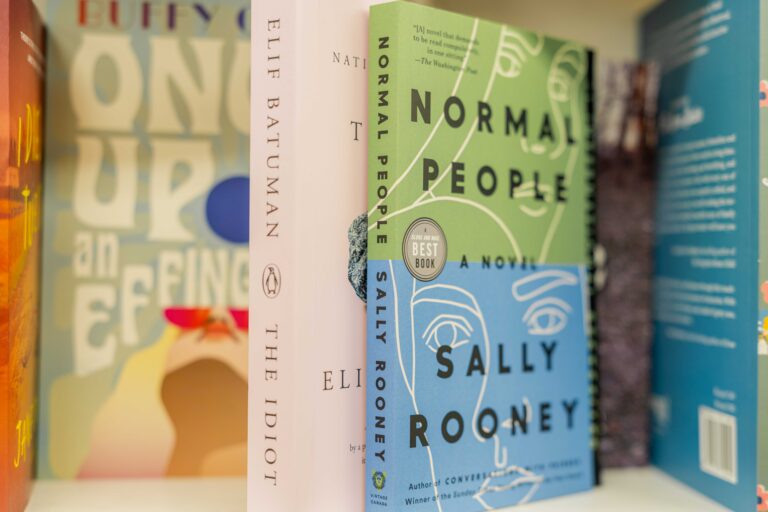
When first year feels like too much, these books will understand you when it seems like nobody else can.
As a literature major, I’ve often sought solace and representation from novels, especially during bizarre and difficult transition eras like the leap from high school to university. These are the books that, as a confused and high-strung first year student, felt like an awkward but warm hug through the chaos of roommates, dining halls, and stilted socializing.
When campus feels more like sarcasm and satire than self-discovery
Elif Batuman’s The Idiot follows Turkish American, Selin, as she starts her first year at Harvard. The story delves into her experiences of new classes as a linguistics and languages student, the friendships she forms, and her growing email correspondence with an older Hungarian student named Ivan.
The Idiot is an stellar coming of age novel that speaks directly to the experience of starting first year university—the confusion, the sarcastic nature, and the absurdity of it all. At its core, the story is witty and hilarious, capturing the intellectual excitement of university with subtle references to philosophy and literature, all while being narrated through Selin’s captivating voice as she tries—and fails—to figure out who she is and why things are the way we are.
Turning eighteen is a weird and confusing age—where one is caught on the cusp of adulthood and teendom. During first year, it’s normal for students to feel simultaneously inexperienced and naive while also feeling like they understand the world better than most of the adults around them. The Idiot captures this cognitive dissonance and Selin’s confusion throughout her first-year experience with such hilarious honesty.
We’re often told—by books, films, and even family—that university is where you’ll “find yourself.” But in a world as absurd and fleeting as this one, I’m not sure that’s ever fully possible. In The Idiot, Selin stumbles through university life, trying to uncover her true passions, all while quietly exposing the contradictions embedded in academia and everyday social dynamics.
Selin challenges typical ideas, professors, and syllabi that most students take at face value, and in doing so, she calls the reader’s attention to aspects of academia’s ridiculousness that’s typically overlooked. She does so with such wit and dry humor that the story frequently made me smile. Batuman seems to point out that we may not always understand life or ourselves, but that doesn’t have to be dark and daunting.
When you are feeling love, loneliness, and everything between
While I’m far from the first person to recommend Sally Rooney’s Normal People—a romance set in Ireland following Marianne and Connell’s friendship and love from high school to Trinity College—I will give credit where credit is due.
I initially read this novel in grade 11, yet every time I reread it I gain something new from the story as I age alongside the characters. While at the heart of the story is a tender and sensitive love shared between Marianne and Connell—who seem to understand one another better than anyone else—the novel also discusses the experience of university in-depth.
Growing up in a small town where hockey took precedence over everything else, I felt more myself in university, where I had the freedom to explore passions like reading and writing. I felt this boost in confidence mirrored in Marianne’s story, as she was always an outsider in high school but began to find deeper ease and sturdy footing in first-year university.
Similar to myself, Marianne approached high school quite passively and seemed to float through it, whereas in university, she becomes an active member of her community and feels a sense of belonging to Trinity College and university as an institution.
On the flip side, Connell is an English literature major, like myself, and I often relate to his critiques of pretentiousness within academia—as well as his inability to truly express himself through literature, despite the deep bond that he shares with it. First-year Connell’s academic experiences remind readers that everyone’s relationship to academia is different and can’t be compared.
Normal People paints an unflinching image of university students who love, cry, laugh, make mistakes, and debate over wine—all while pretending to be fully grown adults.
When friendship feels like both a lifeline and a contest
Elena Ferrante’s My Brilliant Friend is the first novel in her compelling Neapolitan series, tracking two Italian girls—Lila and Elena—through a turbulent childhood to adolescence. Despite their love for one another, the girls constantly compete against each one another in their lives for approval and academic validation by those that surround them in their neighborhood.
The novel perfectly captures the complexities of long-standing female friendships and the ugly jealousies that sometimes fester deep within them.
As a mild perfectionist, Ferrante spoke to me with her ability to represent the daunting feeling accompanied with academia and how hard it can be to prove your worth through writing. When it comes to psychological realism—a literary genre that focuses on characters’ inner thoughts and feelings more so than characters’ external actions—Ferrante hits the nail on the head.
The novel does a good job at capturing the relationship existing between oneself, their hometown, and childhood. Though those early years of one’s life are so critical to our future development as people, it’s rare to see them examined so blatantly in a work of fiction as they are in the Neopolitan series.
It’s rather satisfying to see how everything in the novel is interconnected, attached with invisible metaphorical spiderwebs—reminding readers that no matter how far one may stray for university or in life, childhood connections will always be there, for better or for worse.
***
Whether you’re struggling to make friends, confused by a situationship, or annoyed at pretentious peers, the main characters of these novels are dealing with the same things. Though first-year can be lonely at times, these novels remind you that you aren’t actually all alone.
All final editorial decisions are made by the Editor(s) in Chief and/or the Managing Editor. Authors should not be contacted, targeted, or harassed under any circumstances. If you have any grievances with this article, please direct your comments to eic@queensjournal.ca.