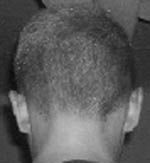
I don’t quite remember when I decided to shave my head. I just remember talking about it non-stop during the months prior to Cuts for Cancer, aggravating more than one floormate. The way I saw it, if I could convince everyone around me that I could do it, then I would no longer have the option of chickening out (pride can be quite the tool).
So on March 25, 2004, I sat with two of my friends in the JDUC while they got their hair cut and I got mine shaved. I didn’t tell anyone from home until after le fait accompli. Despite knowing my history, I didn’t think they would understand.
After, some thought I was brave, others generous, and some just thought I was out of my mind.
I admit, in the end I felt accomplished. I couldn’t help but get teary-eyed when two women came up to me as I walked to get my head washed. Both had cancer, one was a university student and the other a middle-aged woman. They thanked me for doing what I did and I couldn’t help but feel good about it.
A couple of weeks later, I was at a party and a girl came up to me, telling me how much what I did meant to her, how she remembered me from the Cuts for Cancer day, how her friend was fighting cancer and how important an act it was. It was a strange encounter, but it made me realize that no matter what my intention was, it affected others. I couldn’t help but feel guilty.
As much as I’d love to believe in the altruism and righteousness behind my actions, the truth is, it was solely out of self-interest. I tried to convince myself that it would be a way to test my strength of character, of breaking with what was expected of myself as a woman, but that was just a consequence of being bald. I shaved my head for purely selfish reasons. It wasn’t about contributing hair for a wig for a child in need or about raising money (I definitely didn’t raise much). It was just a way of compensating for an insatiable need that I had, a need that had begun to take shape long before I came to Queen’s.
My adolescence was tainted by my mother’s battle with breast cancer. She was first diagnosed when I was 11. At that point, she was given two-and-a-half years to live, but over the next 10 years she went through chemotherapy, surgery and radiation, with periods of remission throughout.
I had a hard time coming to terms with what cancer was all about. I didn’t quite understand what she was going through. My parents made their best effort not to frighten me, leading me to believe that cancer didn’t necessarily equate with death.
I grew up in the Maghreb (a region in northern Africa) and she went overseas to get her treatment, so for the most part, I didn’t really witness the low points.
But most importantly, she never complained about the state of things or gave up. She fought with all her might to stay alive in order to raise me in the best way she could. I couldn’t have wished for a better parent if I were given a choice. My mother’s display of courage over the past 10 years was more than most experience in their lifetime.
By the time my senior year rolled around, things took a turn for the worst and cancer began to haunt every aspect of our lives. She came back home for her treatment that year. It was a rough year, the combination of surgery and radiation caused a lot of irreversible nerve damage in her arm, leaving it partially paralyzed. But the paralysis wasn’t the problem—it was the pain. We tried everything to alleviate her pain but nothing worked. It was unpredictable and unstoppable. At one point she ended up on corticoids that quickly made her gain 10 kg; the chemotherapy that followed took care of that in a matter of weeks. She was bald and feeling more and more self-conscious.
I couldn’t, and still can’t, understand her anguish. All I could do was watch and feel helpless. I can’t imagine what it’s like to watch your body change, to go from independent to dependent on the people you love. She hated the way she looked. She missed her hair, her eyebrows and her energy. All this is to say that I shaved my head in an effort to understand what my mother was going through. I know it doesn’t come even remotely close to anything she’s ever gone through, but it was the best I could do.
After I shaved my head I went through phases where I doubted my femininity. I was self-conscious when I walked into Leonard Cafeteria and felt assaulted by stares. I once went into A&P and this woman wouldn’t stop looking at me disapprovingly. In hindsight, I should have said something, but that incident made me wonder how I would feel if I had cancer, and if I really had to deal with other people’s judgement in addition to my own.
On March 25, 2005—exactly a year after my attempt at bridging that gap of understanding—my mother died.
Shaving my head was the best thing I’ve ever done. Twelve inches of hair replaced the void words couldn’t fill.
All final editorial decisions are made by the Editor(s) in Chief and/or the Managing Editor. Authors should not be contacted, targeted, or harassed under any circumstances. If you have any grievances with this article, please direct your comments to eic@queensjournal.ca.