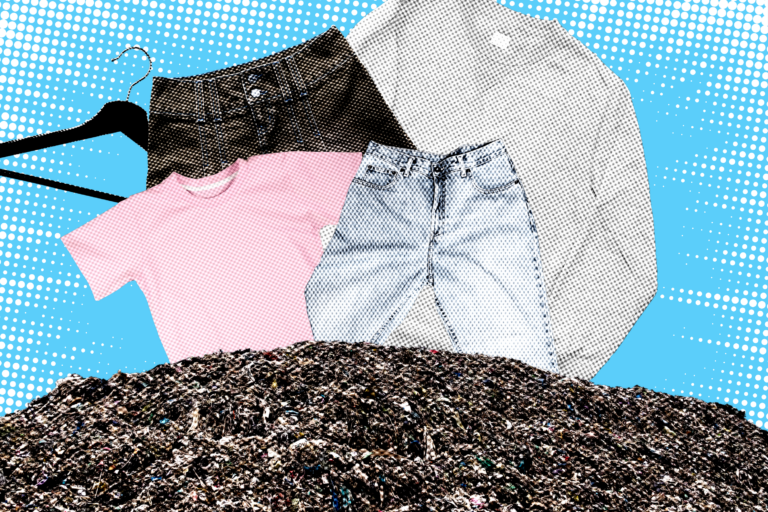
Fast fashion has been on the rise in recent years, but sources say it isn’t the only environmental problem facing the fashion world.
An alternative to fast fashion has emerged: slow fashion. Research and sources argue that slow fashion is the more environmentally conscious option for considerate shopping. It’s described by Oxfam, an international confederation comprised of 21 non-governmental organizations focused on alleviating global poverty, as being the “direct response to the harmful impact of fast fashion on the environment and garment workers.”
Thrift shopping is often presented as a form of slow fashion that’s ecologically friendly, since it keeps clothing out of landfills and gives them a second chance at being used.
The Journal sat down with Queen’s students, fashion clubs, and local business owners to see if thrifting really is as sustainable as it’s been marketed to be.
Queen’s Fashion Industry Network (QFIN) co-Chair Bailey Sutton, ArtSci ’27, believes that there has been “a giant boom in the second-hand market over the last 10 years.”
But she argues that thrifting isn’t synonymous with affordability. Sutton believes the best “pieces” are found at the curated vintage stores, yet that curation comes with a high price tag.
“You go into a “second-hand store,” but it’s all curated stuff, it’s all $100, and the people who actually need this stuff are getting priced out,” Sutton told The Journal. “This is more expensive than buying it at the store firsthand.”
Fellow QFIN co-Chair Laila Maharaj, ArtSci ’27, agrees, mentioning in an interview to The Journal that high prices at thrift stores are starting to become the new normal, especially in major fashion cities like Toronto.
“There are stores and boutique stores that sell second-hand clothing for $100 a piece,” she said. “Who knows if that’s right, but I would say it’s expected.”
Despite the prices, many thrifters continue to choose these stores over the chain thrift stores.
Talize and Value Village accept all variety of donations, resulting in a range of items. People often spend hours digging through racks or bins, hoping to find something that’s good quality and in their budget. At least that’s the case for Kyla Harry, ArtSci ’27, who is committed to searching through racks to find the best and most exclusive items.
“I love thrifting because it gets me really unique pieces for my closet that no one else has, that are no longer in stores,” Harry told The Journal. “I thrift probably once or twice a week if I get bored.”
But some cite the fact shoppers keep coming back as cause for concern.
Sufian Alawiye, ArtSci ’27, believes that many avid thrifters think overconsumption doesn’t apply to them. They automatically believe they are engaging in sustainable practices simply because they’re shopping second-hand.
“I think we think of thrifting as more sustainable [because] the clothing has already been made […] but if you keep feeding into the system, you’re also creating more of a demand for cheap clothing,” Alawiye said. “It’s so much easier to justify buying something because I can donate it and somebody else can wear it.”
Alawiye argues that knowing there’s the option to donate clothing keeps people from thinking critically about their consumption. In the case of thrifted clothing, stores like Value Village only permit exchanges of items, not returns. As such, shoppers are forced to leave the thrift store with essentially the same amount of clothing they came in to return.
According to a CBC article, thrift stores only keep approximately a quarter of all donations, and the rest are being shipped off to other countries or being put in landfills. Avid thrifter Kyla Perkins, ArtSci ’28, understands that thrifting isn’t as sustainable as it appears to be.
“A lot of the clothes at the thrift end up in landfills anyways, because the thrift stores are still rotating through things and they still have to throw things out eventually,” she said in an interview with The Journal.
Perkins asserted that thrift shopping becomes unsustainable when people thrift for trends, a process which is becoming increasingly more common because of social media.
“I think also the media feeds kind of feeds into it as well, just with all the trends,” she said. “You could see a baby doll top at the thrift store and it’s the ugliest thing you’ve ever seen, but no, it’s the best because it’s Abercrombie.”
Thrift stores have left many shoppers with conflicting feelings on the benefits and the pitfalls of thrifting.
“You feel better buying clothes that have already been worn, because then at least they’re not going directly to the garbage or to the landfill, you’re going to wear them,” Harry told The Journal. “But then you end up with a really full closet of clothes you’ll maybe wear once or twice, before you end up bringing it back to the thrift store for somebody else to do the same thing.”
Queen’s For Sustainable Fashion (QFSF) co-President, Kyleigh Phelan, ArtSci ’27, agrees that haphazardly purchasing cheaper clothing from the thrift store is a growing concern.
“I’ve seen a lot of people talk about ‘thrift store blindness,’” she wrote in a statement to The Journal. is when shoppers buy an article of clothing, primarily because it’s cheap, and realize upon getting home that they will never wear it.
Alawiye noted that this is happening more frequently because of the removal of changerooms in Value Village, so shoppers can’t see what the clothes look like on until after it’s already purchased. This results in what Alawiye called “post thrift clarity.”
“I think a lot of people go through that experience of ‘post-thrift clarity’ […] when you get home and you’re like ‘what did I buy?’”
Despite this, thrifted clothes are still widely considered to be “slow fashion,” which is described as the direct opposite of fast fashion in composition and production.
Maharaj argues that while many believe second-hand shopping to be part of the slow fashion movement, it goes far beyond that.
“Anyone on campus might think that [slow fashion] is just about second-hand clothes and thrifting,” she said. “But slow fashion is different. It’s about the values in what’s being made and it’s about the ‘one top forever’ type of thing.”
Montreal Street Collective co-Owner Vanessa Martin believes that slow fashion is “a state of mind.”
Montreal Street Collective is a curated thrift store in downtown Kingston that has been operating since 2020. The shop sells second-hand and vintage clothing, with pieces being sourced from thrift stores around Canada.
“[Slow fashion is] more like a thought process put into what you’re buying, so that it sort of slows down the need for overconsumption,” she said in an interview with The Journal. “If you take your time with each piece you buy, whether that means you’re mending it, you’re reusing it, you’re borrowing it off a friend — all of it just took more time and thought than buying something quickly off whatever site.”
Others agree that slow fashion internalizes the shopping process and requires shoppers to be more attuned to their decisions.
QFSF’s Phelan wrote, “slow fashion simply involves being more aware of what choices you make when it comes to clothes. Are you picking something because you absolutely love it, or is it just the latest fashion fad that will go out of style in a few weeks?”
After working in retail for a year, Alawiye noticed that, on a larger scale, companies need to make fewer things for people to consume.
“I worked in a store and we had new clothes coming in every month,” he said. “The reality of the situation is that there are way more clothes than there are people in the world. There’s a huge surplus.”
Some fast fashion brands receive multiple clothing shipments a week, meaning there are more clothes are made than there are people to wear them.
Harry believes that these brands are focused on producing whatever is trendy because it’s what people are demanding, explaining, “[stores are] going to make whatever’s trendy if there are people out there who are going to buy it.”
“As you get pickier, you’re just going to buy less,” Alawiye said.
Sutton and Maharaj agree that the easiest way to get into slow fashion is to wear your clothes. Many clubs on Queen’s campus show their commitment to slow fashion through upcycling courses and clothing swaps.
“We just recently did the Sidewalk Sale, where we got execs to do curated donations,” Sutton told The Journal. “We were able to sell a lot of them to people at the sidewalk sale, and a lot of first years.”
QFSF aims to embed sustainable practices into all aspects of their club.
“Many of our events focus on direct ways for Queen’s students to participate in sustainable fashion, such as our Blind Date with a Fit event, and Clothing Swaps,” Phelan stated.
Both clubs hope to implement introductory sewing programs to demonstrate what can be done with what’s already available.
“I think it’s also being able to work with what you already have and not just buying more clothes for the dopamine rush of it,” Sutton said. “Knowing what you already have and being able to rework things, repurpose things, and restyle things.”
When the time comes to shop again, students believe it is most important to think carefully about the purchase. Sutton and Maharaj emphasize intentionality when shopping second-hand.
“Just be super intentional with your purchases,” Sutton said. “Not impulse buying is a great way to be sustainable from the beginning, because you’re going to hold those pieces for a long time.”
For Alawiye, this also means being certain that the clothing is the perfect fit. “Everything you should own, you should really, really love and want to put on in the morning,” he said.
Many find it challenging to make the change to slow fashion, but Martin encourages shoppers to really think through their purchases and reminds them not to feel bad if buying new is their best option.
To successfully participate in slow fashion, sources agree shoppers themselves have to slow down. As Phelan wrote, “it can be easy to fall into a cycle of online shopping and wanting to wear the hottest new thing, but I find it much more rewarding to have a smaller amount of clothes that you truly love and will wear time and time again.”
Tags
ethical fashion, Fashion, Sustainability, thrifting
All final editorial decisions are made by the Editor(s) in Chief and/or the Managing Editor. Authors should not be contacted, targeted, or harassed under any circumstances. If you have any grievances with this article, please direct your comments to eic@queensjournal.ca.