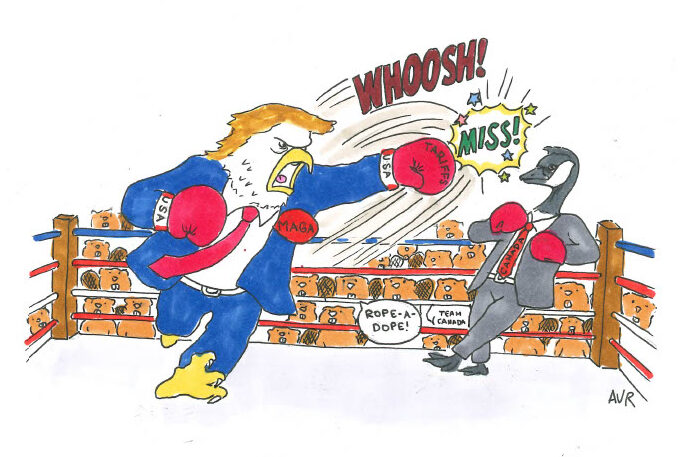
The Canada-U.S. trade war just got real, and we need to prepare for pain.
On Aug. 22, the high-stakes trade negotiations between Canada and the United States collapsed. Canadian Prime Minister Mark Carney cited last minute “unacceptable” demands by the Americans as the reason why talks failed. American tariffs of 50 per cent are now in place on a wide array of Canadian goods.
Certainly, Canadians should some have some pride in our politicians for standing up this strongly against the U.S. The American proposal was ridiculous and as Carney mentioned, unacceptable, and walking away from the negotiation was the right thing to do.
But these tariffs will be significantly more impactful than in the previous spats between Canada and the U.S. Real, material economic pain will come from these tariffs.
Despite our government’s best efforts to diversify the Canadian economy away from the U.S., the Americans remain Canada’s largest trade partner by a considerable margin.
The American consumer base is substantially larger than Canada’s, and many Canadian businesses rely on a consistent supply of American consumers to sustain their business model, especially for smaller businesses.
The Canadian consumer base simply cannot replicate the size of the Americans. And no market, not even the European Union, can replicate the U.S.
Damage will be disproportionate; the American economy is twelve times bigger than the Canadian economy, and our retaliatory measures can only go so far.
As students, we have been shielded from the full effects of Canada-U.S. trade disputes, but we are likely to see a considerable impact on the livelihood of most working Canadians.
However, even students won’t escape the effects of these tariffs. The cost of living, groceries, and everyday consumer products we take for granted are all about to get more expensive.
We might’ve been shielded before, but not anymore. We are going to see the effects of the trade war firsthand in a way we haven’t seen before.
Still, this latest iteration of the trade war will affect working-class Canadians and, ironically, Americans the hardest. Industries that barely started to recover from Covid-era inflation, the rising cost of raw materials, and years of economic stagnation will face an unstable, bleak near future.
The Canada-U.S. relationship is gone and will not be coming back. The Canada we grew up in — the country with a stable trading relationship with our largest consumer — is a relic of the past.
Despite this, the pace of change– 18 months still Trump began his second term – is still astounding. Canadians may be acclimated to Trump’s antics and absurdities, but it still comes as a shock that it has gotten to this point.
There’s also a component of uncertainty. There’s no guarantee that the apparent disdain for Canada is limited to Trump or MAGA, and any future trade agreement may come under threat, depending on who the American people elect.
This was always a lose-lose situation. For holding out, we we’re hit with the brunt of astronomical tariffs. If we accepted, we surrendered our sovereignty. No one will win, but it’s frightening nonetheless to accept that we are about to undergo the most intense trade war we have ever experienced in our lifetimes.
We need to remain vigilant and united as Canadians in the face of Trump. The worst we can do is accept any form of complacency, and we must brace for impact.
— Journal Editorial Board
Tags
Canada, Sovereignty, tariffs, Trade War, Trump, United States
All final editorial decisions are made by the Editor(s) in Chief and/or the Managing Editor. Authors should not be contacted, targeted, or harassed under any circumstances. If you have any grievances with this article, please direct your comments to eic@queensjournal.ca.