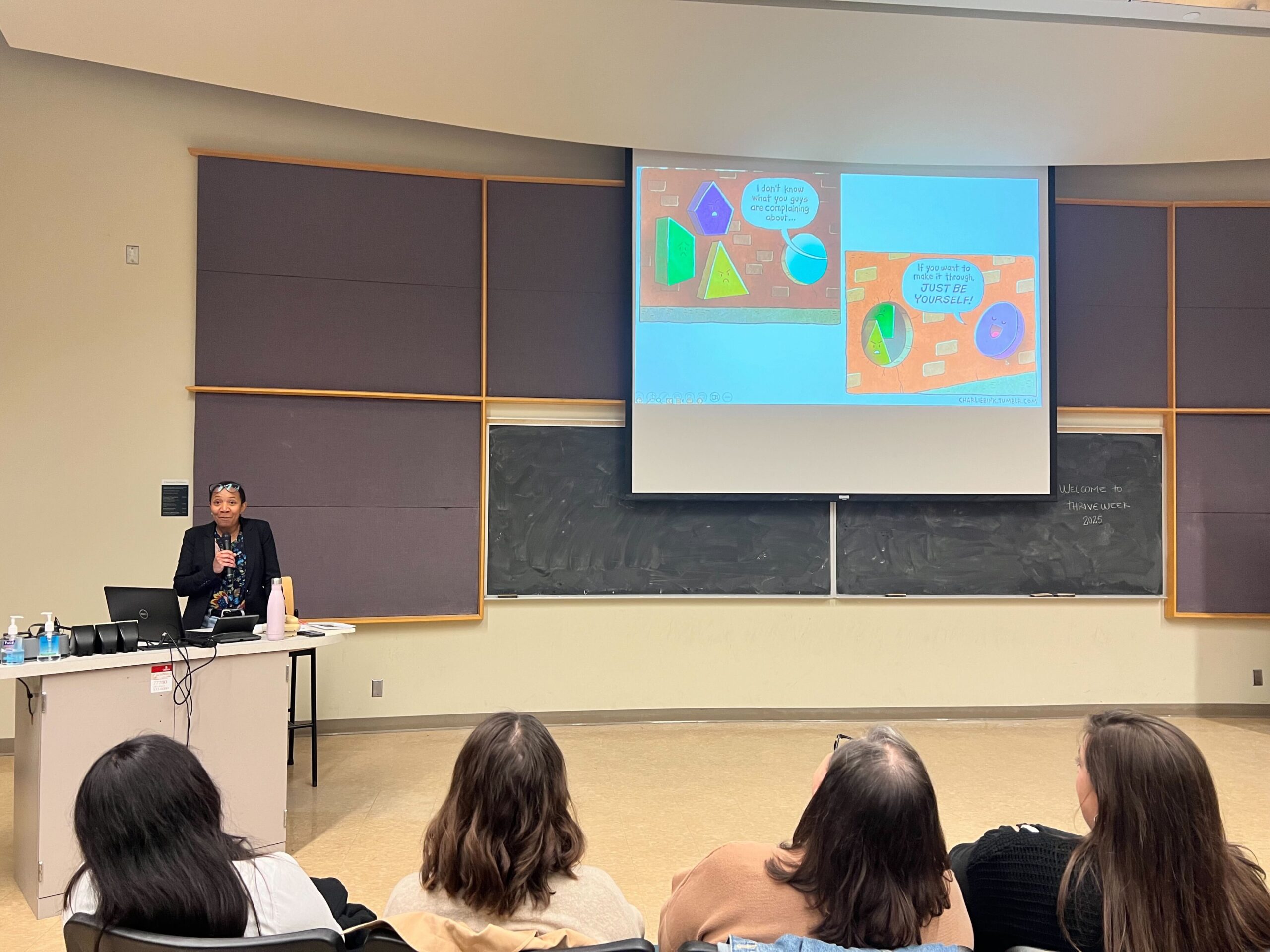
Stephanie Simpson began Thrive Week with a simple message: belonging starts with honouring everyone’s stories at the University.
This past week, Queen’s began its celebration of Thrive Week—an annual event focused on building positive mental health. The series began with a keynote address from Vice-Principal (Culture, Equity, Inclusion) Stephanie Simpson, which took place in Chernoff Hall on Nov. 3 from 9 to 10 a.m., and filled more than half of a lecture hall with attendants. Keeping with this year’s Thrive Week theme, “Thriving Together: Cultivating Connection, Inclusivity, and Community,” Simpson shared her experiences with belonging and community-building at the University.
She began her address by paying homage to last year’s keynote speaker, Chancellor Shelagh Rogers. Simpson pointed to the emphasis Rogers had put on the power of sharing stories and its ability to “reveal our common humanity.” Inspired by these words, Simpson dedicated her speech to further exploring the idea of story and its role in fostering a sense of belonging and shared purpose.
As a child growing up in a Caribbean household, Simpson had loved storytelling—whether it was reading stories or writing her own. When she first came to Queen’s as an undergraduate student in the 90s, Simpson had expected the school to be a place where her storytelling and intellect could flourish, but she was quickly introduced to a much harsher reality.
“At Queen’s in the 90s, there would be very little welcome for me,” Simpson said. “[…] The profound absence of attention to diverse perspectives, realities and contributions to intellectual life and society taught me was that people of my background and my ancestry didn’t exist in any meaningful way in this reality. […] Our Stories didn’t matter.”
Her encounters with both overt racism and racist micro-aggressions impeded her creative thinking and threw her into a deep depression. Simpson cited a small community of Black students and their collective strength and celebration of one another as being the only way she was able to make it through.
Still, decades later, Simpson’s struggling to reclaim her creativity and storytelling. While Simpson claims she’s “not sure she will ever resurrect her writing self, she tries not to let this idea trouble her or put too much pressure on herself to be perfect.
“We’re forever being told that we’re not quite good enough, and we must level up to the perfect people,” Simpson said. “This isn’t respect for our diversity. This doesn’t foster a sense of belonging. But we can counter this by connecting with ourselves, standing in the truth of our stories, and speaking courageously and confidently from that place.”
While Simpson claimed the Human Rights and Equity Office has been working hard to increase equity and diversity at Queen’s, she also acknowledged the political attacks on these ideals currently happening in North America. She categorized this political moment as an attack on “free inquiry itself,” and an undermining of the democratic rights of post-secondary institutions.
“The impact of these policy decisions has already reached Canadian universities,” Simpson said. “We need to prepare for the possibility that universities here will need to navigate increasingly complex political environments in the years to come, while remaining true to our institutional values and attempting to plot a course forward.”
In a statement to The Journal, Simpson clarified that the “public health crisis of the pandemic, chronic underfunding, and the locally experienced impacts of geopolitical conflicts” have also played a role in making these past few years challenging for the equity sector.
Simpson concluded her address by emphasizing the importance of universities remaining places where cultural diversity informs every aspect of learning, and people honour each other’s stories and common humanity.
Events related to Thrive Week will conclude on Nov. 7, with salsa lessons, a jewelry making workshop, and a wellness walking tour.
Tags
Belonging, Stephanie Simpson, Thrive week
All final editorial decisions are made by the Editor(s) in Chief and/or the Managing Editor. Authors should not be contacted, targeted, or harassed under any circumstances. If you have any grievances with this article, please direct your comments to eic@queensjournal.ca.