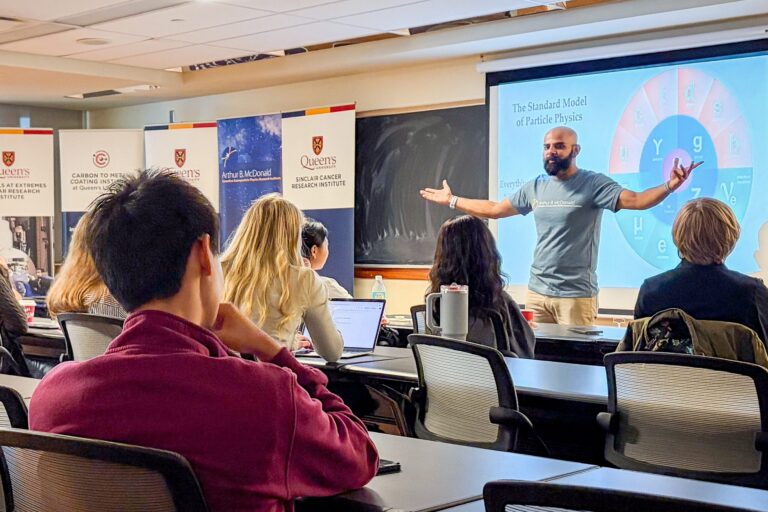
Students had the opportunity to unleash their curiosity in Chernoff Hall last Saturday to mark Science Literacy Week.
The annual week-long celebration is organized by the Canadian Association of Science Centres to inspire the next generation of leaders in STEM. This year’s week from Oct. 4-11, with over 170 events across Canada open to the public.
Four tier-1 research institutes came together for the first time to host “Let Curiosity Radiate: Exploring Radiation,” a full-day science exploration event at Chernoff Hall on Oct. 3 for high school students and first-year undergraduates.
“This year’s theme was curiosity, unleashed — curiosity being one of the key pillars for scientific research,” said Nikhil Arora, MSc ’18, PhD ’22, an education and outreach officer at the Arthur B. McDonald Canadian Astroparticle Physics Research Institute, in an interview with The Journal.
Radiation is energy in the form of particles or waves, like when an atom goes from a high energy state to a low energy state by emitting a particle, explained Arora.
Radiation can either be ionizing or non-ionizing, depending on its energy. Ionizing radiation has enough energy to remove electrons from atoms and can be harmful at high doses, but it can also be harnessed for medical imaging, cancer treatment, and scientific research.
The day featured workshops from each institute exploring radiation’s role in cancer treatment, understanding the universe, and generating nuclear energy.
Arora introduced radioactivity and the “Lego blocks that make up the universe,” followed by a presentation on nuclear energy from the newly launched MAX-Nuclear Institute, which studies the interactions of materials in extreme conditions like nuclear reactors.
The group then toured the Sinclair Cancer Research Institute, attached to Botterell Hall, where they saw a CT scanner, which combines X-rays to create detailed 3-D images of the body, and a linear accelerator, which delivers high-energy X-rays or electrons to destroy tumours.
After lunch, Tetyana Levhchenko, a research, training, & outreach coordinator at the Carbon to Metal Coating Institute (C2MCI), gave a workshop using x-ray crystallography to reveal the exact atomic structures of gold nanoclusters.
The C2MCI’s research includes studying carbene-coated gold nanoclusters to improve treatment for hard-to-treat cancers.
Outside of potential therapeutics, Levhchenko also wanted to show students that “nanoclusters are cool — not just cool, they’re beautiful. The symmetry is something that makes nanoclusters special,” she told The Journal in an interview.
Arora ended the event by walking through the story of the Nobel Prize-winning Sudbury Neutrino Observatory (SNO) experiment, asking, “What if we understand radioactivity so well that we can filter it out? What does the universe have to tell us then?”
The SNO experiment took place at what is now SNOLAB, two kilometres underground in Sudbury, where thick rock reduces background radiation by a factor of 50 million, helping resolve a long-standing puzzle in physics by showing solar neutrinos change identity and have mass.
As a graduate student, Arora ran the Queen’s Observatory, sparking his passion for outreach and science communication. He now also leads the Canadian Astroparticle Physics Summer School (CAPSS), an intensive week-long program for second and third-year undergraduates that takes them to SNOLAB in Sudbury for an in-depth walkthrough of the experiment.
Levhchenko believes students left the event understanding that “science is about collaboration,” by exploring radiation from different perspectives and seeing how physics and chemistry work together. She also hopes the event destigmatized radiation by showing how it can help scientists gather useful information.
For Arora, the takeaway he wanted students to have is that “science is about problem solving,” and that “the universe is understandable to the level we want to understand it […] not just by the people who did this work or who won the Nobel Prize, but every single person who studied science.”
“This idea that the universe is understandable becomes a fairly empowering thing to have,” he said.
Tags
All final editorial decisions are made by the Editor(s) in Chief and/or the Managing Editor. Authors should not be contacted, targeted, or harassed under any circumstances. If you have any grievances with this article, please direct your comments to eic@queensjournal.ca.