This article mentions eating disorders, specifically anorexia, and may be triggering for some readers. The Canadian Mental Health Association Crisis Line can be reached at 1-800-875-6213.
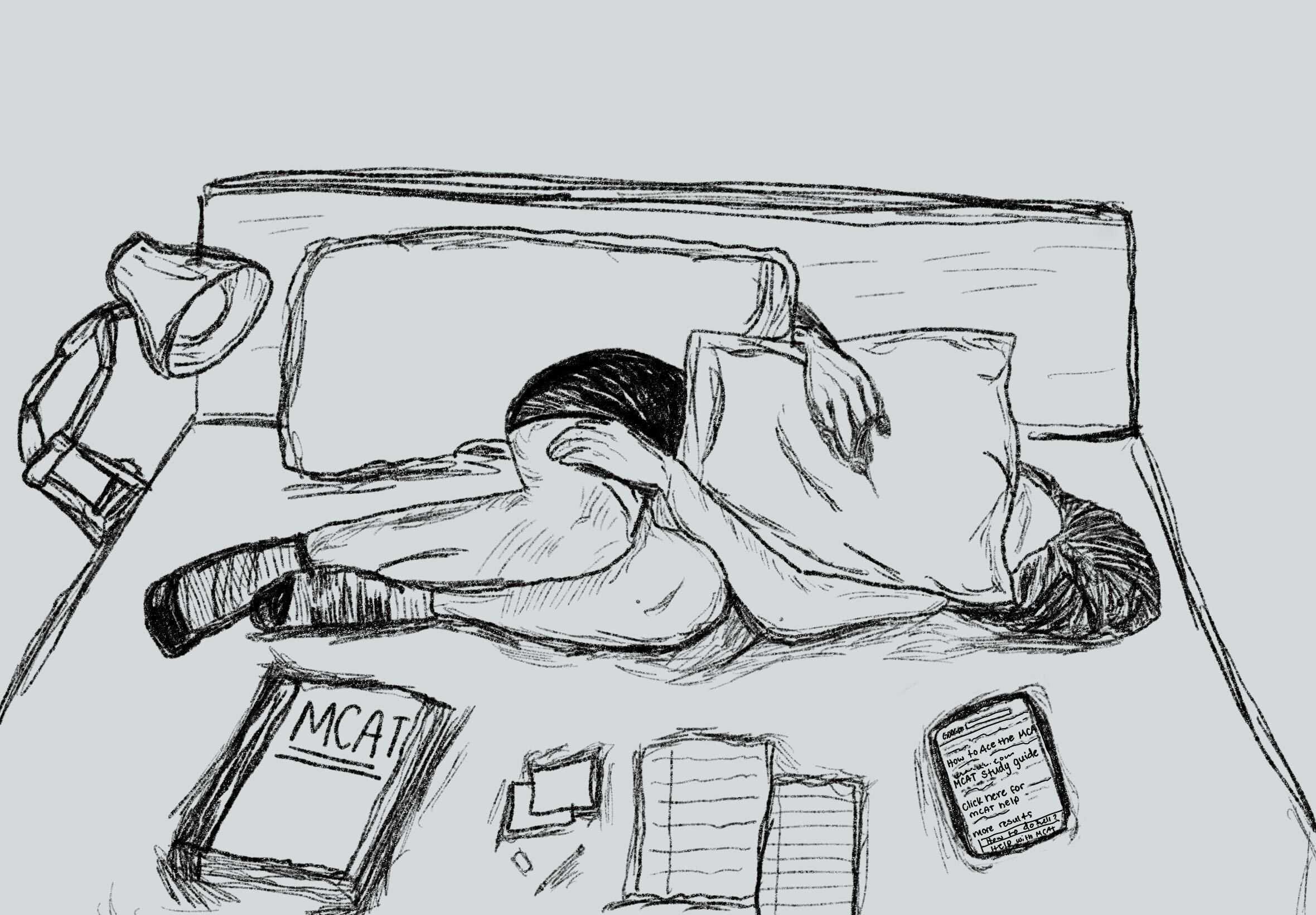
I don’t know if the Kaplan MCAT prep bundle actually weighs fifteen pounds, or if I’m just not that strong. Either way, when I set those seven books on my desk at the start of summer, I felt the weight of them. Physical weight I could measure. The rest—the weight I’d carry through June, July and into August—I couldn’t have anticipated, even though I should’ve.
I started with the behavioural sciences book since it made sense to me. I’ve always been drawn to how our brains work; the psychology behind why we do what we do. Better to begin with something I’d actually want to study before facing the subjects I absolutely hate. A few days in, I reached a chapter that made me stop. The opening paragraph was about eating disorders.
I remember feeling something close to relief. Finally, representation of a mental illness that’s truly difficult to understand—one I’d lived with for three years. One I thought I’d left behind. I kept reading, waiting for the depth, the nuance, the acknowledgment that eating disorders have the highest mortality rate of any mental illness. But that was it—just the opening paragraph. The chapter moved on. I closed the book and kept studying.
Before I started studying for the MCAT, I did a bit of mapping. Recovery had taught me to check in with myself, to prepare. I knew what I needed.
Though, it’s easy to start something; easy to feel motivated at the beginning. What comes after that peak is the turning point where everything goes downhill, where everything falls apart, and it’s never like you planned it. I watched a friend study for the MCAT the year before. I saw them struggle and I thought I could handle it differently. Better, even. I was wrong. I completely undermined my own coping mechanisms, the ones I’d carefully built during recovery from anorexia.
I even went on Reddit and searched “eating disorders and studying for the MCAT.” A few posts encouraged people with EDs to get help, to be gentle with themselves. Most were about stress eating, about managing your diet during this difficult time.
Diet. That word. It follows you everywhere, disguised as wellness, as self-care, as optimization. I didn’t know studying for something like this would take such a mental toll, especially after I’d worked so hard to come out of something I never wanted to return to.
Around late June and early July, I almost started relapsing. The thing is, I’m quite self-aware now. Years of therapy taught me to recognize my patterns and understand why my body reacts certain ways. I knew exactly why my habits were happening. I just couldn’t stop them.
The walks started as breaks. Fresh air, a time to clear my head and step away from the books—that’s what I convinced myself of. But the real reason, the subconscious one, was making sure I didn’t gain weight. Not in a normal, healthy way, but in a way where the thinking was disordered—one where I would feel guilty if I didn’t walk. The brick was back.
I call my ED mind a brick. It’s heavy, it sits on my thoughts and controls my everyday patterns. You learn to cope with it enough to live your life, but sometimes it feels like a battle you’re fighting with one arm tied behind your back.
I tried to make the walks sustainable. I’d call a friend and we would go on virtual walks together while they walked wherever they were, or I’d treat myself to Starbucks. I wasted quite a bit of money that summer just to keep myself moving, keep myself distracted, keep myself from thinking too hard about what I was subconsciously doing.
Day-by-day, I was getting consumed by eating thoughts. And day by day, I kept suppressing them. Even after years of therapy drilling into me that suppression doesn’t work, that the more you push feelings down, the stronger they come back up.
The Yerkes-Dodson Law—something I learned in that same behavioural sciences book—said that arousal and performance follow an inverted U-shape. Too little stress and you’ll underperform, but too much and you’ll crash. I was climbing toward that peak, adding the pressure of an eating disorder relapse onto exam stress, and I could feel myself approaching the edge.
At one point, my appetite just stopped. And I was happy about it, even though I shouldn’t have been happy. The moment I felt that excitement was when I knew: my eating disorder was back—I was relapsing. I was happy because I didn’t have to put in the effort to restrict anymore. My body and mind were already so stressed that they’d decided studying was the only essential thing, and appetite became expendable.
But I knew I had to eat. I knew I had to fuel my brain to study. That was the conflict—one I’d resolved before in recovery but couldn’t manage at this point in my life because it felt like my eating disorder was the only thing I could control. I couldn’t control the outcome of my MCAT. That depended on studying hard, which became harder every day with the ED mindset taking over.
It was heavy, and nothing like I’d experienced before. Not just the restrictive eating and disordered thoughts, but the added stress of waking up at 8 a.m., studying for six to seven hours straight, and doing Anki cards every day. It was hell. Literal hell.
My whole body felt inflamed. I tried to keep myself together throughout the summer, but things kept going wrong. My routine was mechanical: wake up, eat breakfast, study, eat lunch, study more, walk (Starbucks), maybe dinner. Then I started skipping lunch. Then came the days when I got too close to my exam date, and stress manifested physically.
Three days before my MCAT, I developed acid reflux so severe I ended up in the ER. The pain was sharp and constant. I couldn’t eat without my stomach stabbing me. Sitting in that emergency room, hooked up to monitors, I felt something I’m still ashamed to admit I was glad. Glad I couldn’t eat without my stomach hurting. It meant I didn’t have to battle the restrictive mindset. I didn’t have to struggle to resist food. The brick was doing the work for me.
I knew at the time how horrible it was, but the ED mind is loud. Louder than logic, louder than self-preservation, louder than everything I’d learned in recovery.
The day after my MCAT my body wouldn’t come down from the elevated stress. I thought I’d lie in bed and decompress for at least a day, but instead I was travelling by myself, for the first time, to India.
It was great—truly, it was—but my body wouldn’t recover from the trauma I’d put it through. I got sick in India. I refrained from eating much because I didn’t want to get sicker. Then the panic attacks started. I’d be fine one moment, and then my chest would tighten, my breath would shorten, and I’d feel like everything was collapsing inward. It wasn’t just exam stress anymore. It was months of suppression catching up.
I came home three days earlier than my family. I needed to. I couldn’t hold it together anymore.
When I got home, I did what I always do after trips: I stepped on the scale my mom had hidden. 10 pounds down. And there it was—the breakdown, the total low. I was happy. I’d followed what the brick told me to do. And then I cried, because I realized what I’d done.
The overachieving mindset that started my eating disorder in grade 12—the need to excel, to be perfect, to control something when everything else felt chaotic—had shown up again. Different context, same pattern. I was diagnosed with anorexia again in September.
My mom helped me a lot during this time. I’m genuinely lucky to have her. She’d visit, we’d talk, gossip about nothing important, never about the ED. It helped me see beyond what was happening, to enjoy the simple things in life again. Slowly, I found my way back. Not all at once, not in a straight line, but back, nonetheless.
I’ve relapsed before. But this one lasted longer than the others. There were moments I thought there was no return, that I’d lost myself completely to the brick. Recovery is never linear—I know that now in a way I didn’t before. Even after you’ve recovered, even after years of work, you might relapse. And when it happens, you need to find that courage to be kind to yourself again. To remember that falling doesn’t erase how far you’ve climbed.
I’m writing this because other pre-meds struggle with eating disorders too, and we’re never mentioned enough. Not in the MCAT prep books, not in the Reddit threads, not in the conversations about wellness that really just mean optimization.
The MCAT books still sit on my desk. They weigh fifteen pounds. But that summer taught me that the weight we carry in pre-med culture—the pressure to perform, to be perfect, to optimize every aspect of ourselves, including our bodies—weighs so much more. And while that weight is real, while the stress is inevitable, it shouldn’t cost us our well-being. It shouldn’t make us forget that we’re human first, and students second.
Tags
MCAT, Mental health, Postscript, Student life
All final editorial decisions are made by the Editor(s) in Chief and/or the Managing Editor. Authors should not be contacted, targeted, or harassed under any circumstances. If you have any grievances with this article, please direct your comments to eic@queensjournal.ca.