Discussions of global warming can be anxiety-inducing, but art offers a way to explore environmental issues in a less daunting fashion by reflecting on our humanity and our relationship with nature.
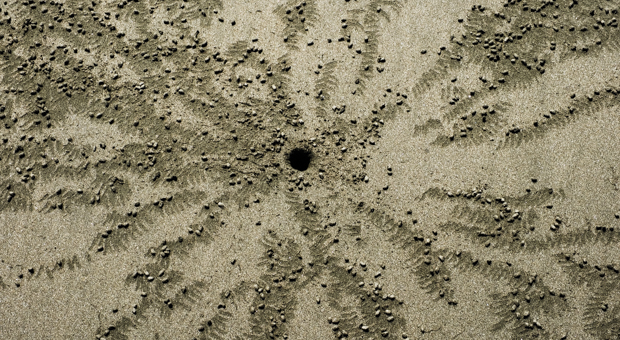
Photographer and bookbinder, Peter Sramek’s exhibition, The Abstraction is not the Reality, ran from July 4 to 9 at the Tett Centre. The exhibit showcases close-ups of photos of debris, and natural drawings made by crabs and snails in the sand, exploring the power and beauty of nature in contrast to human action and consequence.
Sramek’s passion to explore concepts of sustainability, eco-damage, and climate change through his photography derive from his love of nature.
“I’ve always been one to connect with nature and spend a lot of time hiking in the mountains, camping, and being out in the forest. Over many years, I’ve found that to be a grounding place for me,” Sramek said in an interview with The Journal.
The first half of the exhibition is close-up photos of plastic debris arranged on the remote beach Sramek was visiting in Costa Rica.
“Here we were in this pristine environment, surrounded by nature reserves, and there was all this plastic trash coming from our outside world where we live,” Sramek said.
The debris had been arranged in an aesthetic, pictorial way by the waves, causing Sramek to view the plastic arrangement on the beach as a metaphor for how we can abstract our thinking about things such as waste.
“It was an exciting antidote to seeing all the plastic trash,” Sramek said.
Sramek used Japanese washi paper for the photos to give them the surface quality of printmaking. He hung them off the wall for the paper to flutter with the air, offering the photos the feeling of being alive, the noise reminding him of the sound of the waves on the beach.
The second part of the show featured photographs of natural drawings made by crabs and snails in the sand on the beach. Sramek contrasted the animals’ patterns with those of humans, highlighting that humans often create to conform to certain notions of creativity, rather than simply expressing it.
The crab’s drawings were something natural and beautiful, emphasizing how nature thrives without humans.
“When we make art as humans, we’re conscious of what it is we’re doing. We’re seeking for something that relates to how we personally or culturally define art. It isn’t just that we are being creative, it is that we have an idea [of] what creativity is and what the activity is,” Sramek said.
Humans use art to assert our uniqueness, but crabs are making drawings that resemble 20th century abstract art, calling attention to this irony.
While standing next to a 1000-year-old cedar in the South of Japan, Sramek expressed his awe at feeling so small compared to these ancient trees. Yet, he still felt part of this big, powerful world. This sentiment is consistent throughout his art.
Tags
Art, FYIF2024, Isabel Tett Centre, nature
All final editorial decisions are made by the Editor(s) in Chief and/or the Managing Editor. Authors should not be contacted, targeted, or harassed under any circumstances. If you have any grievances with this article, please direct your comments to eic@queensjournal.ca.
Susanna Gordon
Thank you for writing this article about Peter’s exhibition “The Abstraction is not the Reality”. We were fortunate to have his photo-based artwork on exhibit in the Tett Gallery in July. I found the photographs of the tiny “footprints” of the crabs and snails to be very interesting. I haven’t really taken the time to notice those kind of markings so it’s a reminder to slow down and observe when out in the world. Also, the natural markings on the beach in Peter’s photographs reminded me of tire markings in a desert, taken by a drone far overhead – two very different perspectives.