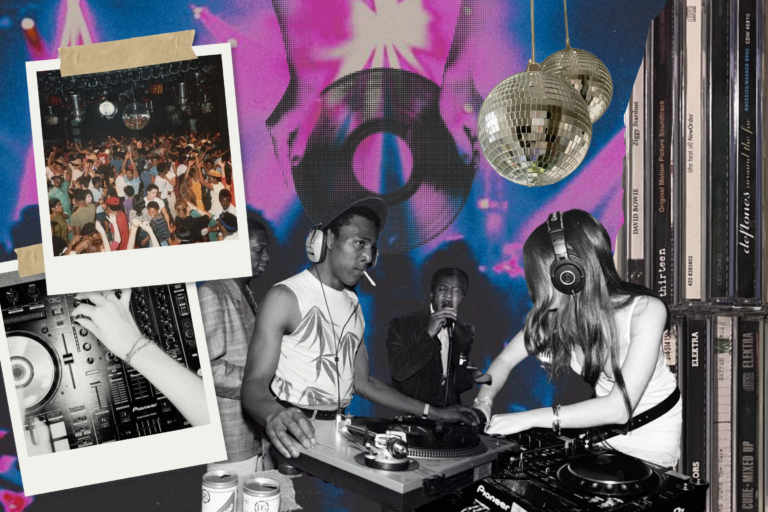
A sweaty mob of university students, clutch dollar beers and vodka cranberries, waiting for something to happen. Then the Disc Jockey (DJ) plays the right song—and the dance floor erupts.
Nowadays, with the rise of digital DJing, prices for digital DJ equipment are much cheaper than equipment needed for turntablism. As well, digital streaming brings a plethora of music right to the DJs fingertips, whereas, in the past, DJing relied on the difficult and more expensive practice of finding vinyls. As a result of this technological democratization, DJing for students is alluring and doable, as seen with Stages Nightclub’s Amateur DJ Competition from Jan. 27 to Feb 10. Yet, discourse circulates the Kingston DJ world about whether this change in DJing is truly for the better.
Over the end of January and beginning of February, Stages Nightclub hosted an Amateur DJ Competition where six local student DJ’s from Queen’s competed for a $1000 award, with the contestants including: Angelina Liu, ArtSci ’26, Ellie Sun, HealthSci ’26, Devin O’Grady, ConEd ’26, Matthew Witz-Tsofin, ArtSci ’26, Riley Spavor, CompSci ’26, Max Logunov, CompSci’27. Despite only picking up DJing in the last year, Liu won the competition, which sparked a broader conversation among DJs about why students continue to be drawn to DJing, even though the music scene has changed so much.
The competition was centered around Amateur DJs, but Kingston is no stranger to DJing with live student DJs taking over the local bars and clubs every weekend. In a time when everyone can access a world of music at the tip of our fingers, there’s some sort of magic within the art that keeps DJ’s in Kingston booked and spinning.
It seems here in Kingston, you can throw a vinyl record out the window and hit a DJ, and The Journal sought to find out what is drawing so many people to the art form.
“The rise of DJs has sort of been very enabled by digitalized DJing, for example those little controllers, like the one I started on. [DJing] is more accessible, which really helps with accumulating that like for creating a passionate hobby and being able to go further with it,” said Mina Saban, ArtSci ’26, Stages only female resident DJ, in an interview with The Journal.
Liu believes digital streaming has made it easier for DJs to familiarize themselves with more music, leading to more diverse and well-rounded sets.
“I think people have a larger knowledge of music than they did before because of streaming, so that’s a good thing, because only a human person can respond to the human energy they’re feeling and observing. Since people have greater music bases and a greater selection of things they like, there’s more opportunity to effectively respond,” Liu said in an interview with The Journal.
Echoing a similar sentiment is Kingston DJ, Laura Kelly, ArtSci ’14, founder of Many Moons Events, has been working as a DJ for over 20 years at venues such as The Toucan, Hotel Wolfe Island, Musikki Cafe, and The Grad Club. Though Kelly is a vinyl DJ, she also sees the positives that accompany digital streaming. “A lot of my favourite DJs are younger than me and they grew up listening to music in a digital format and they know more about music than me because they’ve had access to everything at their fingertips,” Kelly said in an interview with The Journal.
However, as a vinyl DJ herself, Kelly appreciates the tactile element of DJing. She was introduced to DJing through the campus radio station, CFRC, and mentions fond memories of going through the shelves of CDs and vinyls to find new music.
“When you get a digital file to download, it’s much less tactile. I feel it’s a lot less exciting. I discovered music, literally by judging a record by its cover,” Kelly said.
Feeling similar nostalgia for the old age of music is Vanese “VJ” Smith, a DJ and music producer in Toronto, was a DJ in the nineties, who continues to work in music production today. She is the co-founder of Loop Sessions Toronto, a music organization that focuses on vinyl record culture. From Jan-March, she recently hosted a winter residency at Queen’s about DJing and music production. Smith was also a consultant involved with a Disney Channel original movie about young DJs called Spin (2021) that was filmed in Brampton, Ontario. She has a cameo in the final scene that was filmed at Rebel, a nightclub in Toronto.
“It’s a different world now. It’s easy to hop on a laptop and find new music, but before I used to scour record stores for new music, and I would read music magazines to find songs that I loved. Once I found songs I loved, I wanted to share them with others to see if they’d love it too. It became a way to connect, and DJing and music became a way to share and tell a story that was unique to you,” Smith said.
While reflecting on the way the music world has shifted from physical and digital, Smith mentions having the utmost respect for the “generation whose trained their body and devoted themself to the craft.”
“I think the biggest issue with the way music is treated right now. There’s too much music, while there are a lot of options, but we’re only human and our brains can only hold so much,” Smith said in an interview with The Journal. Smith encourages student DJs to learn about DJing’s rich history and to critically engage with music and music production. In his memoir, titled Night People, Mark Ronson, 10-time Grammy winning DJ and music producer, wrote about his experience as a turntablist in 90s New York City. He writes in Night People that he’s telling “a tale of nineties New York—a time when DJing wasn’t about being a Spotify lord, punching play on your biggest tunes in Vegas for two hundred stacks. It was the domain of faceless maestros who knew a disco classic.”
Even for some younger DJs, that era still holds a certain mystique within the DJ world.
For Toronto audio engineer and DJ “FORTYFOUR”, Maxwell Murchie, who has collaborated with Mike Kiofos (2x Juno Nominated producer and song writer), DJing in the nineties is a romantic idea. “Sometimes I sit and fantasize oh man, if I was a DJ in the 90s, it’d be so much better,” Murchie said in an interview with The Journal.
Despite the changes that DJing has faced through technological democratization, other DJs argue there are a lot of benefits to DJ in the post-streaming world.
“Nowadays, you can visualize the tracks playing and sync it up with the press of a button, so [DJing] is a lot easier technically and a lot newer programs help with that, making it easier for the average person to get into. But Djing is about 20 per cent technical work and 80 per cent feeling the crowd, knowing what to play, and trying to get the energy moving. That’s the hardest part because it can only be obtained from experience,” Max Logunov said in an interview with The Journal. Logunov competed in the Stages DJ competition on Jan. 27. He started DJing six years ago, taught by celebrity radio host, DJ Gagarin.
Though times have changed in the DJ world, student DJs tell The Journal that the importance of DJing has remained because of the human connection that it inspires, a sentiment that’s echoed by one of the most famous DJs currently working in the music scene.
Ronson writes in his memoir that DJing is like having “sex with three hundred people at once. A high fueled by our strongest instincts: connection, belonging, sharing, and compassion.”
However, not only DJs believe that DJing is a way to unite a group of people. “[The most valuable thing about including a DJ] is dancing. Dancing completely changes the energy of an event. It brings people together. Good DJing encourages dancing and human connection,” said Associate Curator, Academic Outreach, and Community Engagement at Agnes Etherington Art Centre, Nasrin Himada in an interview with The Journal.She argues that DJing belongs in the art gallery because it’s just as much an art form as any other. She mentions that working closely with DJs in art curation is an absolute game changer for overall event quality.
Dancing, music, mixing are all related, in Himada’s view, as different forms of artistic expression that encourage human connection.
“DJing is inseparable from music and sound in all their aspects, which are crucial for art galleries and curation,” Himada said. As well, she points out that she wants more students to engage with Agnes and to encourage this, it’s crucial to have these creative and lively spaces at the museum.
As an observer, Himada notes that DJing is so valuable in shaping the atmosphere of an event. DJs confirm that this awareness of the crowd’s energies is necessary in creating a successful set.
“[DJing] really brings a curated energy to the dance floor and that is something that AI simply cannot do— it requires presence, being tuned in with others, seeing the vibe and figuring out what people are into,” Saban said.
This responsiveness is what many DJs say is at the heart of the craft.
“You’re curating someone’s experience with the way you’re arranging songs. You’re observing an audience, you’re feeling off of what they want and their energy. I would say that the art for me has always come from creating an experience through music,” Kelly said.
According to Kingston DJ’s, the ability to read the room and respond is what sets DJs apart from solely playing a curated playlist.
“It’s nice seeing your music get appreciated in real time and it’s really fun to control the energy of a room, based on what music you’re DJing. It’s about creating an atmosphere, you’ve got to take the crowd through a journey, rather than keep the room static,” Murchie said.
For many student DJs, the journey into the booth begins with a simple love of music.
Liu was also introduced to DJing through her passion for music, an outlet she was particularly attached to last year over her exchange to Auckland, New Zealand. On a whim, she decided to try DJing with one of her exchange friends. “The atmosphere of being on exchange, when you’re in a city where nobody knows who you are, kind of fuels you to try a lot of new things, and things that I wouldn’t normally do here. But I ended up bringing a lot of those things over, including DJing,” said Liu.
Liu won Stages’ Amateur DJ competition and has also DJed at Daft Brewing and Royal Tavern, even though she only started mixing around eight months ago.
For undergraduates students looking to get into DJing, student DJs at Queen’s agree that other students should just go for it. “My advice: don’t let anyone stop you. If people are trying to convince you not to block out the noise and you’re going to see results,” said Saban. She was sometimes nervous and doubtful before starting to DJ professionally, especially as the only woman DJ at Stages, but she pushed through those feelings and recommended others to do the same.
Student DJs, like Liu, Logunov, and Saban, say that when that connection between DJ and people clicks, the energy of the room is unifying and powerful.
As iconic DJ Mark Ronson wrote, “The shift [of a good DJ] is seismic. Cups slam to countertops, the sofa gets shoved back, bodies flood the floor with raised hands—a collective FINALLY overtakes the place […] The room is alive, buzzing, and somehow, united.”
Tags
Disc Jockey, DJ, Music, Stages Nightclub
All final editorial decisions are made by the Editor(s) in Chief and/or the Managing Editor. Authors should not be contacted, targeted, or harassed under any circumstances. If you have any grievances with this article, please direct your comments to eic@queensjournal.ca.