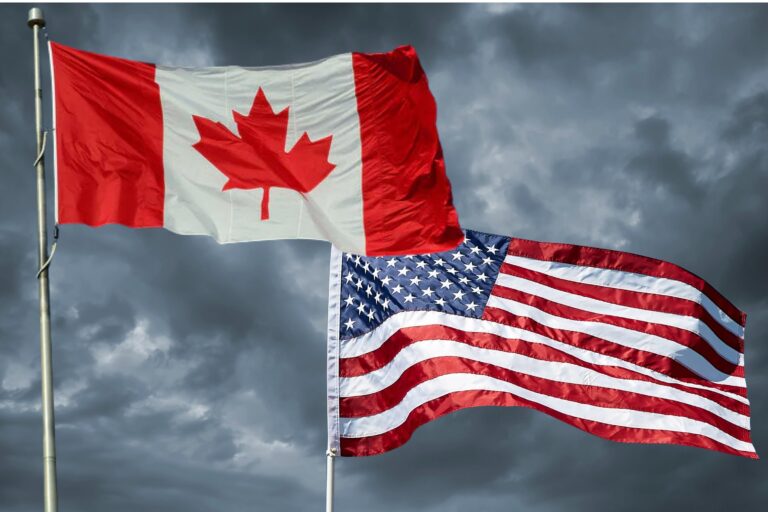
For most of our lives, free trade between Canada and the United States has been so reliable that it was barely worth mentioning. But on midnight, Aug. 22, the United States imposed 50 per cent tariffs on roughly $28 billion worth of Canadian goods.
Trade talks had collapsed hours earlier, with officials on both sides of the table, who were once optimistic, abruptly walking away.
The chaos came after three days of negotiations in Washington failed to reach an agreement. Prime Minister Mark Carney called the new tariffs “a miscalculation,” and announced that Canada would retaliate dollar for dollar, with counter tariffs set to go into effect for Sept. 8.
Free trade between Canada and the United States has been the bipartisan consensus in Washington D.C. and Ottawa since the late 1980s, when the Canada-U.S. Free Trade Agreement was negotiated under Ronald Reagan and Brian Mulroney. Going back even further, the Auto Pact of the 1960’s created an integrated North American auto industry, with both countries relying on each other to create a successful and mutually beneficial automotive sector.
Nicolas Lamp, an associate professor in international law and trade policy at Queen’s, told The Journal that the shift is fundamentally political, not economic.
“It’s really the United States, and particularly the Trump administration, that has changed what it wants,” Lamp said in an interview. “Which is to bring back as much manufacturing as possible to the United States.”
Lamp stated that the car industry became the breaking point in the negotiations. The U.S. offered to reduce its 25 per cent tariff on Canadian-made vehicles to 15 per cent, but disagreements remained over how to charge non-North American goods. It was then reported that the U.S., at the last minute, said the arrangement would exclude Canadian-made trucks, contributing to the collapse of broader negotiations.
“As soon as somebody added a demand, the whole thing fell apart,” Lamp said. “This just shows you how thin the zone of agreement was.”
Canada’s position heading into the talks was built on a long-lasting precedent. Carney has argued that Canada has the resources the world wants, such as energy, critical minerals, and lumber. He argues the U.S. needs Canada as much as Canada needs the U.S.
Lamp felt that this statement holds true in some sectors, but not others.
For example, Canadian producers have been able to redirect a significant amount of aluminum toward Europe after U.S. tariffs hit the sector hard in early 2025, according to the Bank of Canada. “The pain there is being felt more in the U.S. than in Canada,” Lamp said.
Canada is the largest supplier of aluminum to the United States, which heavily relies on imported aluminum. However, Lamp described how Canada’s oil pipelines run mostly south, and steel is too expensive to ship across the country. The car industry is “only viable if it stays integrated with the American market,” Lamp said.
“The problem is geography. We’re just too close to the U.S., it’s the largest consumer market in the world, so we’re never going to be able to replace it.”
Going forward, Canada faces two options: negotiate a new deal with Washington that is less favorable than the USMCA or absorb the economic pain on the current tariff policy, while waiting for a change in the U.S. administration.
However, Lamp cautioned that even a change in administration may not restore what was lost. If tariffs remain intact over a period of years, industries benefiting from higher prices will start lobbying to keep them.
For Canada, this makes diversifying our trade relationships even more important. Canada already has access to every major global market except China, such as Japan, Europe, and others.
Yet, economics is only one component of a much larger shift, especially for two countries who are connected by family ties, shared culture, and daily life across the border.
Lamp cautioned that the implications of the trade war are more extensive and complex than any single industry or city.
“The big implication for every student is that we have to fundamentally rethink our relationship with the United States,” Lamp said. “It was so second nature to treat the U.S. as a partner in everything; defense, scientific collaboration, everything we work on.”
That assumption is no longer true, and for a generation that has grown up with the U.S. as their closest partner culturally, economically, and politically, that may be the most significant realization of the trade war.
“Whatever we do, we have to be more self-reliant and work closer with other allies than we would have done previously,” Lamp said.
Tags
Canadian politics, Economics, federal policy, Trade War, Trump administration
All final editorial decisions are made by the Editor(s) in Chief and/or the Managing Editor. Authors should not be contacted, targeted, or harassed under any circumstances. If you have any grievances with this article, please direct your comments to eic@queensjournal.ca.