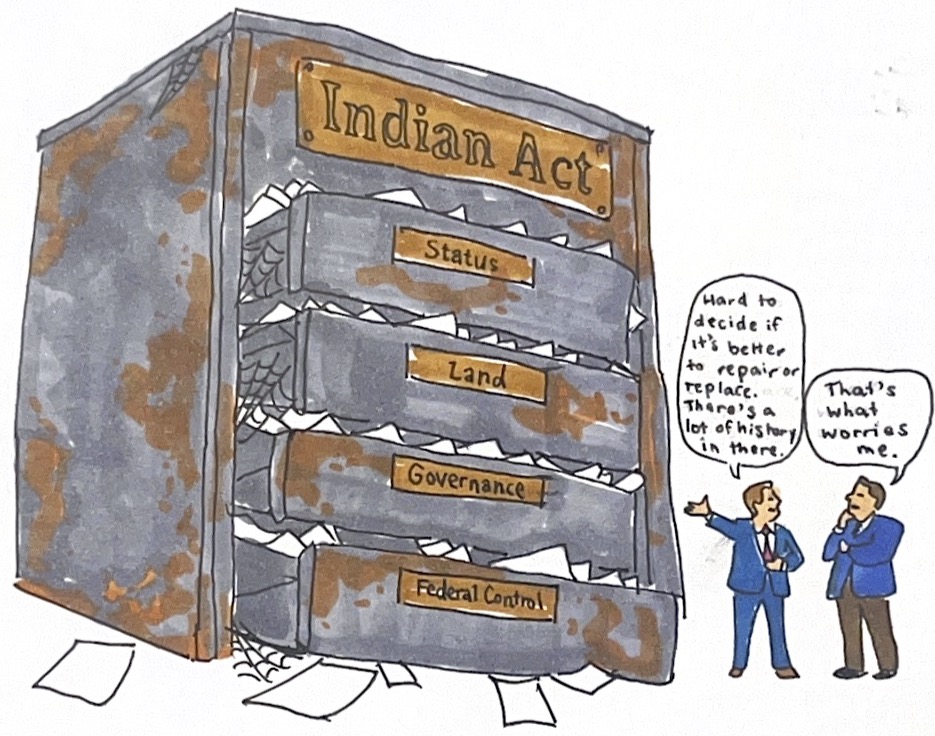
The Indian Act is a controversial piece of legislation, but it’s not up to the federal government to decide whether it should be abolished.
However, this is precisely what Prime Minister Mark Carney touted on Oct. 26, citing the need for Canada to “move beyond” the controversial act originally enacted in 1876 and later revised in 1951.
The Indian Act has changed drastically in practical application since the 19th century, but its original intention was still openly colonial, profoundly racist, and overtly discriminatory. Even the name of the Act — referring to Indigenous peoples as “Indian” — is so outdated.
Of course, the Indian Act was from a different, darker time. It was contextualized by colonialism and cultural genocide, which is why, for decades, Indigenous peoples have been fighting to reform the Indian Act.
And these reforms haven’t been empty. Indigenous peoples have secured land-treaty rights, tax exceptions, language protection, and amendments of cultural protection through the Act, whilst also systemically eliminating much of the openly racist provisions of the act itself.
With that, the question of abolishing the Indian Act is complicated, and the consequences and ramifications could be both complex and controversial.
Consider the history of Indigenous peoples in Canada and that the same federal government that progenerated a genocide against them is now actively pushing to repeal one of the few laws that offers Indigenous peoples genuine protection.
Nuance, therefore, is a requirement when discussing the abolishment of the Indian Act.
But that level of nuance does not appear to have been considered by the Carney government. The announcement felt rushed and incredibly unclear about what would come after the abolishment of the Indian Act, or even, how the Canadian government would go about completing the task.
The intention and plan are not clear, and to that extent, concern is a reasonable response to a lack of clarity.
What is clear is that the Carney government has prioritized economic development above all else, which has included pushing large infrastructural projects through with little to no regard for Indigenous land-rights.
Abolition could open Indigenous land and tax protections to development, and the likely beneficiaries are massive institutional investors like private equity firms and pension funds. Indigenous peoples would bear the cost of whatever protections are lost.
This is not to suggest that Carney intends to abolish the Indian Act through economic incentive alone, but when it comes to Indigenous rights in Canada, it’s only rational to be highly skeptical.
Through all of this discussion though, the most important factor is the perspective of Indigenous peoples.
Ultimately, it’s entirely up to their discretion in determining how Canada should proceed in dealing with the Indian Act. The perspective of non-Indigenous Canadian citizens and the federal Government, quite frankly, is insignificant.
With that, it’s also vital to understand that perspectives will vary, and to remember that Indigenous peoples of Canada are not a single, homogenized group.
For as much as Manitoba’s Cree Premier Wab Kinew might express support in abolishing the act, there is also the Union of B.C. Indian Chiefs (UBCIC) who dispel calls to abolish the Indian Act as “ highly inappropriate and completely disrespectful.”
The point, however, is that decisions pertaining to the Indian Act — whether it should be abolished, altered, revised, or kept the same — is entirely dependent on the debate and deliberation between Indigenous Canada’s people.
— Journal Editorial Board
Tags
Canadian politics, Colonialism, Indian Act, Mark Carney
All final editorial decisions are made by the Editor(s) in Chief and/or the Managing Editor. Authors should not be contacted, targeted, or harassed under any circumstances. If you have any grievances with this article, please direct your comments to eic@queensjournal.ca.
B Harper
So do you want each Province to renegotiate? Maybe Carney will engage with indigenous groups to create better agreement. Your article definitely shows your inexperience in how the real world works. Life is much more than pipe dreams – it is about negotiating the intricacies of nuances of relationships, realities and respect. If not the federal government then you could conceivably have a multitude of deals that could be vastly different. Unfortunately, the modern reality requires a singular approach. Although I do suspect that you would prefer this be done by Pierre Poilievre – the loser’s choice to not lead Canada.