Although video games dominate entertainment with more global revenue generated than music and movie industries combined, most gamers are unaware of its influence on academic media scholarship.
But these discussions are happening right here on campus across disciplines.
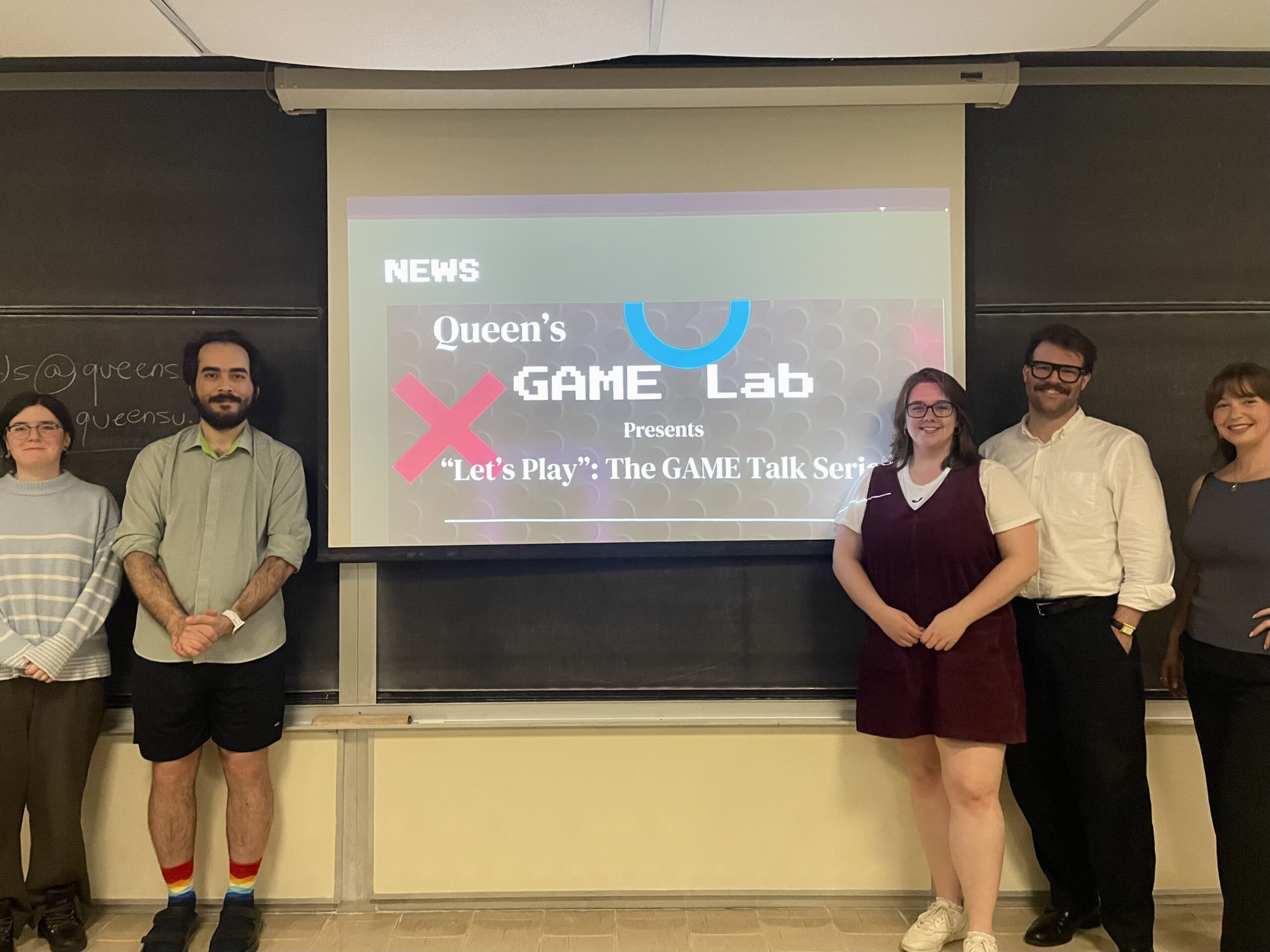
The Queen’s Gamified Arts and Media Exchange (GAME) Lab was founded by Department of English and Creative Writing Professor S. Brooke Cameron and a group of graduate students in 2024.
On Sept. 18, the GAME Lab held a small video game conference with presentation panels ranging from queer subjectivity in Cyberpunk 2077, queer horizons in NieR: Automata, and the ethics of meat farming in Pokémon.
As video game studies are an interdisciplinary practice, lead developers Sara Smith and Sabrina Zacharias, PhD candidates in the Department of English, hope their talk series facilitates exchanges between scholars from various departments.
“Games have become such a foundational piece of media for a lot of people in popular culture and economically the growth that has happened has been astronomical,” Zacharias said in an interview with The Journal. As video games become more narratively complex, scholars are becoming more interested in studying video games.
The GAME lab hopes by bringing interactive video games that adapt literary works and historical periods into the classroom, students will be encouraged to dive deeper into their analyses.
“We also recognize that in order for the humanities, especially English, to be a sustainable discipline, it needs to stay relevant,” Smith said. “[We want students to] understand the different ways that you can interpret something as a text, even if it’s not words written on a page.”
At the conference, several panelists spoke about their research alongside slides with in-game examples to support their points.
Jesse Gauthier, a PhD candidate in the Department of English and Creative Writing, presented a sliver of one of his dissertation chapters, “‘Do you hate your meat?’ Queer Subjects and Plastic Bodies in Cyberpunk 2077.”
In Cyberpunk 2077’s high-tech metropolis, Night City, looks are everything. As an action-role playing game, players can fully customize the protagonist, V. However, Gauthier argues the game’s commodified cyberware menu goes beyond aesthetics when body augmentation is advertised as desirable, raising questions for queer subject formation.
Hamidreza Ghaneei, a PhD candidate in the Department of Cultural Studies, presented, “It Always Ends Like This: Failure, Repetition, and Temporal Drag in NieR: Automata.”
An action role-playing game that requires multiple playthroughs to complete the narrative, Ghaneei connects the game’s music and repetitive structure to queer temporality, a concept in queer theory developed by Elizabeth Freeman and José Esteban Muñoz.
Liayana Jondy, a graduate student in the Department of English Literature and Creative Writing, cooked up a presentation on “Pokémon: The Ethics of Meat Eating and Farming.”
Through an analysis of cooking mechanics in Pokémon: Sword and Shield, Jondy argues game studies have ignored the absence of “real” world animals in the realm of Pokémon that alludes to the farming and consumption of Pokémon, which harms the game’s cozy aesthetic.
Afterwards, the GAME lab held a question-and-answer session. Although attendees played along by asking questions, the discussion became more of a collaborative open dialogue to discuss where panelists could expand their research.
The GAME Lab’s talk series continues throughout the school year. While they’re a relatively new research group on campus, they’re changing the game of how humanities can analyze texts by including video games in their scholarship.
Tags
Academic research, video games
All final editorial decisions are made by the Editor(s) in Chief and/or the Managing Editor. Authors should not be contacted, targeted, or harassed under any circumstances. If you have any grievances with this article, please direct your comments to eic@queensjournal.ca.