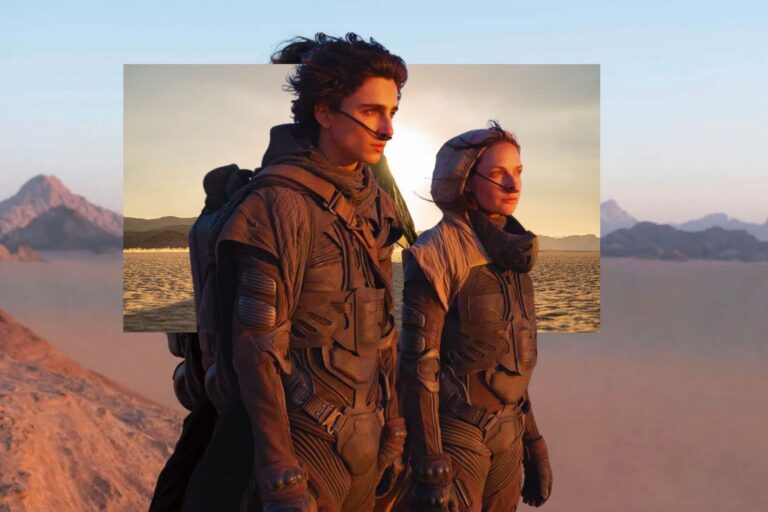
While Frank Herbert’s interest in cultural development is more than apparent when reading the DUNE series as opposed to watching the film, the influence Arabic culture has on the story can be found at every level; from the languages, names, religions, planets, ecology, and politics.
The worldbuilding frames the story in the unique context of sci-fi literature, allowing for a deeper exploration of Arabic culture through the lens of thousands of years of cultural development. Instead of merely injecting his book with references to Arabic life and culture, Herbert chooses Arabic culture as a stand-in for humanity as a whole. Taking an already ancient culture and tracking its development over thousands of fictional years, DUNE’s use of Arabic speaks to the strength of human ingenuity and creation.
Herbert began writing what would become DUNE in 1958 and would publish the first book in October of 1965. As a fan of ecological preservation, he created a story that spoke to the dangers of environmental change through the lens of religious zealotry and charismatic leaders. While not a scholar or university graduate, a life of interest in cultural differences, sociology, and the development of peoples prepared him to undertake the mission of worldbuilding that the DUNE series would eventually demand.
Set approximately 20,000 years in our own future, DUNE is coined as “soft” sci-fi, a term that sets it apart from other books in the science fiction genre like Project Hail Mary or War of the Worlds. Soft sci-fi refers to science fiction stories that are less stressed with the accuracy of its setting, focusing less on physics and technology, in favour of developing characters and relationships. Instead of focusing on ultra futuristic robots and planet sized spaceships, Herbert traces a line for human history over thousands of years of developments.
The theme of “the human” is one of the cornerstones of Dune’s philosophy: the triumph of the human mind over that of the machine. His work questions how Earth’s cultures would develop over thousands of years of history and migration in a futuristic setting.
In the series, there is little interaction with technology. There are no robots or artificial intelligence.
Some characters fight with swords and spears like Gurney Halleck, played by Josh Brolin in the film, who condition their abilities to be almost superhuman. Other characters like Paul Atreides, played by Timothee Chalamet, weaponise other powers like faith, using his charisma and leadership to wage war on the universe.
This is a “full circle” moment in the worldbuilding of DUNE. Since people returned to a more “ancient” way of living, many cultural connections can be drawn from their past.
The Arabic influence on DUNE is most felt in its setting and characters. The planet of Arakkis serves as a stand in for the Arabic world on Earth. Rather than taking place on a small corner of the world, Herbert extends the Middle East to be its own planet with the native inhabitants being descended from Arabic nomads originating on Earth.
Herbert takes the legacy of the classic Arab world and develops it into a setting that feels both old and new.
The merging of languages and religions show how much time our descendants have had to develop, which further infuses culture into the story. From this, Herbert created ideas such as the Zensunni faith, a combination of Zen Buddhism and Sunni Islam. The Fremen, the inhabitants of Arakkis, speak their own language known as Chakobsa. It is a dialect based in Arabic that still employs certain Arabic words, though forged over thousands of years of migration from Earth.
Herbert had such appreciation and knowledge of Arabic culture that he was quoted saying “my Arab friends wonder why it’s called science fiction.”
However, he has faced some criticism from the Arabic community for borrowing their religious and spiritual cultures for his worldbuilding.
One of the biggest criticisms posed to him is his use, and at times blatant copying, of lines and themes from the book, The Sabres of Paradise by Lesley Blanch, an exploration of Muslims in the Caucasus. Herbert’s own idea in Dune of a “white savior” who learns the ways of a “foreign people” and becomes connected to them can even be applied here.
While not Arabic himself, his ability to allow a culture other than his own to influence his work is still relevant today with the success of the DUNE films and the excitement surrounding the upcoming release of the third installment in December of this year.
Through his sci-fi story, built upon the history of already existing peoples in our own world, Herbert calls to attention the importance of cultural development. Even in a novel set tens of thousands of years into our future, Arabic culture is still alive, highlighting the longevity and strength of culture.
Tags
All final editorial decisions are made by the Editor(s) in Chief and/or the Managing Editor. Authors should not be contacted, targeted, or harassed under any circumstances. If you have any grievances with this article, please direct your comments to eic@queensjournal.ca.